web site update
From Kabutoshimen by Toryu
I updated to the newest wordpress 2.6.2 and five plugin updates, please let me know if something does not work
…
From Kabutoshimen by Toryu
I updated to the newest wordpress 2.6.2 and five plugin updates, please let me know if something does not work
…
From Kabutoshimen by Toryu
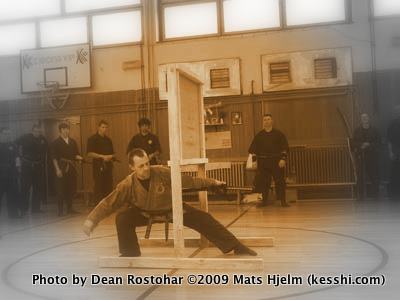
In September 2009 Bujinkan Kaigōzan dōjō SSIF in Stockholm, Sweden hosted a seminar with Dean Rostohar, Shihan from Bujinkan Croatia.
First I would like to say thanks to Dean Rostohar for coming to us once again, this was the 4′th time we had him over here. Also special thanks to Davor, Hana and Ivica who travelled by car all the way from Croatia just to come here to train and assist their own teacher! Also big thanks to René coming from the Netherlands and Jukka coming from Finland. Also thanks to Tony for helping with transportation and stuff, and Johan for taking pictures and filming the seminar. Finally also thanks to the participants from Kaigozan Dojo, To Nan dojo, Solstaden Karlstad, Eskilstuna Bujinkan, Örebro Kampsportsförening and Berserk MMA.
This was a very good seminar where Dean taught and showed us many, many good and useful techniques and examples from his personal experience. First I felt quite ashamed that I couldn’t get more people interested enough to show up on the seminar. Then I felt pity for the fools that missed the chance to get really good training, what did you do this weekend that was so important? Seriously, I don’t want to hear all bad excuses, let’s leave it at that I’m sure you can convince me you had good reasons
.
As always Dean teach from his big heart, you who have been to his trainings know what I mean. The first day he did techniques based on the first technique Ichimonji from Kihon happo kata. But it was different than what he showed before, more realistic and useful. Although he never said that the basics is bad to know or practice, but the basics is basics to teach students a foundation to build up on. When you know the basics well you combine each basic movement to the situation, and it comes alive. You do what you have to do to benefit from the situation. He showed many different taijutsu techniques this weekend.
In the afternoon training Dean and his students from Croatia showed many interesting techniques and team tactics how to work in a group, everything from quickly climbing up over a wall, or in to a window. How to take out a guard and many other examples how to work as a team.
The second day Davor started by showing and teaching his excellent taihenjutsu skills, he did some of the best taihenjutsu moves I have ever seen. He was rolling smoothly and silently like a cat moves, very nice! Then Dean taught more taijutsu techniques from Kihon-happo. Then later on he showed us how to train up the sensitivity, and then he moved on to some sword techniques. Finally he showed and explained to us how to train while blindfolded.
The KGZ BUDO SHOP have many DVD’s with Dean Rostohar. This seminar DVD will be available for order in October 2009, shortly after there will be three more DVD’s with Dean released at KGZ BUDO SHOP. Here is a direct link to the Shinken Kata videos… https://www.budoshop.se/store/videos/dvd-bujinkan-budo-taijutsu/shinken-kata
Happy training!
Mats Hjelm (seminar organizer, dojo-cho at Kaigozan Dojo)
Please feel free to leave comments. It might take a while before the comments is approved because all comments is moderated to stop all spam, and hate comments.…
From Kabutoshimen by Toryu

Now it is less than a week until the Ninpo/Ninjutsu Seminar with Dean Rostohar. Here is some updates and news…
Dean is coming on Friday already, but we have no extra training planned. Dean is also bringing some of his top students with him this time, so I’m sure they will also help him with the teaching. This will be an exciting seminar, he will teach lot’s of stuff we usually don’t see in the trainings in a regular Bujinkan Dojo.
For more information about this seminar see this web site… http://kaigozan.se/seminars/2009-09-26/…
From Kabutoshimen by Toryu
I had this on my old blog. I was reminded when I watched a video and realized that maybe the way I do it comes from Judo. So instead of explaining I uploaded the pictures and you can watch the video I found at the bottom of this post.

Bring it around the body, and make sure it is not crossed on the back (not shown).

On the video below, he tuck in the other end first, it doesn’t matter which one goes first.


…
I haven’t had time to check it the latest weeks. I was recommended the first oen on Facebook, and I searched for more.
Moti is a Good instructor from Israel.
The German Buyukai
Edit: Missed this one from Bujinkan Czech Republic
Actually I couldn’t find anything else good the past three months or so. I avoided the guy who always use CAPS (seems kinda desperate if you ask me). Seems like it is only “non Bujinkan clubs” tagged as Bujinkan at youtube, are they so desperately wanting attention or what :-D, you be the judge of that. …
From Kabutoshimen by Toryu
In the previous tutorial I explained my way of moving the feets when I do the basic jodan-ukemi, so I thought I also show how I attack (still only footwork!).
In Kihon-happo we attack straight to the face with a jodan-tsuki (in basic it should be a shikan-ken), so I will explain from this point of view. If he has a good ichimonji no kamae, he point his arm straight to my center which makes it more difficult. If his front arm is pointing to the side (like Gyokko-ryu), I would try to step on his foot while entering. But he is too clever for that, so he force me to move around his left arm. Going to the inside is not good so I will attack him from his outside.

I keep both knees bent, with the weight a little more on the rear right leg. I keep the spine straight and relaxed. I should be able to jump or push the body in any direction with the left or right foot. When I move in to strike, I want to be as quick as possible without making any signs before I explode forward in to the opponent.

The distance to the opponent decides how big the first step with the left foot should be.
I lift the left foot and quickly push the body forward with the rear right leg. I turn my left knee to the left in the same direction as the left foot is pointing (see the picture). There is no strange angles in the knee, I put the left side of the left foot on the floor first, and when my weight is over the leg, the whole foot will be rooted firmly to the ground.

Then I quickly put the right foot forward. As soon as my body weight passes the left foot I start pushing the body forward with the left foot, as I do this it is important that the left foot is rooted to the ground.
Soon after my right foot is placed on the ground my right fist makes contact. Then the spine twists, and my right foot and leg is starting to stop the body’s forward motion (if that is what I want*) as I strike through the target. The right knee should stop just above the toes, and you should have good balance and both knees bent. More weight on the right foot than the left foot.
*If the opponent jumps backwards or move quickly backwards, I can move the left foot forward very quickly with three more strikes in that left step (I will explain this in another tutorial if I there is interest). I can run after him much faster than he can run backwards, don’t think something else!
Also if the opponent doesn’t move properly here (like I explained in the previous tutorial) it will be very easy for me to kick him in the groin with the left foot (if he move the right foot too much to the side), or placing the left foot behind him for osoto-nage (if he moves his left leg off line).
It is very, very important that the left foot (picture 2 & 3) does not turn on the ground as you are pushing forwards, then you will loose friction to the ground and you will slip very easily if you push forward strongly. Also Miyamoto Musashi spoke about the importance of rooting the feet to the ground and push the body forwards or backwards with the whole foot rooted, and not on the toes or balls of the feet.…
From Kabutoshimen by Toryu
I think most of you have heard about the 45° step when you do the basic jodan-uke for example, this does not mean that you end up in a 45° angle to the attack that I so often see. I think this is a misunderstanding, and I will explain here so that you have to be an idiot if you don’t understand
.
But first let’s make some reference points. To get the distance right we need to understand that the opponent will hit you in the head with his right fist. And that you want to end up at a safe distance where you can block the opponent’s right arm from the inside without being to close or too far away. So you need to move your whole body as one unit about one arms length. So measure how far that is. I will use the tatami mat as a reference point so that you can easily understand. I recommend that you also use the tatami mat as I do here so that you can do the step without looking. And then look down and check if you are on the correct spot, angles and length wise.
Remember that you move the body one arm’s length, it doesn’t matter how long the opponent’s arms is. If he knows how deep he should punch (just through the target and not an inch more!) it will be perfect distance for you.

When you move from point A to point B in the first step you should have the exact same angles but one arms length further back to the side. You should have rotated the whole body about 30° to the left, but the angles and alignment should be the same.

So when you start in the basic Ichimonji no kamae both heel’s should be on the same line and pointing directly against the opponent’s center. I won’t go into detail about anything else than the footwork here. I might do a part two of this tutorial later?

The right foot and toes should be pointing exactly 45° back to the right against the other corner of the tatami mat. Keep a rather low position with both knees bent (in basic training, be extra low), more weight on the right leg.

Lift the right foot and push the body strongly and quickly back to the right with the left foot. You should explode from the position, so make sure the front leg is not too straight. Do not move the left foot first (I say that this is a bad habit). If you keep your right arm straight against the opponent, he will not step on the left foot, as he have to move around your arm.

The right foot should go exactly 45° towards the corner of the tatami. Note how the right foot have turned a little, but the heel should be on the line. At the same time the left foot should follow the right foot in a straight line.

As you can see this angle is about 30° from the starting point. Also worth mentioning is that the feet’s is never this wide apart as it is rather a jump than step, step. It is important that the upper body should not go anywhere else but straight backwards to the side as if you where on wheels.

See how the left foot ends up on the same line. Now you have moved the body 30° back to the right. You should end up in the exact same position as when you started. Your kamae is “closed” and good, aimed directly to the opponents inside.

From here you block and take his balance… as you can see you have also opened up the opponent’s lower region. You have the opening where you will place the right foot as you step in and counter with your own attack.
A very good training drill is to stand in Ichimonji no kamae and move from point A to point B as explained above. Repeat this several times, you should move in a big circle keeping a perfect Ichimonji no kamae the whole time. Then change side and do it to the left. This is a good exercise that strenghten your legs and gives you a good foundation.
Happy training!
/Mats…
If you can’t see the video clip above, turn off your adblocker, and allow flash. Find more videos like this on Budoshop
Click on the button on the right side to pay and download this movie. Payment of $8.99 is through PayPal and download is done from Payloadz. You will get instructions after you pay how to download this movie.
Shortly after his second Japan trip this year training with Soke and the Shihan, he held this seminar. This video contains Taijutsu techniques with variations including the Hanbo (short staff). Also Hanbojutsu basics with Taijutsu applications. You can see how similar the Taijutsu techniques can be done with a weapon, and how easy it is to do a weapon technique without a weapon.

This movie was filmed June 27′th in 2009 at Kaigozan Dojo. This training was taught by Mats Hjelm, Bujinkan Shihan Kugyo Happobiken.
NOTE! The instructions is in Swedish, but there is not so much talk but more action.
This is a movie file optimized for iPod and iPhone and any other device that can handle standard H.264 videos. Import the file to iTunes and sync it to your iPod or iPhone.
On a Windows PC you can watch it in iTunes or Quicktime player (these programs is available for free on apple.com. VLC is another good program that can play these files.
480 x 272 pixels
H.264, AAC
Bitrate 942
70 minutes
450 Megabytes
Chapter markers
Click on the button on the right side to pay and download this movie. Payment of $8.99 is through PayPal and download is done from Payloadz. You will get instructions after you pay how to download this movie.…
From Kabutoshimen by Toryu
Disclaimer; this is not necessarily the correct way of doing this technique, it is the way I see how it should be done.
Technique No 3 from Kukishin-ryu Rokushaku Bôjutsu – Keiko sabaki kata

1. I assume Chûdan no kamae and plan to make the opponent open up his left side…

2. I move the left foot forward to the left and enter in to the opponent’s right side. I angle the body in a way to draw the attention to my left hand and hide the right hand sliding back to the end of the staff.

3. I step forward with the left foot and thrust in chudan-tsuki to the opponent and force him to move. Since I enter on his right side I pretty much force him to move to his left.
Note: If he is not moving I strike through his guard and get him. If he put force into the block it is better for me, but I’m not waiting to feel it (physically) then it would be to late for the next step.

4. I quickly move the right foot forward and strike his left elbow with dô-uchi.

5. Then another quick kote-haneage strike from under to his right arm to completely disarm him. The kata officially finish here, but it is easy to keep going and take control of the space and the weapon he just lost.

6. Then I jump back to Seigan no kamae and assume zanshin (because the next kata starts from here which makes it easier to remember the next kata).
After you and your partner have learned the kata, try to work on a better defense with the sword. Try to be more offensive and gradually make it more difficult to attack with the staff, instead of moving backwards move forwards and be more offensive. The swordsman’s distance is shorter and he need to be on a safe distance or closer where he can get the opponent with the staff quickly. The person with the staff need to be outside the swordsman’s reach or be completely covered. You can practice this technique with more freely distance and timing, but keep the same sequence of attacks (keep to the kata). If you do this I suggest you use safe weapons (padded weapons) and maybe protections, or just be very careful.
There is also kuden; things taught personally from teacher to student, so please find a good teacher and study with him/her.
Happy training!
/Mats…
From Kabutoshimen by Toryu
I changed the Menu, I hope it looks better and works on all systems, if not please contact me!
I also added two new more pages under “Bujinkan”, it is Kukishin-ryu Dakentaijutsu and Bojutsu. I plan to add pages for the other schools and weapons later.…