Skip to content

Hiden – Togakure Ryū – article translation

From Wanderings in Budo by Mats "Toryu" Hjelm

What follows a translation I have been mulling over for a time of a single sheet handed out by Hatsumi sensei at class in Ayase.

What his reasons were at the time for passing this around I do not know (most probably it was found buried under a pile of other books, weapons and objects in the Bujinkan office – that being the same situation for me when I rediscovered it a few months back). It is a photocopy of a page from the Japanese martial arts magazine Kakutogi Tsuushin 格闘技通信. The date written by hand at the bottom left is 平成2年5月(the fifth month of the second year of the Heisei era) or May 1990.
(* 9 Jul – corrected source ref from Hiden to Kakutogi Tsuushin)
I have endeavoured to translate the text into English without much in the way of interpretation or rearrangement, some parts may therefore seem a little clumsy or confusing whilst reading. First I’ll present the Japanese text that I have had to write from scratch onto the laptop, then my translation paragraph by paragraph, followed by any notes or explanations that seem relevant. I will present this translation over several blog entries over the next few days or weeks.

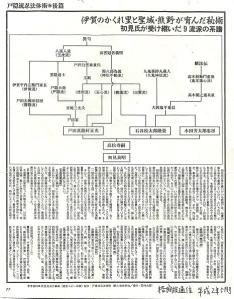
To describe the page – after the heading and sub heading there is a genealogy chart that lists notable people and the styles or schools (ryū) demonstrating their connections and eventual merging together under Takamatsu Toshitsugu to be passed on to Hatsumi Masaaki. The text under the table is from an interview where Hatsumi sensei gives a summary of the different origins of the schools he has inherited, then some information on each of the 9 schools, concluding with a profile of Hatsumi sensei.

Title and Headings…

戸隠流忍法体術–後篇
伊賀のかくれ里と聖域•熊野が育んだ秘術
初見氏が受け継いだ流派の系譜

Togakure ryū ninpō taijutsu – the last part
Hidden village and sanctuary of Iga • mysteries nurtured in Kumano
As successor and inheritor Mr Hatsumi’s nine schools genealogy

Genealogy table image…

Main text…

初見氏が受け継いでいる武術では、伝書の類をあまり重視していない。というのは、どこで誰が始めたとはっきり言えるような類の術ではなく、多種多様な文化交流の中で自然発生的に生れてきたものだと解釈しているからである。その発生期を考えれば、世紀頃にさかのぼらなければならない。その頃、大陸から渡ってきた僧やクグツ奇術師などが、拳法や幻術を持ちこんだ。また、同じ頃修験道が起こり、それに密教がかわってくる。

In the martial arts that Mr Hatsumi has inherited there has not been much focus on the variety of densho. In other words, rather than to say clearly that this kind of art comes from a great variety or diversity (of sources) … because some have interpreted that it is something that is born spontaneously through the cultural exchange of a wide variety of styles/arts. If you think of this origin time then you have to go back to the 7th Century. At that time monks and magicians (puppeteers and illusionists) came over from the continent (China) and brought martial arts (kenpō) and magic (genjutsu). Also, at the same time there are changes brought to Esoteric Buddism and Shugendō appears.

そういった初期の武士や修験者、僧などが、人里を離れて山中に集団生活を営むようになった。周囲に深山を囲まれた伊賀は、彼らの絶好のかくれ里で、いわば文化の吹きだまりだったのだ。そういった中から次第にいろんな術がまとめられ、やがて多くの武術の流派を生み出していった。その過程を示したのが系図の左側のブロックである。

Such early warriors, shugensha and monks began living a communal life secluded in the mountains. Iga is surrounded by mountains and ideal for their hidden villages, it was a kind of drifting together of cultures. In such a place where many arts gradually came together, eventually many martial arts schools were created. The block on the left side of the genealogy table illustrates this process.

初見氏が持っている伝書の類は、発生期の頃の記述があいまいだが、それは複雑にからみ合った歴史の流れを一種のモデルケースとしてまとめたものだと考えればいいだろう。初見氏に昔の技を見せてくださいと頼んだらいつの時代の技ですかと訊き返された。当然である。時代の文化背景によって技も兵法も常に変化し続けているのだ。紙に書かれた歴史も史料として大切だが、それよりも、それぞれの時代の文化を肌触りとして伝え続けた武術が、現代に受け継がれているということの感動である。まさに数百年に渡る知恵の結集なのだ。

In the kind of densho Mr Hatsumi holds, the description of the time of the origin is ambiguous/vague, when you think of it as a summary – a kind of model case – of the intricately intertwined course of history. I requested Mr Hatsumi “please show me the ancient techniques” and asked “what techniques have been around for all time?”.  The techniques and tactics are constantly changing depending on the cultural background of different eras. Written or recorded history and historical records are also important, however, each cultural period has continually transmitted the feeling of martial arts, with passionate people some of these have been handed down to the present day. He brings together wisdom from over hundreds of years.

一方、伊賀からやや南下した熊野は、古く神道のメッカとされた聖域だ。ここでは神道の行法を取り入れた武術が育まれた。それが系図右側のブロックである。また、熊野灘には熊野水軍や九鬼水軍と呼ばれる海賊一種の海上武士団が勢力を誇っており、彼らが武術を育てたことも見逃せない。

Contrast this with Kumano, a little south of Iga, that has been a sanctuary and Mecca for old Shintō. In this area martial arts that incorporate Shintō have been nurtured/cultivated/flourished. The block on the right side of the genealogy table illustrates this process. Also, they could boast of the Kumano navy known as the Kuki navy and also called pirates (one kind of maritime warrior group) that used the open sea around Kumano, I cannot miss out the martial arts they were raised in?

そして、伊賀と熊野という日本の文化史上重要なスポーツで育まれたつめ武術は、高松寿嗣によってひとつにまとめられ、初見氏に伝えられた。凄いものだと感心していると、初見氏が言った。はっきり言って昔のことはよくわからないですよそのつもりで各流派の解説を読んでほしい。

Also the 9 martial arts from Iga and Kumano are an important part of Japan’s cultural history and sports, combined into one by Takamatsu Toshitsugu and passed on to Mr Hatsumi. Mr Hatsumi said he was impressed to be given such an amazing thing. I do not know the old saying exactly, but please read the description of each school with that intention (bearing that in mind?)…


…

Shinobi Daisho

From Paart Budo Buki by Mats "Toryu" Hjelm

Hello Buyu's

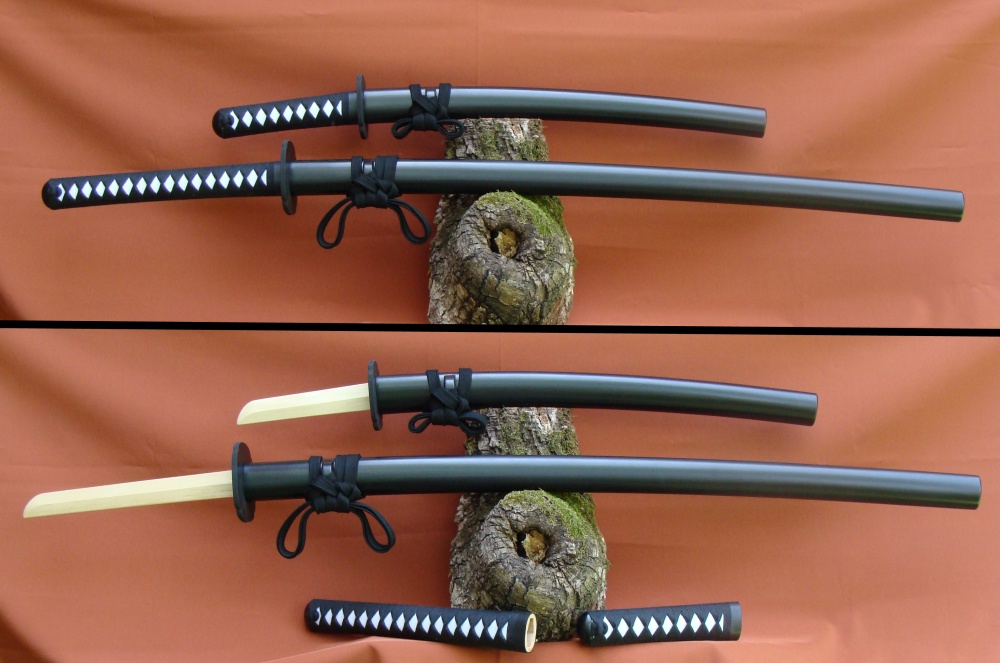
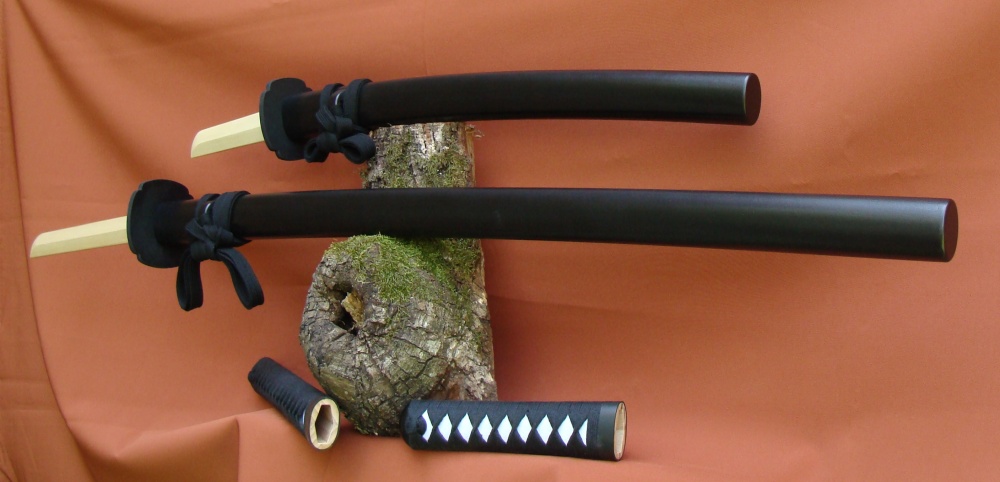
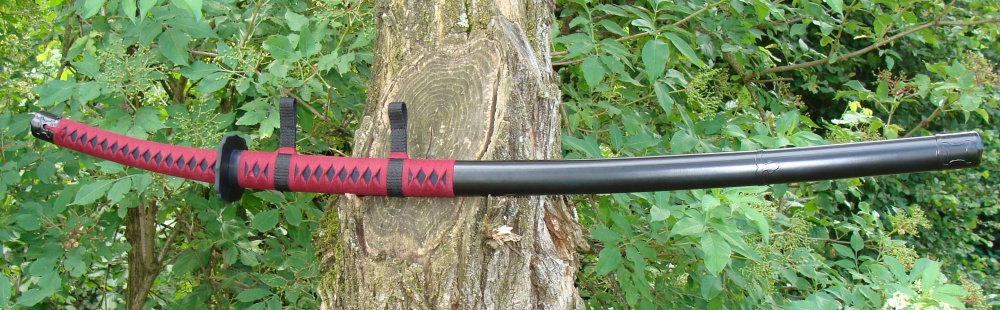
here is the new swords, I never asked for the right name for these swords, so if someone knows, I'll be grateful.
For now, we call them Shinobi Daisho, of course, these are for sale and who offered more, will have an interesting training.
According to some sources, this weapon can be called "Gyaku ni Daisho", gyaku because the reverse placed.
You could see this type of tool on some video material, or in the literature of  Soke Hatsumi,
so you probably all realize the purpose of this tool.  
 
The key element is definitely a surprise, but in addition there are several more important details.
  The first is the Tsuba, which in this case closer to the top of the blades, which practically marks part is called "Mono uchi" or part of the blade used for cutting. 
In this way we can better control the opponent's blade or him, also we can used Tsuba for pulling opponent as some kind of hook.
Sageo is also a position that allows a special kind of control blades, for example, if you drag the end of the Sageo in the direction of the opponent, tip of blade will also move in the direction of the opponent.
Other benefits try to discover you using your own imagination, if not ask someone else, or visit one of my future workshops, which I will try arrange to meet people with the technical characteristics of  weapons used in their Budo training


…

Tachi bokken "2"

From Paart Budo Buki by Mats "Toryu" Hjelm

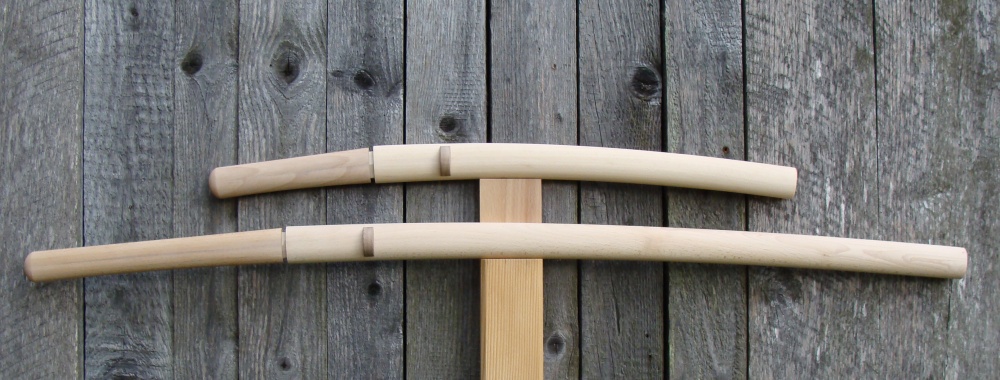
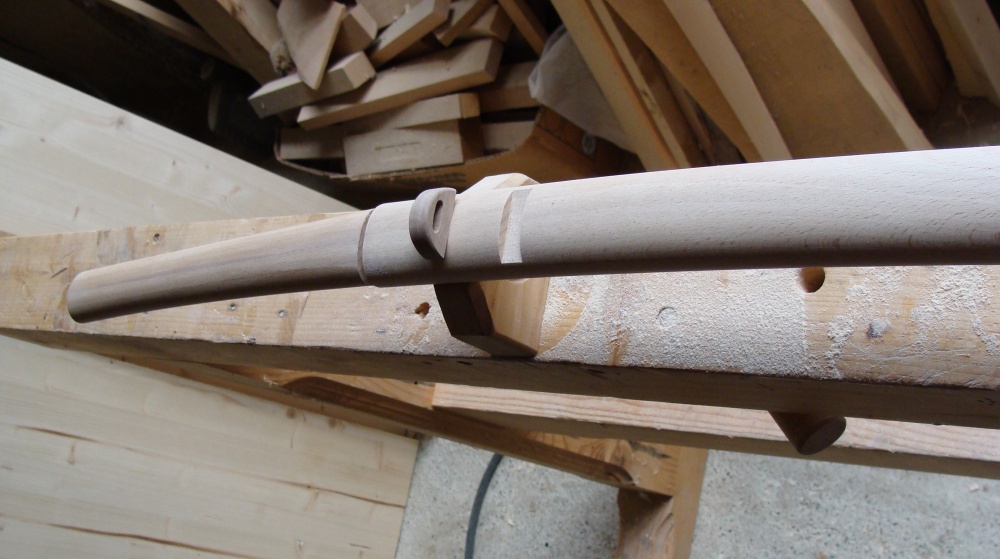
This is the second tachi bokken slightly better, with few details on the saya and kashira, still under development,
third should be fully faithful to original copy of the Tachi sword.


For now, enjoy the pictures, and all other possible questions or orders, please contact me via e-mail, because it will be three more tachi bokken AVAILABLE.


…

Thoughts on Rank

From BUJINKAN TASMANIA by Mats "Toryu" Hjelm

The ranks in the Bujinkan are for heart.

Those with the right heart will accept rank from their teacher without question.
The student, with their feeling of discomfort or inadequcey for their new rank, should then go away and train hard until they become worthy of the grade.
This is understanding Sakizuke.

This is the correct feeling to have when dealing with the Bujinkan grades.

Everyone in the Bujinkan receives rank based on Sakizuke ( attaining a rank before the actual skill/understanding is achieved ).
It is important to understand this and therefore not become concerned with ranking requirements to achieve a higher rank.

The Bujinkan is like an Organism, rather than an Organisation. It is alive and very natural.
Those that wish to control their dojo by creating set requirements, rules and obligations etc, often are going against natures way.

All we have to do is trust in Sokes manner of transmitting his budo and train hard to obtain Shin Gi Tai Ichi.

There are over 300 jugodan ranks in the Bujinkan world today. Soke has said that none of them are masters. His ranks are in “hope” that one day, some masters will sprout from this group. this is an important teaching. It is important for everyone to keep training and never become complacent or satisfied with their supposed rank. Rank is transparent in the real world. The teachings are to remove oneself from the constraints of material gain and reward and to understand that the “shugyo” is the most important thing. The training never ends and the master never thinks of being a master. The master thinks of himself as forever a student. This is what truly inspires. Very few people in any martial art can truly become masters. Thus, the ranks of the Bujinkan are alive and people succeed or fail just as in life. The ranks of the Bujinkan are teaching that life and budo are one in the same. Therefore, we are encouraged to walk everyday with an everyday mind and just think of “keeping on Going”. That is all that matters – Bufu ikkan!!


Words based on recent thoughts sprouting from classes in Japan.


…

Think by Yourself.

From BUJINKAN TASMANIA by Mats "Toryu" Hjelm

THINK BY YOURSELF
– By Soke Masaaki Hatsumi

In ancient times, a person who strve to learn budo would do individual keiko. After learning skills from his teacher, he trained himself to master those lessons. He had to have the determination to study through the techniques alone. Going into the mountains, he would repeat his solo training in nature, fighting with animals and trees.
These days, so many people forget to ” go into the mountains.” These people tend to desire the easy way out. If they are having problems that are complicated, they immediately ask someone older to solve it for them. Moreover, the elder gives them easy advice. Most people answer nicely because they think it would be good to help the situation along, but in fact, this often ends up hurting the individual`s growth.

It might be a little different from keiko in budo, but some problems can only be understood by the person who has the problem. An advisor gives suggestions trying to solve the problem through applying his own experiences, while the listner ( who does not have those same experiences ) listens to the guidance as if it were being recieved from some divine being. There is sometimes a serious danger in issing a lesson`s important point. Therefore, you should sometimes offer the advice, ” Ponder the dilemma yourself,”You may consider this ” coldhearted.” However, being cold illustrates the need to solve a problem ( finding warmth ).Perhaps some days later, the individual will return saying: ” I can`t figure out a solution…” and he will recount his problem in a totally different manner than his first telling. You will now be able to discern how to offer advice that is more appropriate by judging from his revised account.

In budo, we inform students of the proper answer after the “torment”, of making them think for themselves. Some things must be learned through suffering or they will be forgotten for the rest of your life. We must all learn to solve our own difficult problems.Furthermore, in budo, we suffer great pains to master the best techniques. It was throught the pains and labors of our ancestors, who became the founders of our traditions, that these techniques were invented.


…