Skip to content

Shoninki books

From 8þ Kabutoshimen by Mats "Toryu" Hjelm

20121030-125323.jpg

I got a question today about these books, if they are important for Bujinkan practitioners.
http://www.coloradospringsninjutsu.com/Shoninki.html
http://www.shoninki.com/home/Welcome.html
For what it’s worth here is my answer.

Hello. I don’t think it is very important today, but probably very interesting in historical view. I know Don lived in Japan for many years and probably discussed the book with the Shihan when he run into problems in translation. I don’t know who the other person is, he might be better in Japanese, but if he haven’t been training he might have missed some things. Both books probably have errors, why not get both?
But I don’t believe it is that important, the knowledge is old. There is better modern books about survival skills, medicine, tools etc today.

Thanks for the links, I didn’t know Don also had a translation.

Happy training!

Mats

The post Shoninki books appeared first on 8þ Kabutoshimen.…

Shikomi zue

From Paart Budo Buki by Mats "Toryu" Hjelm

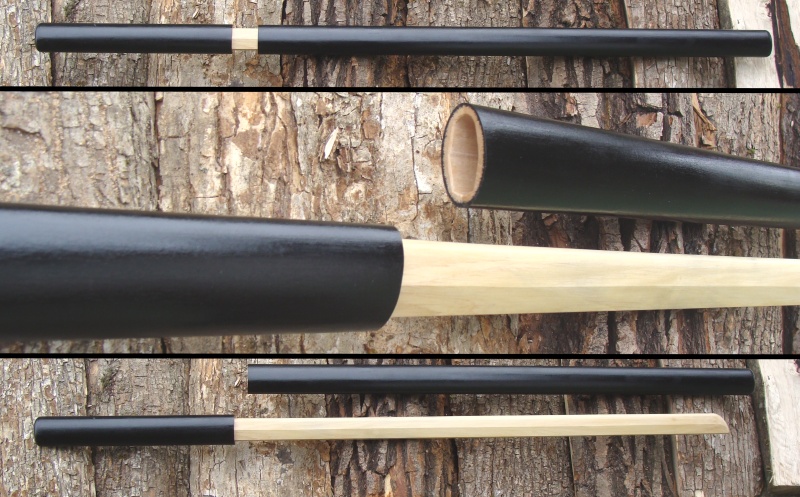
here is one of my older works,  full wooden Shikomi Zue, 
but not as some standard hidden blades, more like walking stick from Zatoichi movie, from Takeshi Kitano 

this one is with black finish, but as all what I make you have choice


…

Shikomi zue

From Paart Budo Buki by Mats "Toryu" Hjelm

here is one of my older works,  full wooden Shikomi Zue, 
but not as some standard hidden blades, more like walking stick from Zatoichi movie, from Takeshi Kitano 

this one is with black finish, but as all what I make you have choice


…

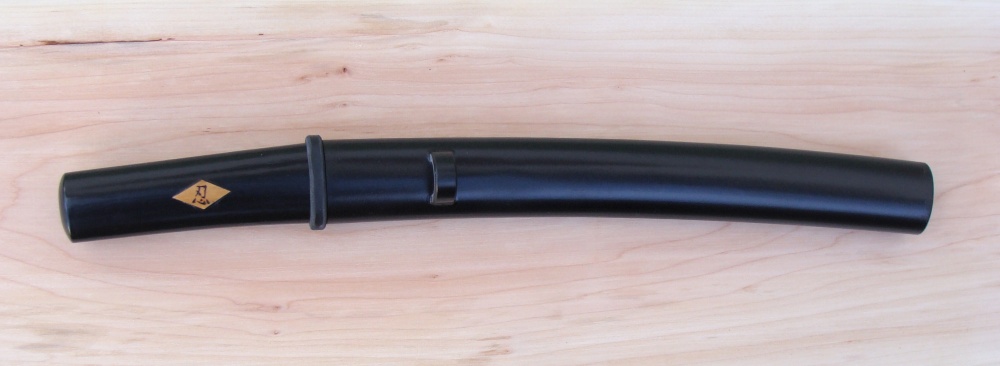
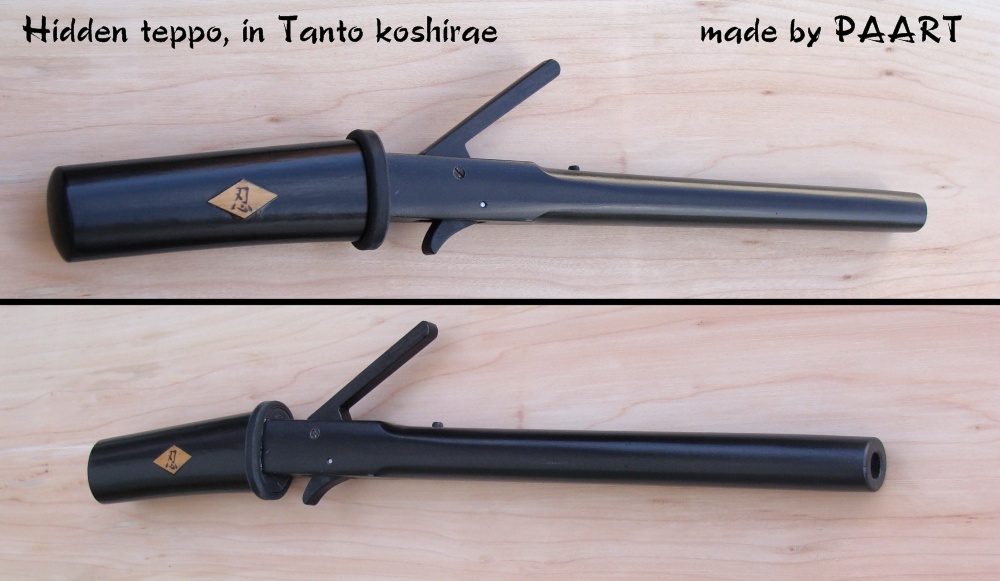
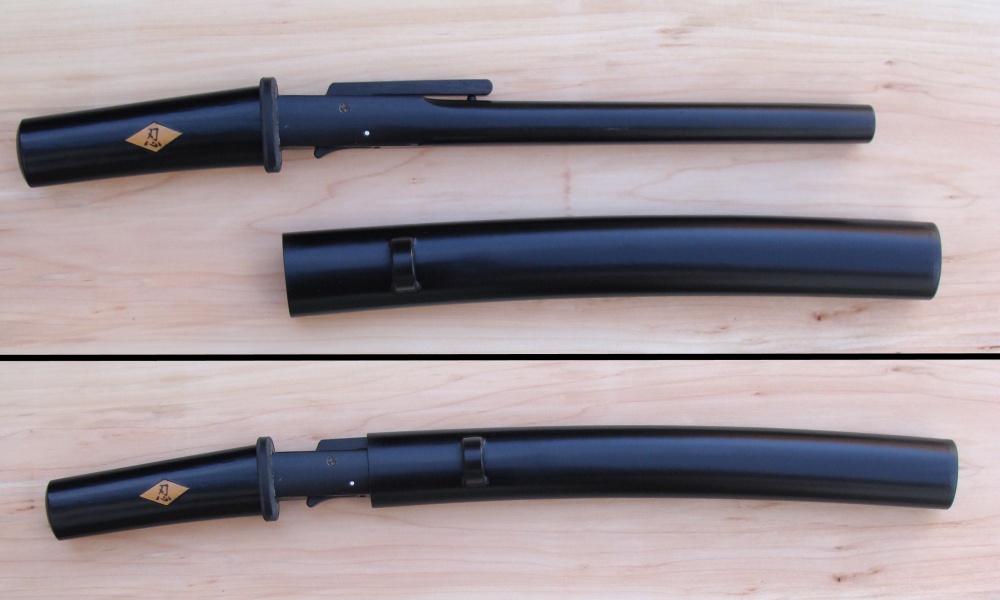
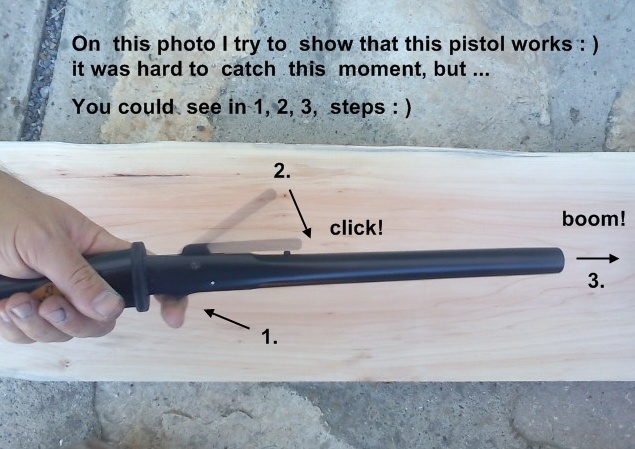
Hidden Teppo

From Paart Budo Buki by Mats "Toryu" Hjelm

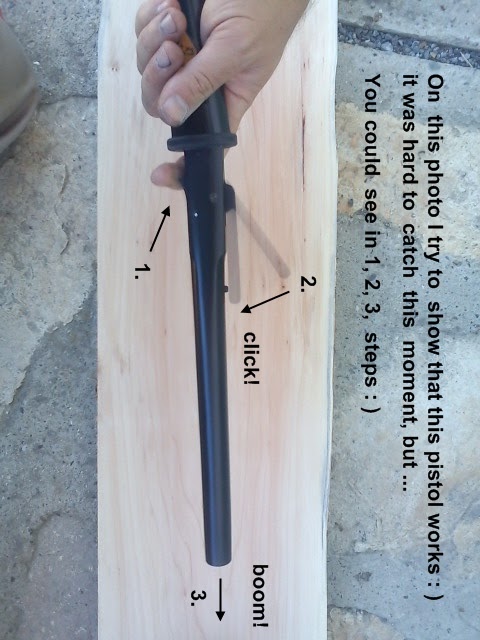
The other night when I brought this new " toy" to training, everyone was surprised,
 which is my main goal, a comment was again "you're crazy", perhaps the best compliment you can get,
only Sensei said, "I thought that was a real gun, but by the smell of lacquer I known that is not"
What to say, for now, this is about the highlight of my armorer skill,
after all, during my military service I was trained as a mechanic of infantry weapons, gunsmith.

So you are looking at Hidden Teppo wooden wersion made for practice.

Profession says that it's actually Tanju Aikuchi, or Tanto (depends on the length),

 although you would think that it is really a ninja weapon, but it seems that's not the case.
It was known that Samurai's have rejected the idea to replace their swords with firearms, so it seems that "some" were later accepted the firearm but packed in a familiar look.
By the number of this firearms that can be found in antique shops, it seem to be exactly what was happened, normally they never ​​mass manufactured, but still ...

Ninja like that idea too, for his undercover mission, and probably the only one who has used this tool fully, why?
Because after you use this single shot, you could use it like Jutte too, there were also cases that Jutte was conceal to look like Tanto (I make one too, pic. will be in new topic)

But what is really this?, 
it is Japanese made single shot percussion pistol, disguised in Tanto koshiare,

usually it was Caliber 31,

history of this weapon goes in the middle of 19th Century, after Japan has been open to foreigners, the common types of European pistols types of Curiosa percussion pistols.(according to "The Gun Report")

Some other say that  this is rare tanto pistol was used during the political turmoil in Japan, following the arrival of Commodore Perry's black ships in 1854, political assasinations were so frequent that Daiymo began carrying concealed pistols, giving them some protection
against visiting opposing Daiymo.
Most of these special order pistols are unsigned (but find some which is signed) 
Profession says that this percussion firearm is particularly rare because Japanese firearm technology was suppressed until the mid-1850’s, which is about the time that metal cartridges began to achieve commercial success.

Whatever that was the reason for the development of this weapon, for those of us who practice ninjutsu, is essential idea of hidden, unexpected and element of surprise, which gives us the advantage, in the battle for survival.
So if you ask me why this? here is my answer:
As you all know, Ninjutsu legacy is huge, because it grows in parallel with another great power, Samurai,
means that ninja need same knowledge with additions and special equipment to survive in combat against the Samurai, real number of that equipment we will newer know :-(

There is many Dojo's around the world, but they equipment for training is poor, mostly, you will know better.

So my mission is to create authentic equipment for training, yes today is time of new and modern weapons, but "root" is the same.
I that time it was Tanto pistol, today is cell phone pistol, again idea is same.
Soke used to say,  "explain the feeling", so yes it is all about "the feel", 
 but how can you explain the feeling when you do not have the real thing in your hand?
 it's true you could try  to imagine it, but is it same feel?

I had luck (or bad luck) to spend my best years of life around war and in war (Croatian independent war 1990. -1995.) so I see many things. 
Today's young people who come to train at our Dojo do not know almost nothing about the weapons of that time, twenty years after war,
we, the older ones that train ninjutsu not know much about weapons from the Samurai time, 
all that because we not have the opportunity to see real one and take in hand "to feel".

So now I ask you, how you will learn from history, how you will explain to other that history?
Miyamoto Musashi in "Go rin no sho" book in one chapter  say;
 "it cannot be clearly explained in writing, You must practise diligently in order to understand"


and yes, it will be some more for sale, for lucky on's : )


…

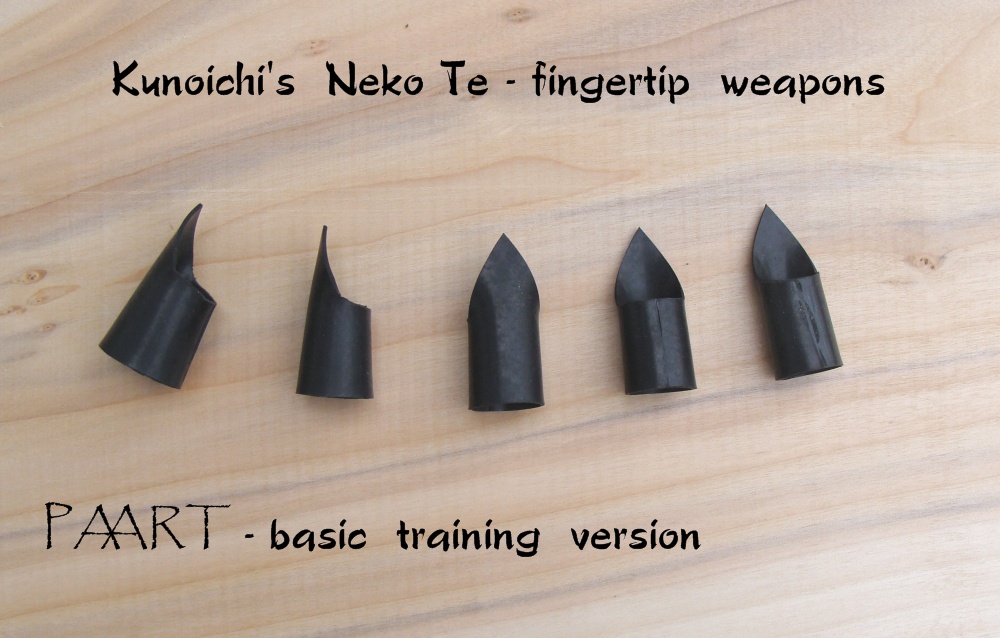
Kunoichi’s Neko Te

From Paart Budo Buki by Mats "Toryu" Hjelm

Dear ladies,
 
I apologize if it seems that I forgot about you in my work.
This is one of the projects that was a long time in my drawer (there are still plenty of),
 I planned to present it on the first Kunoichi TAIKAI, but unfortunately due to personal problems remained unfinished until now.
 
In front of you is the simplest version of Neko Te for training, it was made of rubber to be safe and prevent injuries, 
I have a similar version of the metal, on which I still work, to make it easy to adjust the size of finger person which will use it.

According to the book "NINJUTSU History ad Tradition" from Soke  Hatsumi, this weapon of Kunoichi we called "Neko te"
 
Originally, this instrument of female Ninja is made of leather and steel,
Neko te, fingertip weapons, as the book says, turn a Kunoichi's hand into a death- dealing claw,
how you are use it, I live up to you or your sensei's .
 
As for the technical side I can say that this tool requires adjustment to the size of your fingers, 
 
soon I will explain how you can easily make a measurement of your finger, if you decided ask me to make this tool for you.

Anyway, I will add new info about this project so check this topic from time to time if you are interested.


…

生

From BUJINKAN TASMANIA by Mats "Toryu" Hjelm

Don`t seek to improve. Seek to learn how to endure and maintain the spirit of Heijoushin and Fudoushin.

There is no limit to Budo. There are limits to sports. People must retire or become a coach after a certain period in the sporting world.
Budo is not a sport. We train and study for life, not to win. To win is the concept of a fighter. The feeling of the Budoka is that of surviving. Winning and losing, strength and weakness have no meaning in the real world. Survival requires the living entity to understand that “change” and “adaptability” is the key point ( kaname ).

Therefore, the kaname is forever changing and evolving. This has been the essence of the nine schools that comprise the Bujinkan for thousands of years. Soke trusts this and thus, does nothing to change it. This is wisdom. People attempt to change things because it does not fit with their concept of what martial arts is. They therefore are not really listening to thousands of years of blood,sweat and tears. Do people really think they know better than 2000 years of knowledge after only 25 years of training in the modern world? Soke doesn`t. He has been training for over 50 years and still listens and follows his teachers words and teachings.

This is why I look at the evolution of the Bujinkan through the concept of Shu Ha Ri. We are seeing the evolution of a man ( soke ) and his training path from beginning to end. The most important thing is to search for the Kaname of this process. Takamatsu Sensei apparently said that the most important thing is “sincerity” or magakoro.

Keep training and polish your heart under the sword that cuts away ones vices so you may clearly see the way of living as a martial artist in tune with nature.
忍

This is the path I try to walk.


…