Skip to content

Seimeisen 生命線: Walking the Line of Life and Death

From Bujinkan Santa Monica by Bujinkan Santa Monica

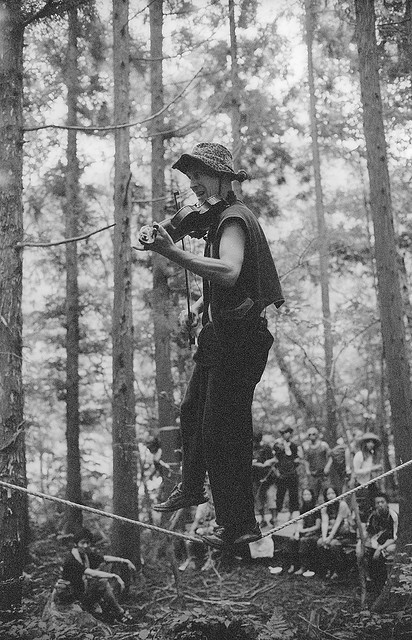
Photo from Gifu Prefecture by tallkev
One of the hiden 秘伝  (secret teaching) ideas of the sword is that life and death are just flip sides of the same instant. The reason this is a secret is not because no one talks about it, but because you must discover its mystery for yourself. Hatsumi Sensei is always reminding us that just as we can end life with the blade, we can also protect life or what he calls, the "life giving sword."

So what about this secret and how does this translate into sword technique? When you are in kamae, and about to cut or thrust to your opponent's suki, there is a Seimeisen 生命線, or an invisible lifeline between you. If your sword is on this line, it is "live," if not it is   considered dead. This line is very fine and there isn't room for two blades there. So only one blade can give or take life. This is also an aspect of Shisen 死線, the point between life and death.

To truly understand this lifeline requires a state of fudoshin. That is the only way you can stay on the line without being diverted. And when you are in that place it gives you a mysterious perspective that allows for some useful sword strategy:

後の先 Go no sen when you know where your opponent will strike so you let them strike there before you counter.

先の先 sen no sen is where you know what your opponent will do so you strike him first before he can move. Similar to tai no sen.

先々の先 Sen sen no sen where you sense what the right strategy is by intuition alone and subtly guide your opponent's strategy so that you may win.

Sen 先 and Saki share the same kanji but one meaning is future and one is previous. So Saki no Saki may be a more familiar feeling to anyone that has taken the Godan test.


神妙剣 Shinmyoken: a Victory Without Killing

From Bujinkan Santa Monica by Bujinkan Santa Monica

There is a Buddhist idea that when we kill another being we assert the radical difference between us and them. And this would ultimately be an incorrect assertion. But killing is all around us. It is part of the very fabric of nature. So what do fighters do with this?

This is a great mystery in life and martial arts. One of the most mysterious secrets is that of 神妙剣 Shinmyoken  or the life giving sword. At its most basic level it is a technique for overpowering your opponent without injuring him with the sword. This simple idea contains many mysteries, the first being, why would you endeavor NOT to kill your opponent?

This lesson comes to us in the form of a sword, but it could be any weapon. The sword clarifies the feeling of life and death because it is a very fine (and sharp) edge between the two. Hatsumi Sensei constantly reminds us not to kill. It takes a lot of control with such a dangerous weapon to use it without killing. Sensei tells us that the Ninja understood that ultimately no one is victorious in war. Everyone loses. Hatsumi Sensei says the Ninja's idea of Shinmyoken was born from this understanding.
"Good weapons are unfortunate instruments.
People hate them. So someone with Tao does not rely on them . . .
Weapons are unfortunate instruments, and not the wise man's instruments.
When he uses them because there is no other choice,
he stresses straight-forwardness and, in victory, does not praise himself."
Lao Tzu, Section 31
But Hatsumi Soke doesn't suggest we become pacifists. Wrapped up in the mysterious sword of shinmyoken is also a strategy for combat. Shinmyoken is used for judging the crucial point on the body and it can be where the tip of the sword settles and finds its target.

There is an interchange of tai and ken. Sometimes you present the attitude of your body as the sword and the sword as your body. But you must also see this exchange in the opponent's body and sword. So your observation (見ken) finds the correct point on his body. The mind must be in perfect harmony with the body and sword.

Shinmyoken is also a part of understanding this admonition Soke often tells us,
"Hell gapes beneath the upraised sword... Step in! And Heaven is your reward!"
That's nice to think about, but how do you step in? With shinmyoken! Entering with
shinmyoken means entering with a free and natural body, and free and natural mind, mind
and body and sword as one.

切り結ぶ刀の下ぞ地獄なれ、ただ切り込めよ神妙剣
Shinmyoken was deeply promoted by Yagyū Munenori 柳生宗矩(1571-1646) a Japanese swordsman who was appointed official sword instructor to two Tokugawa shoguns. Yagyu’s style is known as the Shinkage-ryu, for centuries the official style of the Tokugawa dynasty. His spiritual mentor was Zen priest Takuan.

Munenori proposed the idea of a “life-giving sword” - the notion of controlling an opponent by the spiritual readiness to fight, rather than during the fight. This may end a fight before it ever begins. But it also is the ultimate sutemi, because you must be willing to stake your life on it. This is how the old cat wins in the Neko no Myojutsu story.

Munenori wrote,
"If you want to strike at your opponent, let him strike at you first. The moment you succeed at having him strike at you, you have succeeded in striking him."
This really gets to the heart of the idea of no separation between attacker and defender. You kill him and you are killing yourself. Something Hatsumi Sensei often reminds us. The shin of shinmyoken can refer to the divinity, core or spirit of the combatants. This shin gives rise to the mystery, or myo, of the outward appearance of the clashing swordsmen. Even if you slice him open you will not find his shin.

I was in class with Hatsumi Sensei when he told the Jugodans that were present that they are always taking the godan test. They are also always giving it. Taking the test is like dying, and giving it is killing. But the killing happens through you. Soke said it is kami binding with kami. Shinmyoken as divine sword.

This transforms the nature of killing into the natural flow of life and death.


How to Win a Sword Fight

From Bujinkan Santa Monica by Bujinkan Santa Monica

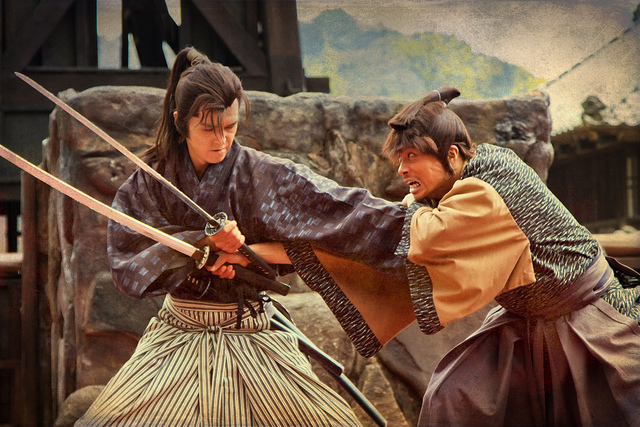
Edo Wonderland Sword Fight, photo by -ratamahatta-
If you are any good with a sword, Hatsumi Sensei says you can win without drawing your sword. He suggests this to us by pointing out the example of the famous Zen sword master, Yamaoka Tesshū (山岡 鉄舟, June 10, 1836 - July 19, 1888), a famous samurai of the Bakumatsu period, who played an important role in the Meiji Restoration. He is also noted as the founder of the Itto Shoden Muto-ryu school of swordsmanship.

One day Tesshu had a sword contest with a famous sword teacher, Asari Gimei. They fought for half a day and Tesshu was defeated. Tesshu became Asari's student and threw himself into Zen practice to try to understand the nature of his defeat.

As part of his search to understand what happened to him, he was given a koan to study by Tekisui Roshi'
"Crossed swords; neither permits retreat.
The sword-master, like a lotus in the fire,
Has a heaven-soaring spirit."
This advanced koan shows both the problem presented by a fight and the solution. Tesshu sums up his problem here:
'[When] two swords cross, all thoughts turn towards striking the opponent.'
Tesshu explains that the desire to strike an opponent while avoiding being struck is deluded. Not because this is a physical impossibility but because 'Originally, the mind is thoughtless like a bright, unclouded mirror...When the mirror is completely clouded, nothing can be reflected.' He continues 'When confronting an opponent, thoughts of striking or being struck indicate ignorance and illusion.'

Tesshu struggled with the crossed swords koan for three years of training. One morning while sitting in Zazen, he had a breakthrough. He stood up and went to fight his teacher Asari in the dojo. Asari realized right away that Tesshu had pierced through the lesson and declined to fight. He formally named Tesshu his successor and never again picked up a sword. Tesshu became a famous sword instructor who taught the way of the sword as a spiritual path.

So what happens when you cross swords with an opponent? If you are not in Zanshin, you may experience two states of mind. One is a calculating, worrying state where the mind is constantly questioning: Can you hit your opponent? Can he hit you? How can you enter, is there an opening? Does he see an opening? Can you trick him? Can you try this move or attack? Does he know that strategy and will he use it? This state is limiting, creates fear and you are defeating yourself. The limiting thoughts are never ending...

The other state lets the whole universe run through you. You erase the self and there is no you, just boundless possibility, unafraid of being cut or cutting. Your opponents efforts are no problem whatsoever. Attacks dissipate like mist.

Hatsumi Sensei says that Tesshu found this enlightenment by hearing the song of the gods in his heart. Soke describes this gokui (essense):
"In the world of martial arts, one should not stick to strength or weakness, softness or hardness; rather one should transcend physicality and understand the void, 'ku,' regarding the body also as empty."
Hatsumi Sensei goes on to explain how to use this gokui to win without drawing your sword,
"...prepare your body and show courage, the true gokui is the mind. Win without without drawing your sword. If you draw, do not cut down; bear patiently, and know that taking a life is a grave thing."


Weapon Malfunctions Can Turn Into Tactical Failure

From Bujinkan Santa Monica by Bujinkan Santa Monica

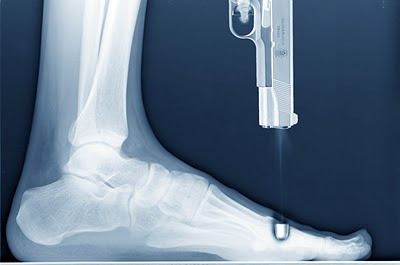
Don't malfunction yourself.
What if your gun jams, or you sword breaks, or even worse, you have a complete tactical failure?  The first two are are easy problems, the third is more difficult, but can be dealt with naturally.  Let's consider all three in turn.

If you have any firearms training at all, you already know that you should train for malfunctions.  A malfunction in this case is confined to the weapon or the ammunition itself.  It is a malfunction of the tool you are using.  A stove-pipe, a misfeed, or the worst, a broken firing pin - are all situations that must be trained for.  One common malfunction that we don't even consider as a malfunction is running out of ammo.  Why is this not a malfunction?  The weapon is essentially useless.  We don't see it as a malfunction because this is something that we very naturally expect to happen.  We train to reload.  You should train for those other malfunctions just as you train to reload smoothly and with as little interruption to your defense as possible.

And of course this training must include making a hasty tactical withdrawal (retreat)!

On several occasions I have been training with Hatsumi Sensei and he has used two swords that have red saya.  These swords never draw properly.  He at first blamed it on them being new.  But I saw this occur again years later.  Maybe the saya have a poor fit or something.  The cool thing was, that he didn't let the malfunction slow him down at all.  He made use of the half drawn sword.  In one case he said, 
"It's OK if the sword doesn't draw.  What's important is this aspect of the sword not drawing.  You can't have the idea that the sword is always going to draw.  You must have the expectation that the sword won't always draw."

So lets consider tactical failure.  Whether with a gun, a sword, or with your tactics, use yourself in a way that you don't become an obstacle.  Don't malfunction yourself.

Don't get caught up in the malfunction so that you yourself malfunction.  The failure will spread like a virus.  Soke went on to say something simple yet profound about using weapons,
"All these things are connected and you have to have this connection within the weapon."

So if you want to overcome tactical failure, there is a natural solution to the problem.  If you understand Sensei's kuden up to this point, you will know that having a natural posture and natural heart is the secret. Soke refers to his teacher Takamatsu Sensei who said that nature lies in a sincere spirit.  And that nature will bring about the destruction of your opponent.

If this doesn't help you, remember this is kuden.  It is something I've learned and experienced directly from Soke and my teachers.  You need to find a teacher to experience it from.  You can't learn it by reading about it.


Hiding Behind Totoku Hiyoshi No Kamae

From Bujinkan Santa Monica by Bujinkan Santa Monica

Seeing Totoku Hiyoshi No Kamae for the first time can be misleading.  Usually a student's first exposure to this kamae is seeing someone hold a sword out in front of themselves while someone else throws shuriken at them.  Then the instructor hands the sword to you and says, "Next."

by eflon

This aspect of Totoku is often perceived as one of those quirky things in our training that we may try out, but never take seriously.  After all, who has had to dodge shuriken for real?  I'm not counting the dishes your girlfriend threw at you during a recent argument.  Maybe you try this out, maybe block a few rubber shuriken and then forget it.

Totoku forms part of some very rich strategy in our art.  And the more you look for it, the more you will encounter.  I personally have heard Hatsumi Sensei reference it many times, and it wasn't anything to do with shuriken blocking.  It is a running theme in our taijutsu that has to be experienced from a qualified teacher.

Maybe a starting place to understand this kamae can be from the Tachi.  This sword was mainly held in one hand.  There was little tradition of handheld shields in Japanese Budo.  So how do you deal with incoming arrows, spears, or enemy sword attacks?  You use your own sword.  The first use of the sword is to protect yourself before cutting.  It becomes your first line of defense and your shield.

What if you don't have a sword?  The idea of Totoku goes even deeper.  It moves into the idea of hiding yourself behind a shield.  But what is a shield?  Soke speaks about this in reference to Goton No Jutsu:


Examine the character for "Ton" as used above in Tongyo ("hiding one's form"; or alternatively, "the discretion doctrine"), and you can discover it to be a combination of the characters "fleeing" with a "shield" - just as along the path of Ninpo.  The priciple of recognizing the value gained by winning through flight is one of Ninjutsu's cardinal rules.  However it is not simply a question of escaping.  What can one use as a shield?  One can use:
  • the Five Elements (wood, fire, earth, metal, and water)
  • the Five Rings
  • the Five Ways (the way of enlightenment)
  • the Five Arts
  • the Five Teachings
  • the Five Confucian Virtues (benevolence, rightousness, prosperity, wisdom, and sincerity)
  • Nature
  • the shining (or shadowed) glory of the martial ways
  • beliefs
  • politics (or rather policies for life)
the shields are multiple and varied.

Soke says on another occasion,

Everything is a natural shield.  So, anything can be a natural shield.  One should move in a connected way like Juppo Sessho, and Koteki Ryoda which include these teachings.  Such things are written in old Japanese scrolls.

And finally, I watched one day as Soke was demonstrating some of his mysterious muto dori, and he explained, "You must evade by the thickness of air.  Use the air as your shield."


Tachi Tips & tricks (6)

From Shiro Kuma's Weblog by kumablog

No harm

Yesterday during my seminar, one student was waving his sword held to his wrist by the rope at the tsuka kashira and the ring at the end broke releasing the sword.

Training weapons are NOT real ones and might break easily. Do not get over excited while training and keep high security levels. There was no harm but an accident could have happened.

We are now training with metallic blades instead of padded ones. Therefore our ways of training should adapt accordingly. Permanent adaptation is not to be applied only during the techniques but should include all the elements of the class in the dôjô. Adaptation is what tachi kumiuchi is teaching us. Stop thinking always in the same ways. Last month sensei said: “don’t hold to what you know or you won’t improve your skills”. The key point is to adapt.

A weapon designed for training purpose is still a weapon. Please be careful. You can influence the actions of a sentient being during the fight but there is no possibility to affect an in-animated object.

Be aware of this.


NEW DVD – Kukishin-ryu Bikenjutsu Kata w Holger Kunzmann

From Budoshop.se by budoshop

DVD is available at Budoshop.se

Title: Kukishin-ryu Bikenjutsu Kata
Instructors: Holger Kunzmann
Theme: Kukishin-ryu Bikenjutsu Kata (Sword Fighting)
Recorded: Recorded in Stockholm March 13-25th 2009
The instruction is in English
Format: NTSC, AAC Stereo, DVD/R- (it might not work on older DVD players! check your manual first!) approximately 80 Minutes playing time.

Shortly after returning from training in Japan again with Soke and the Shihan, Holger held this seminar in Kaigozan Dojo, Stockholm, Sweden.

This DVD contains all the nine basic sword techniques from Kukishin-ryu Bikenjutsu Kata plus the Sayugyaku techniques. They are taught and explained thoroughly as a basic foundation, and then with many applications and variations. The techniques covered on this DVD is the following.

附込 TSUKI KOMI
突掛 TSUKI KAKE
斬上 KIRI AGE
斬下 KIRI SAGE
銯止 KASUGAI DOME
小蝶返 KOCHOU GAESHI
四方斬 SHIHOU GIRI
八方斬 HAPPOU GIRI
月之輪 TSUKI NO WA

All these techniques are explained and taught in detail. The DVD has menus where you can chose technique to see, completely with chapters.

– See the DVD video trailer at Budo Shop Community
Buy the DVD at Budoshop.se Store

Pre order swords now before Tuesday (price adjustment is coming)

From Budoshop.se by budoshop

We will make a new order on Wednesday since we are out of stock on almost all our swords. You can pre order swords for the same price as they are in the shop now. When we get them back in stock we need to raise the price because the dollar is much higher now than when we set the price last time.

We made a sword catalog you can download with all specs of the swords we recommend. Note we can get a lot of other swords, but you need to contact us with requests because we can not keep them all in stock. We do not sell so many swords so please be patient with us. Read more in the PDF…

http://www.budoshop.se/download/BudoshopSwordCatalog.pdf

Verticle Tachi stand

From Budoshop.se by budoshop

Vertical sword stand for short or long swords. Keeps swords out of the way and reduces chance of someone bumping into it. Flat black finish with rubber foot padding on base.

Vertical sword stand for Short swords to long swords. Keeps swords out of the way and reduces chance of someone bumping into it.

Flat black finish with rubber foot padding on base. Phillips head screw driver required for assembly.

Height 580 mm
Width 170 mm
Depth 310 mm…