Skip to content

KYOKETSU-SHOGE and NAGE-NAWA

From 8þ Kabutoshimen by admin

KYOKETSU-SHOGE AND NAGE-NAWA. This article is about the weapon (actually farm tool). At the end is a video (from Bujinkan Kaigozan Dojo previous week).

KYOKETSU-SHOGE

Kyoketsu-shoge (距跋渉毛) translates as “to run about in the fields and mountains”. It is one of the weapons used in Togakure-ryu and Kumogakure-ryu.

This weapon is believed to be the forerunner of Kusarigama. Wikipedia says it is a double edged blade with a curve edged blade attached. I don’t believe that was true. I think the double edged blade was just as dull as the Kunai. And only the inside of the curved blade was sharp.

The Kyoketsu-shoge was used by the rural peasantry class from the Iga province. If they was caught with something that looked too much like a weapon, they might have been executed on the spot.

KYOKETSU-SHOGE
Kyoketsu-shoge as it probably looked hundreds of years ago. Except the rope, it was made of hair.

I think it was a multi purpose farm tool. You dig the earth, cut the grass, tie up the grass with the rope etc. Why would a farm tool have chain. Rope made of hair was less suspicious. The farmer could stick into his belt and not cause too much attention.

NAGE-NAWA

NAGE-NAWA

Nage-nawa 投げ縄 (rope throwing) is not as easy as it looks. The trick is to throw the loop and make sure the rear end of the loop passes on the other side of the hand.

On the video below I show you two common techniques we in the Bujinkan Dojo use at demonstrations. In the first technique I hit down on his hands to unarm him. Threaten him with the blade and protect the sword (we had no room to do this on camera).

Throw the ring towards his head. He steps to the side and catch it. Yank it out of his grip and prepare for the throwing. Do the first loop around his hand. He grab the rope with his other hand. Make it look like a tug of war. Loop his other hand.

Blind his eyes with the rope (or Shuriken, powder etc), he covers his eyes with the hand. Continue and loop the rope around his hand and neck.

He kicks. You do Kerikaeshi and take him down. Tie him up more with the rope. Put the blade to his neck and cut his neck.

The second technique he is attacking you and you deflect withe the blade and strike with the ring behind you to hit him. Loop the sword and yank it out of his grip. Loop his hands and neck as previous technique.

Do these techniques with good choreography and acting and it will look good in demonstrations.

Yes I know looping around the sword and yanking, the sword would probably just cut the rope. Even looping around his hands he can cut the rope. These techniques is mostly for demonstrations and just fun training.

KYOKETSU-SHOGE and NAGE-NAWA at KAIGOZAN DOJO

Check out my video channel https://www.bitchute.com/bujinkan/

The post KYOKETSU-SHOGE and NAGE-NAWA appeared first on 8þ Kabutoshimen.…

BŌ-SHURIKEN at KAIGOZAN DOJO

From 8þ Kabutoshimen by admin

Last Tuesday I practiced BŌ-SHURIKEN at KAIGOZAN DOJO. I made up my own Bō-shuriken Kata. I will explain below. Enjoy!

I’m not going into detail how to start practicing because it is too difficult explaining. But basically you always start close to the Makiwara. I tell my students to start close. When the Shuriken is hitting the target good, they should take one short step back. If the next Shuriken does not hit good, do not step back until the next Shuriken hit good. If they manage to hit with all five Shuriken, they can start further away and repeat. As long as all five hit good they can start working on longer distances. When learning a new throw or with the non dominant hand you always start close.

Scroll down to see the video.

手の内  TE NO UCHI
手の内  TE NO UCHI

This is the order I throw the Shuriken. I’m throwing the 4’th Shuriken with my left hand. So I prepared by flipping it with the point outward.

BŌ-SHURIKEN KAMAE
TENCHI NO KAMAE

Prepare by taking this Kamae. Aim with the left hand against the target and hold the right hand over the right shoulder and head. Zanshin.

HON UCHI
MIGI HON UCHI

1. Migi Hon-uchi. Shift the weight forward to the left foot and throw the first Shuriken with the right hand. Bring the left hand to the left hip.

YOKO UCHI
MIGI YOKO-UCHI

2. Migi Yoko-uchi. Step forward with the right foot and throw directly from the left hip as you would do an Ura-shutō with the right hand.

GYAKU-UCHI
MIGI GYAKU-UCHI

3. Migi Gyaku-uchi. Step forward with the left foot behind as in Yoko-aruki. Throw the third Shuriken from under with the right hand. Use the momententum from the left step to increase the power.

YOKO-UCHI
HIDARI YOKO-UCHI

4. Hidari Yoko-uchi. Spin around anti-clockwise and throw the fourth Shuriken with the left hand directly.

HON-UCHI
MIGI HON-UCHI

5. Migi Hon-uchi. Finish by throwing the fifth and last Shuriken with the right hand.

Analyse your Shuriken hits.

As you can see only one Shuriken hit good. Most Shuriken are “dead” and only one is “live”. The rear end of the Shuriken should be lower than where it hit, if it is higher the weight is not going into the target so much. It is rather going upward. These hits are called “dead”. When the Shuriken is completely level or the rear end is lower than the tip it is called “live”.

I did a Gyaku-uchi where the rotation was the opposite way. I don’t know which Shuriken that was, maybe it was “live”. Also the two Yoko-uchi might also be “live” as it was rotating sideways.

BŌ-SHURIKEN at KAIGOZAN DOJO, The VIDEO

Follow Kaigozan Dojo on Instagram

Bitchute does not allow me to embed video’s. Click here to visit my Bitchute video channel.

Throw me an e-mail if you are interested getting me for a seminar.

The post BŌ-SHURIKEN at KAIGOZAN DOJO appeared first on 8þ Kabutoshimen.…

STICK FIGHTING, traditional self defence techniques with MATS HJELM

From Budoshop.se by BUDOSHOP.SE

Stick Fighting, traditional self defence techniques is a follow up on the old Stick Fighting, Techniques for Self Defence video released 9 years ago. This video cover the traditional aspect of Stick Fighting.

On this video Mats show all 16 Hanbō techniques from the nearly 700 year old school Kukishin-ryū in the Bujinkan system. In the first level there is nine techniques against someone armed with a short sword or knife. The second and third levels is against someone armed with a sword. The instructions are in English.

This video was recorded at a seminar done by Mats Hjelm in Tallinn, Estonia in February 25-26’th 2020. The seminar was organised by Bujinkan Estonia.


The standard 48 minute video shows all 16 basic techniques.

HD1280x720 903,3Mb

The extended 100 minute video with additional variations and explanations.

HD1280x720 1,85Gb


九鬼神流半棒術
KUKISHIN-RYÛ HANBŌJUTSU

Here is an outline of all the stick fighting techniques in this school which was taught at this seminar.

三心之構 SANSHIN NO KAMAE

1. 無念無想之構 MUNENMUSO NO KAMAE
2. 型破之構 KATAYABURI NO KAMAE
3. 音無之構 ŌTONASHI NO KAMAE

初傅 SHODEN

1. 片手折 KATATE UCHI
2. 突落 TSUKI OTOSHI
3. 打技 UCHI WAZA
4. 流捕 NAGARE DORI
5. 霞掛 KASUMI GAKE
6. 行違 IKI CHIGAE
7. 顔砕 KAO KUDAKI
8. 当返 ATE GAESHI
9. 逆落 SAKA OTOSHI

中傅 CHŪDEN

1. 小手返 KOTE GAESHI
2. 逆落 SAKA OTOSHI
3. 払技 HARAI WAZA
4. 外技 SOTO WAZA

奧傅 ŌKUDEN

1. 飛落 HANE OTOSHI
2. 股掛 MATA GAKE
3. 小手払 KOTE HARAI

Stick Fighting video cover

The standard 48 minute video shows all 16 basic techniques.

HD1280x720 903,3Mb

The extended 100 minute video with additional variations and explanations.

HD1280x720 1,85Gb

Bonus stick fighting video

At the last hour on the last day we finished off the training where the participants showed a Taijutsu technique of their choice, and Mats showed how the technique could be done with the Hanbo (stick fighting). This footage is not included in any of the download videos, it is only available at our Bitchute channel (download it for free from there). Create an account on Bitchute and subscribe to our channel.

About the instructor

Mats Hjelm started training in Bujinkan for the first time around 1983, but it wasn’t until 1986 he had the opportunity to start training more seriously under a Shidōshi. He has taught at numerous seminars all around the world, gone to Japan 3-5 times every year. Since he started training he never had a training break. He takes his budo training very seriously! If you want to sponsor a seminar or course, please don’t hesitate to contact him. For more information see his web site kesshi.com or come and train with him at Kaigozan Dojo.…

Gikan-ryū Koppōjutsu and my JapanTrip#48

From 8þ Kabutoshimen by admin

On my last trip Noguchi Sensei surprised us by teaching Gikan-ryū Koppōjutsu. I think he just recently decided to start teaching this Ryū-ha. He said he learned the techniques from Hatsumi Sōke four years ago in a private session.

I have trained techniques that was claimed to be Gikan-ryū by western teachers before. I did not see any similarity what so ever, this was completely different.

There is 10 techniques in all, they don’t have any names. He showed us his notes and it was 3-4 pages with descriptions of the techniques. I attended two of the Gikan-ryū trainings he did in November this year. Fortunately I got to train all 10 techniques (I think?) with a lot of henka. It was a blast training with such good friends as Ari (Dai Shihan from Finland) and Philip (Dai Shihan from Denmark).

I’m not gonna give any descriptions here, but Noguchi Sensei said that the characteristics of this school is to attack the opponent from the side. Several techniques you hit his kidney. Many strikes was done with Ura-ken for example.

This inspired me to create a new page to the web site, click the button below.

Nagato Sensei on his first day as Shindenfudō-ryū Sōke

Earlier this year I heard that Ishizuka Sensei had been appointed as the new Sōke of Gyokkō-ryū. Now Nagato Sensei said that he had been appointed as the new Sōke of Shindenfudō-ryū. At the Buyukai I heard rumours about Noguchi Sensei was going to be the next Kotō-ryū Sōke (which now has been confirmed). No one has been appointed Sōke for Gikan-ryū yet, but I have my suspicions.

Sōke is now 88 years old

88 is an important number in Japanese, not only because it is a “double infinity”, but…. The eighty-eighth birthday is the occasion of beiju (米寿), “rice age”, because the Chinese character for rice, 米, looks like the characters for eight tens plus eight (八十八).

https://www.instagram.com/p/B5hqW4wJ-it/
Hatsumi Sōke imitating Frank Sinatra, he looked so cool.

Hatsumi Sōke was in a good mood this trip. His knees are weak so he have trouble getting up and down on the floor so we do standing bow ins and outs in the training now.

Senō Sensei said a few years ago, he felt energised during Hatsumi Sōke’s birthday because there was so many familiar places coming and giving him good energy. I think Hatsumi Sōke feels the same way.

I have added several more pictures on the Kaigozan Dōjō Instagram page.

New Books and DVD
New Ninjatō DVD and Book. Also a relatively new Mutōdori Book now in the collection.

The post Gikan-ryū Koppōjutsu and my JapanTrip#48 appeared first on 8þ Kabutoshimen.…

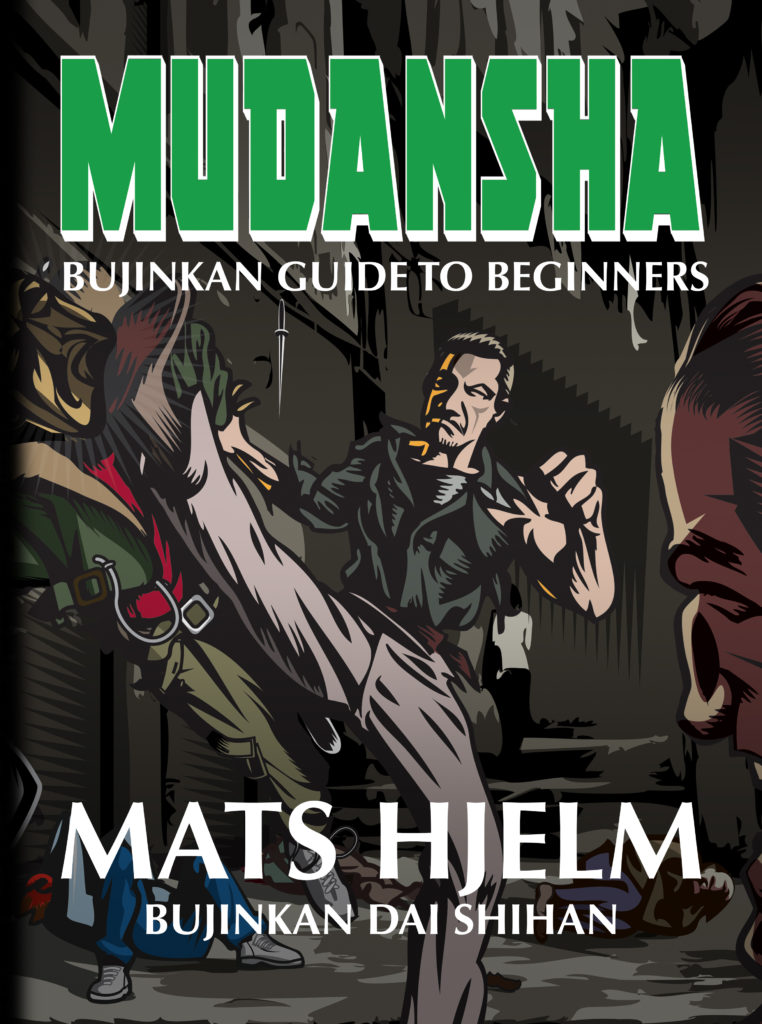
MUDANSHA BOOK by MATS HJELM

From Budoshop.se by BUDOSHOP.SE

武神館無段者の案内所
MUDANSHA – BEGINNERS GUIDE TO BUJINKAN

List Price: $14.99
Introduction Price: $11.99
You Save: $3.0 ( 20% )
Prints in 3-5 business days

English, Perfect-bound Paperback, 96 pages richly illustrated with pictures and illustrations.

This book is a guide for beginners in the Bujinkan Dojo. Everything about the rules and expectations of you as a pratctitioner, etiquette and traditions as well as the most fundamental techniques in our beautiful art.

  • 天略の巻 TEN RYAKU NO MAKI (The scroll of Heaven)
    Here we learn to move the body naturally and effectively. Essentially how to become a good Uke (receiver of techniques). When Hatsumi Soke’s own teacher Takamatsu Sensei started training over 120 years ago as a young boy he was thrown around the Dojo by the seniors for a year before he was taught any techniques. This gave him a good foundation for the next level.

About the Author: Mats have been training Bujinkan Budo-taijutsu since the early 1980’s. He travelled all around the world to train and teach Bujinkan Budo-taijutsu. http://YudanshaBook.com

Print details: 6″ x 9″, perfect binding, white interior paper (60# weight), black and white interior ink, white exterior paper (90# weight), full-color exterior ink.…

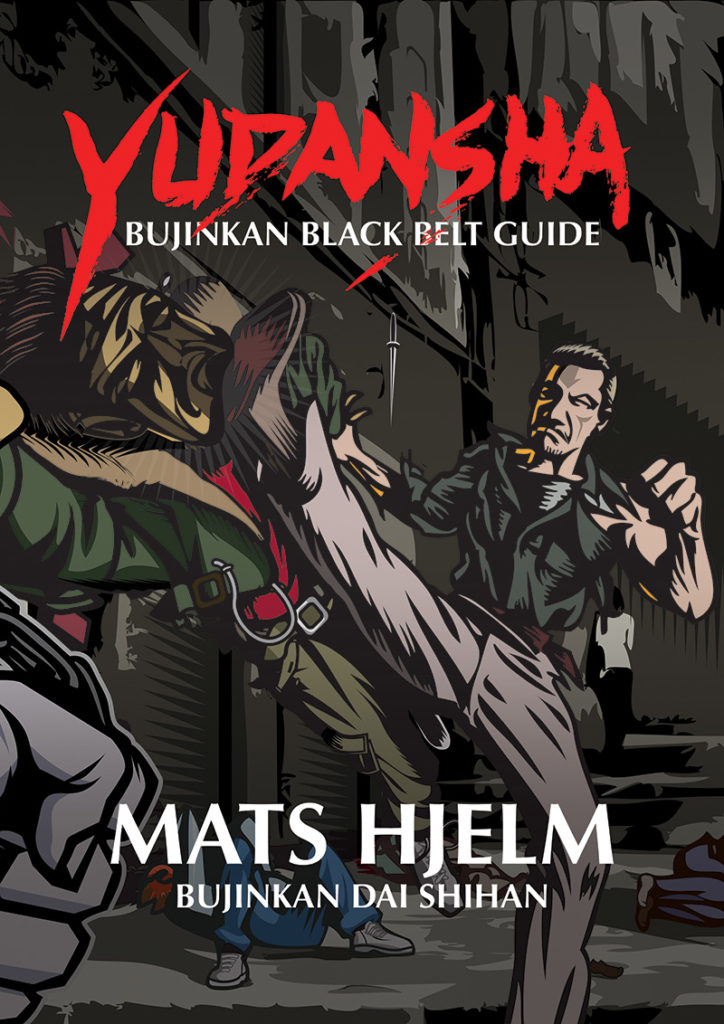
YUDANSHA BOOK by MATS HJELM

From Budoshop.se by BUDOSHOP.SE

武神館有段者の案内所
YUDANSHA – BUJINKAN BLACK BELT GUIDE

List Price: $27.77
Introduction Price: $22.22
You Save: $5.55 ( 20% )
Prints in 3-5 business days

English, Perfect-bound Paperback, 184 pages richly illustrated with pictures and illustrations. (32 483 Words, 145 533 Characters)

This book is a comprehensive guide to understand the Taijutsu of the Bujinkan system as taught by Masaaki Hatsumi Soke. We have this concept of Shu-Ha-Ri which is three major processes to learn Budo. First, we learn the fundamentals, then how to break them up. Then you transcend to a state where you are totally free without even thinking of what you are doing. Needless to say, you can’t get to the last stage without knowing the first stage well. It is said that you should study each level for at least 10 years. This book is all about the first stage we call Shu. It is further divided into three levels.

  • 天略の巻 TEN RYAKU NO MAKI (The scroll of Heaven)
  • 地略の巻 CHI RYAKU NO MAKI (The scroll of Earth)
  • 人略の巻 JIN RYAKU NO MAKI (The scroll of Man)

About the Author: Mats have been training Bujinkan Budo-taijutsu since the early 1980’s. He travelled all around the world to train and teach Bujinkan Budo-taijutsu. http://YudanshaBook.com

Print details: 8.26″ x 11.69″ (EU Standard A4), perfect binding, white interior paper (60# weight), black and white interior ink, white exterior paper (90# weight), full-color exterior ink.…

Takamatsu Sensei taught Hatsumi Sōke with 42 hands

From 8þ Kabutoshimen by admin

At the training yesterday Sōke said that he had been taught by the 42 hands of Takamatsu Sensei. He was referring to 千手千眼観自在菩薩 Senju-sengen Kanjizai Bosatsu that had 1000 hands and 1000 eyes. The deity emphasizes the compassion that sees suffering (with 1000 eyes) and acts to relieve it (with 1000 hands).

千手観音Senju Kannon appears in the 虚空蔵院 Kokūzōin of the 胎蔵界曼荼羅 Taizōkai Mandara, with 27 faces and 42 main arms, while innumerable small arms fan out behind. Since it is difficult to portray one thousand arms, images usually show Senju with two principle arms in 合掌印 Gasshō-in (Sk: anjali mudra) in front of his chest and 40 arms, holding attributes and forming mudra, on the sides (altogether 42 arms, or shijūnihi 四十二臂). This number can be justified because each hand saves the beings of 25 worlds, and 40 times the 25 equals 1000.

Takamatsu Sensei died when Hatsumi Sōke was 42 years old. 42 years later we had a big Taikai in Japan to celebrate Takamatsu Sensei and starting a new cycle. In Japanese culture, the number 42 is considered unlucky because the numerals when pronounced separately—shi ni (four two)—sound like the word “death”.

Many cultures around the world recognise the number 42 in interesting ways.

There are 42 questions asked of persons making their journey through Death in the ancient Egyptian Book of the Dead.

42 is the number with which God creates the Universe in Kabbalistic tradition.

42 is also the Answer to the Ultimate Question of Life, The Universe, and Everything according Douglas Adams in his science fiction book Hitchhikers Guide to the galaxy.

Funny fact; in 1996 Cambridge astronomers said that Adams was right. Dr Richard Saunders, who led the research, sounded a trifle abashed by the result. “We have taken two measurements for the constant, and the average of them is, well, it’s 42.”

Sōke showed us antique small miniature weapons. He said it is important to appreciate the quality and details, and we should study them.

The post Takamatsu Sensei taught Hatsumi Sōke with 42 hands appeared first on 8þ Kabutoshimen.…

文殊 MONJU – Bujinkan Theme 2018

From 8þ Kabutoshimen by admin

文殊 MONJU (Guardian of the Law, Voice of the Law) is one of many meanings. Monju is considered the wisest of the Bodhisattva, and thus acts as the Voice (Expounder) of Buddhist Law.

Japanese sculptures of Monju often depict the deity sitting atop a roaring lion or shishi, which symbolizes the voice of Buddhist Law and the power of Buddhism to overcome all obstacles. Shishi are also commonly found guarding the entrance gate to shrines and temples. Monju typically holds the Sutra of Wisdom in the left hand and a sharp sword in the right, which Monju uses to cut through illusion and shed light on the unenlightened mind. In some artwork, Monju carries a lotus flower and sits atop a shishi (mythical lion).

Monju’s cult was introduced to Japan by Ennin 圓仁 (794-864 AD; also spelled 円仁), a Japanese monk who visited Wutaishan (a five-terraced mountain in China’s Shanxi Province that today is still a major center of the Monju cult) during his travels to China (838-847 AD).

Mañjuśrī is a bodhisattva associated with prajñā (insight) in Mahayana Buddhism. In Tibetan Buddhism, he is also a yidam. His name means “Gentle Glory” in Sanskrit.[1] Mañjuśrī is also known by the fuller name of Mañjuśrīkumārabhūta,[2] literally “Mañjuśrī, Still a Youth” or, less literally, “Prince Mañjuśrī”.

A mantra commonly associated with Mañjuśrī is the following:

oṃ arapacana dhīḥ
The Arapacana is a syllabary consisting of forty-two letters, and is named after the first five letters: a, ra, pa, ca, na

A is a door to the insight that all dharmas are unproduced from the very beginning (ādya-anutpannatvād).
RA is a door to the insight that all dharmas are without dirt (rajas).
PA is a door to the insight that all dharmas have been expounded in the ultimate sense (paramārtha).
CA is a door to the insight that the decrease (cyavana) or rebirth of any dharma cannot be apprehended, because all dharmas do not decrease, nor are they reborn.
NA is a door to the insight that the names (i.e. nāma) of all dharmas have vanished; the essential nature behind names cannot be gained or lost.

Tibetan pronunciation is slightly different and so the Tibetan characters read: oṃ a ra pa tsa na dhīḥ (Tibetan: ༀ་ཨ་ར་པ་ཙ་ན་དྷཱི༔, Wylie: om a ra pa tsa na d+hIH).[14] In Tibetan tradition, this mantra is believed to enhance wisdom and improve one’s skills in debating, memory, writing, and other literary abilities. “Dhīḥ” is the seed syllable of the mantra and is chanted with greater emphasis and also repeated a number of times as a decrescendo.

Bujinkan Keiko 2018
As far as the training goes, it is basically the same as previous years. A lot of Mūtō-dori against knife, sword and rokushakubō. Very often Sōke uses his fingers to “walk” across the hands, which finally captures a finger lock. He makes the attacker to forget he got a weapon in his hand and he just pick it out of the hand of the surprised Uke.

Even when it is Taijutsu, the concept of Mūtō-dori is the same principles used.

More about Monju.
More about Manjushri.

The post 文殊 MONJU – Bujinkan Theme 2018 appeared first on 8þ Kabutoshimen.…

三光稲荷 Sankō Inari

From 8þ Kabutoshimen by admin

On the second training this year Sōke improved an old painting with a fox. He painted white hair on the Fox and added the kanji. Then he put it up on the left side of Shomen wall in Honbu Dōjō.

三光稲荷 SANKŌ INARI
(Three light rice load)

G00g1e translate isn’t much help. But I found interesting story on Wikipedia about Inari Ōkami is the Japanese kami of foxes, of fertility, rice, tea and sake, of agriculture and industry, of general prosperity and worldly success, and one of the principal kami of Shinto. In earlier Japan, Inari was also the patron of swordsmiths and merchants. Represented as male, female, or androgynous, Inari is sometimes seen as a collective of three or five individual kami. Inari appears to have been worshipped since the founding of a shrine at Inari Mountain in 711 AD, although some scholars believe that worship started in the late 5th century.

By the 16th century Inari had become the patron of blacksmiths and the protector of warriors, and worship of Inari spread across Japan in the [[Edo period]. Inari is a popular figure in both Shinto and Buddhist beliefs in Japan. More than one-third (32,000) of the Shinto shrines in Japan are dedicated to Inari. Modern corporations, such as cosmetic company Shiseido, continue to revere Inari as a patron kami, with shrines atop their corporate headquarters.


Inari and their fox spirits help the blacksmith Munechika forge the blade kogitsune-maru (Little Fox) in the late 10th century. This legend is the subject of the noh drama Sanjo Kokaji.

The fox and the wish-fulfilling jewel are prominent symbols of Inari. Other common elements in depictions of Inari, and sometimes of their kitsune, include a sickle, a sheaf or sack of rice, and a sword. Another belonging was their whip—although they were hardly known to use it, it was a powerful weapon that was used to burn people’s crops of rice.

Inari is a popular deity with shrines and Buddhist temples located throughout most of Japan. According to a 2007 report from Kokugakuin University, 2970 shrines are dedicated to Inari.

If you find one or usually many red Tori gates it is most likely a shrine dedicated to Inary deity.

So what does this mean for Bujinkan? I don’t know, it is an interesting part of Japanese culture. Maybe he just want us to look it up.

The post 三光稲荷 Sankō Inari appeared first on 8þ Kabutoshimen.…