Skip to content

Riga seminar in February 2011

From 8þ Kabutoshimen by admin

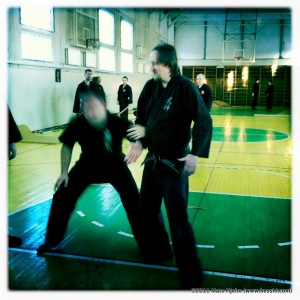
The past weekend I was invited by Juris from Bujinkan Kurokawa Dojo in Riga to teach a seminar on Sanshin no kata and Juttejutsu.

On Saturday I showed and explained the way I feel is the base for Sanshin no kata. First we did the traditional warm-up routine; doing the first technique five times on the right side, and then five times on the left side, and finally ten times alternately on right and left side. Then the same with all the other four techniques. Sanshin no kata consists of five simple techniques…

Sanshin no kata

三心の型 SANSHIN NO KATA

地 CHI (earth)
水 SUI (water)
火 KA (fire)
風 FŪ (wind)
空 KŪ (void)

In the early 1980′s there was a “guy” that had only been training a couple of years and interpreted these techniques with Buddhism and created his own philosophy around these techniques. He wrote many books on the subject, and almost everyone copied his idea. It was a very nice idea, but it was not the Sanshin no kata that Hatsumi Soke taught as many people believed at the time (and unfortunately still believes). Do not think of the elements too much. Just simply look at them as a way of counting, nothing else.

Some people talk about three different ways of doing these techniques and they also have a name (shoshin, gogyo, goshin). I have never been taught this by Hatsumi Soke or any one else of the Japanese Shihan, and I have never seen the source for this. So I’m not teaching this, but I think this also is a good idea. I think it is important to always look at things from three perspectives. For example left, right and middle. The way I taught on the seminar was the following.

The principle of capturing, strike and quickly capture again

Solo training, try to get the form correct and understand all movements, angles, timing, distance, technique, kamae and everything else. I heard that even the Japanese Shihan who have been training for 30-40 years still do this every day. So there is no reason for you to think that you have already learned it. I to still discover many things when doing the forms.

With a partner you will understand the the solo training forms better. The forms you do in solo training will never bee exactly the same when done with a partner, you need to adjust according the way your partner attacks. We did the base (as I see it!) with five different blocks and five different strikes, then moved on to applications and more direct response from natural posture.

Using weapons will increase the understanding even more. If you use a weapon try to keep to the ideas we learn from the forms. But small adjustments are done according the characteristics of the weapons used.

http://www.youtube.com/watch?v=tN4XcGbDsm8

This 45 minute video from the seminar is available for instant download at BUDOSHOP.SE

十手術 JUTTEJUTSU

the JutteThe jutte or jitte (十手), literally meaning “ten-hand” (i.e., the weapon with the power of ten hands), is a specialized weapon. In Edo period Japan the jutte was a substitute for a badge and represented someone on official business and was carried by all levels of police officers including high ranking samurai police officials and low-rank samurai law enforcement officers (called okappiki or doshin). Other high ranking samurai officials carried a jutte as a badge of office, “aratame” or official inspectors including hotel, rice and grain inspectors carried a jutte.

On Sunday we did the six techniques from the old Hanbo, Tessen and Jutte book published by Hatsumi Soke in 1984 ca. It has six basic techniques, we did them all. In 2003 the Bujinkan theme was Kunai and Hatsumi Soke taught five of these techniques using a Kunai. The weapons are different so adjustments need to be made according the characteristics of these weapons.

落花 Rakka technique

We studied the following techniques with Jutte in mind (not Kunai), first the basic form and then variations and applications.

桐之一葉 KIRI NO HITOHA – falling paulowina leaf (arrival of autumn)
落花 RAKKA – falling blossoms
水鳥 MIZU-DORI – water bird / 五輪碎 GORIN KUDAKI – five rings crush
雷閃 RAI-SEN – flash of lightning
竜下 TATSUGE – inferior dragon
廻捕 MAWARIDORI – revolve and capture

The training both days seemed to be successful and everyone seemed happy about it. I sure had a good time both in the dojo and outside before, between and after the trainings. The first time I was in Latvia in 2002? I asked about traditional masks but I didn’t know so much about them that they understood what I meant. So after the training Juris surprised me with a mask I asked about nearly ten years ago.

The arrival of masked visitors

This practise is variously referred to as budēļi, čigāni “gypsies, going gypsying”, kaladnieki, ķekatas, maski “masks, going masking”, nabagi “the poor ones”, etc. Although this practise could occur at any time of the winter (between Mārtiņi and Meteņi ), it was particularly common on Christmas eve. It is strongly reminiscent of the tradition of mummers and mummering in Great Britain and Newfoundland.

Latvian “mummers” might dress up as animals (bears, horses, cranes) or as Death. They would go from house to house and were warmly greeted, as they were assumed to drive away evil spirits. They would arrive in groups in front of the house, and sing songs and dance. Then they would be invited in and fed with bacon buns (pīrāgi), butter, sausages, and given ale to drink. They made a special effort to disguise their voices and mannerisms, so that no one would be able to guess who each one was, but if a mummer was correctly identified, he or she would have to “unveil”, i.e. remove the cloth which was covering their face.

It is still common for children to be required to recite an appropriate verse before receipt of their presents (there are many).

Vai, lielie ziemas svētki,
Puiši trekni, zirgi vāji;
Puišiem alus, brandavīns
Zirgiem tukšas redelītes.

Oh my, Christmas time
The lads are fat, the horses lean;
The lads get beer and whiskey
But the hay racks are empty.

I’m happy about the whole seminar, and especially happy that people also came from the neighboring countries Estonia and Lithuania. I was asked to come back after summer, maybe in August. I’m already looking forward to it.

Thank you Juris and everyone who attended and made the seminar possible.

Happy training!

Click here for more pictures from the seminar.

The post Riga seminar in February 2011 appeared first on 8þ Kabutoshimen.…
KAIGOUSURU 2002 TAIKAI with 14 INSTRUCTORS from DENMARK, SWEDEN, SWITZERLAND, UK and USA

From Budoshop by BUDOSHOP.SE

Buy the VideoCD click here!

Kaigousuru 6 -- the sixth International Bujinkan Training Party with Mats Brickman, Tomas Franzén, Gunnar Björnsson, Martin Spring, Mats Hjelm, James McNab, Eric Gyllenberg, Rikard Sundelius, Ed Martin, Christer Westberg, Mariette v.d. Vliet, Micke Clysén, Michael Schjerling, Hasse Nilsson in Sweden.

The theme of this year was Takagiyoshin-ryu and Bujinkan Taijutsu, knife, sword and sticks.

Recorded in Stockholm, Sweden October 2002


71 minutes, 490 Mb for $14.99
Buy the full VCD, click here!


Sample clip from the video

www.youtube.com/watch?v=KSp2SV84PoA

About the download

Click here for more information about our download files and how it works!

KAIGOUSURU 2001 TAIKAI with SVENERIC, MARIETTE, MARK, ELIAS, RIKARD, KEITH and many more

From Budoshop by BUDOSHOP.SE

Buy the VideoCD click here!

Kaigousuru 5 -- the fifth International Bujinkan Training Party with Sveneric Bogsäter, Mariette v.d. Vliet, Keith Porter, Mark O’Brien, Elias Krzywacki, Rikard Sundelius and many more in Sweden.

The theme of this year was Gyokko-ryu and Bujinkan Taijutsu.

Recorded in Stockholm, Sweden October 2001


68 minutes, 480 Mb for $14.99
Buy the full VCD, click here!


Sample clip from the video

www.youtube.com/watch?v=dcKIC553XNY

About the download

Click here for more information about our download files and how it works!

KAIGOUSURU 1999 TAIKAI with ARNAUD COUSERGUE, PETER KING and SVENERIC BOGSÄTER

From Budoshop by BUDOSHOP.SE

Buy the VideoCD click here!

Kaigousuru 2 -- the second International Bujinkan Training Party with Arnaud Cousergue, Peter King and Sveneric Bogsäter in Sweden.

The theme of this year was Kukishin-ryu Taijutsu. All three teachers teach various aspects of Kihon Happo and Sanshin no kata. Arnaud taught Sword basics at the Shidoshi class for example.

Recorded in Stockholm, Sweden July 1999


70 minutes, 470 Mb for $14.99
Buy the full VCD, click here!


Sample clip from the video

www.youtube.com/watch?v=st9QB8ZoD2Q

About the instructors

Hehe… the Shi-tenno needs no introduction. Arnaud, Peter and Sveneric are famous Shihan in the Bujinkan. See their own web sites for more information about them…
- Shi-tenno web site

About the download

Click here for more information about our download files and how it works!

KAIGOUSURU 1997 TAIKAI with PEDRO FLEITAS and ARNAUD COUSERGUE

From Budoshop by BUDOSHOP.SE

Buy the VideoCD click here!

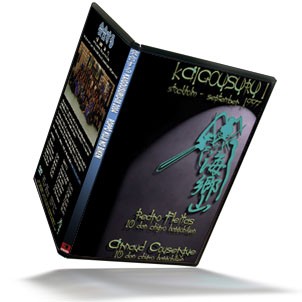
Kaigousuru 1 -- the first International Bujinkan Training Party with Pedro Fleitas & Arnaud Cousergue in Sweden.

The theme was Jo Jutsu and Taijutsu. They taught many Jo Jutsu techniques and henka from Kukishin-ryuu Jo jutsu. They also taught Taijutsu, unarmed fighting techniques.

Recorded in Stockholm, Sweden September 1997


72 minutes, 480 Mb for $14.99
Buy the full VCD, click here!


Sample clip from the video

www.youtube.com/watch?v=tr-i7MeDMgQ

About the instructors

Hehe, both Pedro and Arnaud are famous Shihan in the Bujinkan. See their own web sites for more information about them…
- Arnaud Cousergue web site
- Pedro Fleitas web site

About the download

Click here for more information about our download files and how it works!

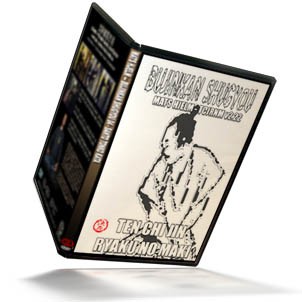
TEN-CHI-JIN RYAKU NO MAKI with MATS HJELM

From Budoshop by BUDOSHOP.SE

Buy the VideoCD click here!


40 minutes, 480 Mb for $14.99
Buy the full VCD, click here!
Ten Chi Jin Ryaku no Maki is the absolute foundation of Bujinkan Budo Taijutsu, unarmed fighting and self defence techniques.

Recorded in Stockholm, Sweden September 2002 -- February 2003

Kaigozan dojo and many other use these techniques as a base for ranking beginners up to 1′st degree black belt.

Ten ryaku no maki: 9 kyu -- 7 kyu (yellow belt)
Chi ryaku no maki: 6 kyu -- 4 kyu (green belt)
Jin ryaku no maki: 3 kyu -- 1 kyu (brown belt)

All these techniques is demonstrated on this video 1-3 times. It is not a self study course, it should rather be seen as a reference material and a compliment to your studies with a good teacher.

There is no verbal instructions or speaking on this video. So it doesn’t require that you know English or any other language.


Sample clip from the video

www.youtube.com/watch?v=i2LN9ZiBHTM

This is one of the first videos we made. It was filmed between 2002 and 2003. The movie quality is not very good. But it has been our best seller since we opened our web shop. Many people like to know the basics :-) .

Note: Not all teachers use this curricullum exactly for their ranking. But the techniques are the most fundamental and basic techniques in the Bujinkan Dojo system. So it is worth studying anyway!

Techniques covered in this video

TEN (first level, usually 9 kyu to 7 kyu)
- Taihenjutsu Ukemi (breakfalling),
- Kamae (9 basic positions),
- Hiken Juuroppou (16 basic strikes),
- Sanshin no Kata (5 basic movements),
- Kihon Happou (8 basic techniques),
- Shinken Taihenjutsu (escaping sword cuts),

CHI (second level, usually 6 kyu to 4 kyu)
- Hajutsu Kyuhou (9 methodsd to free oneself),
- Gyaku Gi (9 joint manipulations),
- Nage Kata (9 basic throws),
- Ryusui Iki (5 sacrificing throws),
- Shime Waza (5 basic strangulation methods),

JIN (third level, usually 3 kyu to 1 kyu)
- Suwari Kata (3 defenses from a seated position),
- Katate Dori (5 defenses from a single hand grab,
- Ryoute Dori (7 defense techniques from a double lapel grabs),
- Haibuyori (5 defense techniques from attacks from behind),
- Tsuki Uchi (9 defence techniques from a punch),
- Keri Ni Taisuru (5 defense techniques agains kicks),
- Tsuki to Keri ni Taisuku (4 defense techniques from kicks and punches),
- Nage Kaeshi (8 defense techniques against throws),
- Muto Dori (1 defense technique from a knife stab),
- Zanto Tonko no Kata (7 methods of fleeing from the attack).

About the instructor

Mats Hjelm started training in Bujinkan for the first time around 1983, but it wasn’t until 1986 he had the opportunity to start training more seriously under a Shidôshi. He attends around 20 seminars, go to Japan 2-3 times every year. Since he started training he never had a training break. He takes his budo training very seriously! If you want to sponsor a seminar or course, please don’t hesitate to contact him. For more information see his web site www.kesshi.com

About the download

Click here for more information about our download files and how it works!

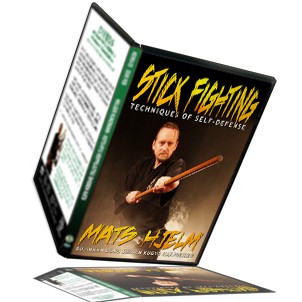
STICK FIGHTING, Techniques of self defence with MATS HJELM

From Budoshop by BUDOSHOP.SE

Stick fighting for self defence with Mats Hjelm


70 minutes, 480 Mb for $19.99
Buy the full DVD, click here!
Stick Fighting, techniques of self defence (cane and short stick). Recorded in Stockholm, Sweden -- June-July 2010

These are very effective and simple self-defence techniques that anyone can learn. You can use a cane, sticks of all sizes, pencils, rolled up magazine or anything with a stick like form.

On this video Mats show all the techniques from the classic “Stick Fighting” book by Hatsumi & Chambers. We recommend you to also buy this book for further studies.

Mats: I recently acquired your DVD on the hanbo. It is by far the best available. I have made a special study of hanbo and cane techniques for the past 10 years and have collected more than 150 books and DVDs on these techniques, so I believe I can make that statement with confidence. Congratulations!

- Tom Lang Author of The Stick and Cane in Close Combat (Unique Publications)


Sample clip from the video

www.youtube.com/watch?v=TZnZCp0tGSw

Buy the book from Amazon!

In 1971 Kodansha released a book with Hatsumi Sōke and Quentin Chambers, this book have been a good resource for many martial arts instructors and practitioners, not just within the Bujinkan, and this for a good reason. The techniques from the book is a collection of techniques from various ryū-ha, mostly from Kukishin-ryū. The book have step-by-step instructions with over 300 pictures, but if you don’t have previous experience in Bujinkan the movements might be difficult to fully understand. But together with this video, you also get the movements behind the techniques. We recommend you both the book and our video.

We do not sell this book, buy the book from Amazon, click here!

Both the video and the book contains the following techniques…

- 8 basic movement techniques
- technique 1-11 is against fist attacks
- technique 12-16 is against foot attacks
- technique 17-31 is against wrist holding
- technique 32-43 is against sleeve and lapel holding
- technique 44-47 is against seizure from behind
- technique 48-51 is against stick holding
- 7 immobilization techniques


Screen captures from the video

gjvghjg hghg hgh shugyou07-04 shugyou07-05 shugyou07-06 shugyou07-07 shugyou07-08 shugyou07-09 shugyou07-01 shugyou07-02

About the instructor

Mats Hjelm started training in Bujinkan for the first time around 1983, but it wasn’t until 1986 he had the opportunity to start training more seriously under a Shidôshi. He attends around 20 seminars, go to Japan 2-3 times every year. Since he started training he never had a training break. He takes his budo training very seriously! If you want to sponsor a seminar or course, please don’t hesitate to contact him. For more information see his web site www.kesshi.com Note!

Note: The instructions is in English and there is no sub titles on this DVD

About the download

Click here for more information about our download files and how it works!

KUKISHIN-RYU DAKENTAIJUTSU with MATS HJELM

From Budoshop by BUDOSHOP.SE

All 48 basic taijutsu techniques from Shoden, Chûden, Sabaki and Okuden no kata. There is 12 basic techniques in each level. Together with Shirabe-moguri kata (not covered in this dvd) the school consists of total 60 dakentaijutsu techniques.

Recorded in Stockholm October 27-28th 2007
The instruction is in English

Shortly after returning from 3 weeks training in Japan with Soke and the Shihan, Mats held this seminar. This DVD contains all 48 basic taijutsu techniques from Shoden, Chûden, Sabaki and Okuden no kata. There is 12 basic techniques in each level, together with Shirabe-moguri kata (not covered in this dvd) the school consists of total 60 dakentaijutsu techniques.

In the Shoden and Chuden level we learn how to dodge attacks through a series of throwing attempts, grab

Save $7.97 and buy all four levels
110 minutes, 803 Mb for $19.99

Buy the full DVD here!

and punch situations, and defences against kicks and punches. The Sabaki level is characterized by a shorter distance and foot work is even more important. In the Okuden kata the opponent starts to resist and do more counters. The opponent is attacking more freely. We try to get him in to a bad position and then apply a technique from the lower levels. In Shirabe-moguri kata (the last level, not covered on this video) the defender is now so skilled that he have developed the ability to feel what the opponent will try to do before he starts doing it.

Kukishin-ryû is a very complete system, if you study the basic techniques well you will have a good defence system against any kind of attacks. On the Keiko #18 dvd, the whole Shoden no kata is covered in much more detail!

About the instructor

Mats Hjelm started training in Bujinkan for the first time around 1983, but it wasn’t until 1986 he had the opportunity to start training more seriously under a Shidôshi. He attends around 20 seminars, go to Japan 2-3 times every year. Since he started training he never had a training break. He takes his budo training very seriously! If you want to sponsor a seminar or course, please don’t hesitate to contact him. For more information see his web site www.kesshi.com Note!

Note: The instructions is in English and there is no sub titles on this DVD

About the download

Click here for more information about our download files and how it works!

TORIDE KIHON GOHO with MATS HJELM

From Budoshop by BUDOSHOP.SE

KosshiKihonSanpoThis is Kihon Happo part 2 of 2. Mats show the basic techniques. Each technique have two ura-waza and many henka. Included is for example Oni-kudaki, Muso-dori, Ō-gyaku and more as ura-waza techniques on this video.

Note: The instructions is in Swedish, with subtitled comments by the instructor in English.

KIHON HAPPO -- TORIDE KIHON GOHO

Kihon happo is the most fundamental and basic techniques in the Bujinkan system. It is divided into KOSSHI KIHON SANPO and TORIDE KIHON GOHOU. On this video the following techniques from TORIDE KIHON GOHO is performed…

42 minutes, 290 Mb for $10.99

1. OMOTE KOTE GYAKU DORI DAOSHI
HENKA
URA WAZA 1
URA WAZA 2

2. OMOTE KOTE GYAKU KEN SABAKI KATA
HENKA
URA WAZA 1
URA WAZA 2

3. URA KOTE GYAKU DORI DAOSHI
HENKA
URA WAZA 1
URA WAZA 2

4. UDE JIME ASHI ORI KATA (MUSHA DORI)
HENKA
URA WAZA 1
URA WAZA 2

5. GANSEKI NAGE
HENKA
URA WAZA 1
URA WAZA 2

NOTE! This video together with the KOSSHI KIHON SANPO is also available as a DVD at the BUDOSHOP.SE/store.

Sample video

Note: The techniques is from part 1 (Kosshi Kihon Sanpo)

www.youtube.com/watch?v=vi9dmV-2R_4

About the download

Click here for more information about our download files and how it works!

HANKYO 2009 the KGZ CHRISTMAS SEMINAR

From Budoshop by BUDOSHOP.SE

Click here to buy the DVDReflections of this years Bujinkan theme, Sainou konki taijutsu. Many people went to Japan this year and they all came together to share on this seminar.

The instructors was Mats Hjelm, Fredrik Markgren, Daniel Åberg, Kristoffer Nowén, and Jan Granroth.

Recorded in Stockholm, Sweden December 2009

Note: Some of the instructors spoke Swedish, and others English.

This movie is available on DVD (click here!) or available as download, click button below.


70 minutes, 450 Mb for $6.99

Sample video from the seminar

www.youtube.com/watch?v=1I7MmBxRwog

About the download

Click here for more information about our download files and how it works!