Skip to content

Iro 色: Attach to Color, Follow the Color

From Bujinkan Santa Monica by Bujinkan Santa Monica

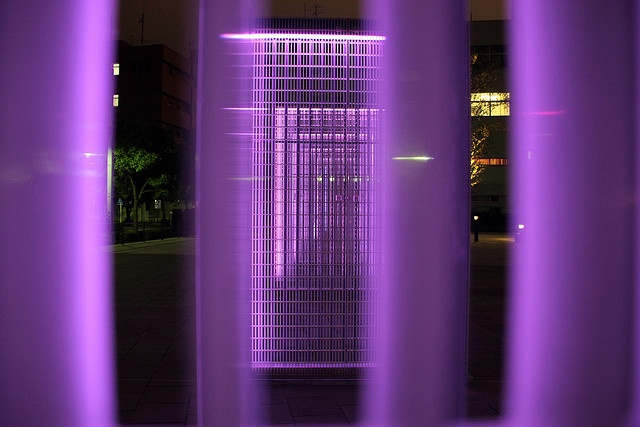
Purple Grid - Yokohama, Japan photo by OiMax
Many of you have seen Hatsumi Sensei's purple hair. Everyone wants to know what that is about. Iro 色 (color) is a very important symbol in Japanese culture and martial arts. Let's look at that idea first, then Soke's hairstyle.

In martial arts Iro 色 is something that can be observed. For example: the color of your face, color of your sword, color of your attack, color of your Kamae, etc. The opponent's attack or his desire to win is often times described as Iro.

I describe hearing Sensei refer to this on my blog post, Beyond Striking and Kiai Into the Mysteries of Toate No Jutsu:
I was at a Friday night class with Hatsumi Sensei in the Hombu Dojo when Soke described toate no jutsu as a kiai or projection of spirit (maybe 気迫 kihaku?). Sensei said it was like the color of your heart projecting into space. That color comes from your character or can be that which you decide to project. He said all this with his purple hair and made reference to Kabuki theatre in which a purple scarf on the head denotes death.
The concept of Goshiki 五色 can be 5 colors. Usually we hear this word as 5 consciousnesses (Goshiki 五識). From the Great Buddhist Dictionary (仏教大辞典、小学館) we can learn the following:

"The five basic colors are Green, Yellow, Red, White and Black. They refer to the five Skandhas (goshiki 五識), the five Wisdoms (gochi 五知) or the five Buddhas (gobutsu 五佛) as an expression of the various Buddhist teachings.

In Japan there was the custom during the Heian period to hang a scroll of Buddha Amida Nyorai in front of a dying person, whith a fivecolored string (goshiki no ito 五色の糸) coming from the hand of the Buddha extending to the hands of the person. If you hold it firmly during your last minutes, you were assured a strait passage to the Paradise of the West (Amida Joodo 阿弥陀浄土).

One of the objects in the hand of a Kannon with 1000 Hands (Senju Kannon 千手観音) is a Fivecolored Cloud (goshikiun 五色雲).

The water poured over the head of the statue of Shakyamuni as a child during the festival for his birthday on April 8 (kanbutsu-e潅仏会) is called Fivecolored Water (goshikisui 五色水)."

You can also see these colors in 5 types of Daruma dolls, or Tibetan and Japanese prayer flags (goshiki ban 五色幡) .

These flag colors also represent the 5 elements:
Ku: Blue is the sky;
Fu: White is for the clouds;
Ka: Red is fire;
Sui: Green is water; and
Chi: Yellow is for the earth.
Each wave of the flag by the wind is considered one complete reading of the prayers printed on the flags.

On an ancient battle field,  5 colored flags were used for moving troops.
YELLOW shows the location of base camp or rally point.
When the other flags are raised:
BLUE:    Frontline Troops will GO EAST
RED:     Frontline Troops will GO SOUTH
WHITE:  Frontline Troops will GO WEST
BLACK:  Frontline Troops will GO NORTH

This is where we get the expression "色につき色にしたがふ" (attach to color, follow the color) and even though these ancient battle field strategies have been forgotten, the expression survives till this day in kenjutsu practice.

In a Japanese Shrine, you may find four animal flags in each direction:
East: Blue Dragon
West: White Tiger
South: Red Peacock
North: Black Turtle

So what about Hatsumi Sensei's purple hair? If you ask him you may not get the answer you expect. He told someone I know that it was to protect him from STD's (sexually transmitted diseases). For a straighter answer, here is what he told Doug Wilson: Smoke On The Water.

We can learn a lot about the color Murasaki 紫. In Feng Shui it symbolizes Yin, spiritual awareness, physical and mental healing. A purple Daruma (there are some!) is for a long life and preventing disasters. The pigment Murasaki is taken from the root of the plant  with this name and in Japanese poetry it denotes perseverance.

Murasaki iro 紫色 also suggests high rank and leadership. In the ancient courts of Japan, there was The Twelve Level Cap and Rank System (冠位十二階 Kan'i Jūnikai), established in 603. The highest rank was assoiciated with the highest virtue. At the top was 大徳 Daitoku Greater Virtue and it was represented with purple.

紫の雲にいつ乗るにしの海
murasaki no kumo ni itsu noru nishi no umi

on purple clouds
when will I set sail?
western sea
-Issa


偸眼 Chugan: Eyes Like a Dragonfly Thief

From Bujinkan Santa Monica by Bujinkan Santa Monica

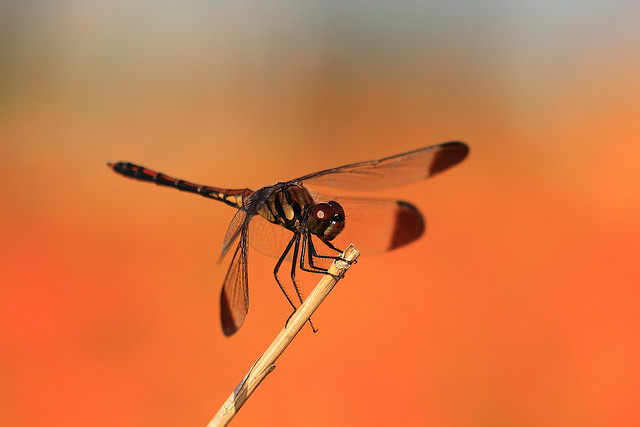
photo by TANAKA Juuyoh (田中十洋)
When I was a young man, one of my favorite movies was "The Karate Kid." The Sensei in that movie, Mr. Miyagi, played by Pat Morita, was full of patient but stern advice for his young student, Daniel-san. In one memorable quote, he chastised Daniel for looking down,
"Look eye!, always look eye!"
Very good advice for self defense. But there is a lot more to be understood about the eyes in our training. And, despite my fondness for that simple time in my life when a movie meant so much to me, I will break from Miyagi Sensei to suggest you don't always look eye.

There is a lot of psychology in a glance. A lot of nonverbal communication that takes place before a fight. Looking someone in the eye can be perceived as aggressive and create tension or make you a target for their anger. At the same time, the right type of look can cause the opponent to back down.

Takamatsu said that truly skilled martial artists can decide a fight by looking at each other. The better fighter knows he is better and graciously gives his adversary an opportunity to back down. If the weaker has any skill at all, he will perceive his opponent's superiority and concede to him.

A proverb says that the eyes are the window to the soul. This creates weaknesses and opportunities. If, you give away too much in your own eyes, your opponent can see your bluff, or know what your next move will be. Or, if you look in his eyes and see fear. You could easily reflect or manifest that same fear in yourself.

On the other hand we have the idea of Seigan, ‘Correct eye’ 正眼 with the feeling that you can manipulate your enemy and control his mind. As Soke says,
"to cloud the mind can be another important way of blinding the eyes. I would like you to know that it is the core of the metsubushi techniques to make the eye stop working."
This brings us to a more advanced use of the eyes for mind control. Ganko Issen is a sudden flash or glint of light of the whites of the eyes which can create the effects of Fudo Kanashibari and is also a basis for Toate no jutsu (striking from a distance).
"I have no eyes -- I make the flash of lightning my eyes." - unknown samurai c.1300
Hatsumi Sensei says that it is possible to "see" without using the eyes, and to "hear" without the ears. He says that, "In Ninpo your whole body must act as your eyes and ears."

This brings us to the concept of 偸眼  Chugan - looking askance; pretending not to look, or stealing a look. Maybe another word for it is tōshi 盗視 or 偸視 a stealthy glance;  furtive glance. I see Hatsumi Sensei do this all the time. In fact he often advises us to do this.
偸眼にして蜻蜒伯労を避く。
With a pilfered glance, the dragonfly evades the shrike.
This idea has many layers. One is that by not looking directly at your opponent you can make your focus broader to take in the whole environment. People and animals often do this naturally when surrounded. Looking nowhere but everywhere. This can be called Happo Nirami (staring in all directions). One benefit here is that your opponent's actions will be caught in your peripheral vision which responds very well to sudden, quick movement.

Another layer is that you can confuse your opponent by shifting his mind along with your line of sight. This can be simple misdirection like looking at one target on his body with your eyes but attacking another. As in 二目遣い Futatsumetsukai from Noh theatre which is a double glance where you look first but your mind does not stop there; or you look at your opponent when you appear not to be looking.

But it is also something more profound. When he attacks, especially if done with anger, he is looking to confront another soul directly. By shifting your awareness, it is like you are sidestepping his intent (like shifting your spirit back at 45 degrees) and his attacks will dissipate when they encounter nothing.

Hatsumi Sensei is constantly saying things that allude to this concept. Like "dissipate" the attacks, or you just "disappear" in the face of the attacks. Become zero.

Thank you Miyagi Sensei. I was sad when actor Pat Morita died in 2005, but his lesson is immortalized on film. And I'm sure he would agree, acting is all about the eyes.


強弱柔剛 Kyojaku Jyugo: Like a Dream in the Void

From Bujinkan Santa Monica by Bujinkan Santa Monica

Paul Masse Santa Monica Training
We had some great training with Paul Masse last weekend. One idea that Paul shared with us is:
強弱柔剛あるべからず 故にこの心から離れ 空という一字に悟り  体また無しとして 之に配す
Neither strong or weak, soft or hard, separate from the heart of these and enlighten yourself to the one character of nothingness. Make your body nothingness and reside therein.
This comes to us from Toda Shinzaburo Masahide of the Togakure ryu. Another translation of this phrase can be found in Hatsumi Sensei's book, "The Way of the Ninja,"
"One should be neither strong nor weak, neither soft nor hard. Leave such thoughts behind, awaken to the Void, and make your body Null to abide by this."
Paul had us exploring these ideas through 虚実 kyojitsu, 無心 mushin, and 縁 connection.

Paul explained that for kyojitsu to be effective you have to sell it. He likened it to a magician performing an illusion. In order to sell it, he has to believe in it himself. In the world of magicians this is called misdirection. The next day Paul and I shared our personal stories as magicians with each other. We both studied and performed magic when we were younger. It was a lot of fun sharing memories on prestidigitation and coin sleight of hand methods.

With kyojitsu you can show the kyo to the opponent (misdirection) and then you hit him with the jutsu. The interesting part is, if he doesn't fall for the kyo, it becomes real- it becomes the jutsu. Maybe it was never fake to begin with?

Soke on Kyojaku Jyugo,
It's not whether you're good or bad. If you think you've reached a certain skill level then you probably haven't. That's why there's this saying, strong or weak, it doesn't matter. You have to have the balance of these points (heijōshin 平常心).
Mushin 無心 means "innocent" or "free from disturbing thoughts" or simply, "empty mind." Mushin is held in the fourth, intuitive level of Godai:
"The fourth dimension is that of the world of Mu— nothingness— a world haunted by death, a world of spirit only. It is a world with no physical existence, where everything simply disappears. That is why in that world you must not let an opponent see or sense your form- you must wipe it out entirely." -Masaaki Hatsumi, The Way Of The Ninja
In Zen, Mushin is the thinking of the body. In the Bujinkan we often describe this as flow. And it is obvious when watching someone whether they are doing technique from their heads or from the wisdom of their body using flowing taijutsu.

Under heaven nothing is more soft and yielding than water.
Yet for attacking the solid and strong, nothing is better;
It has no equal.
The weak can overcome the strong;
The supple can overcome the stiff.
Under heaven everyone knows this,
Yet no one puts it into practice.
-Lao Tzu

Hatsumi Sensei describes Kyojaku Jyugo further:
"This means that in Budo, it is naive to get caught up in thoughts of strong weak or soft/hard; in the end, even concepts such as skillful/unskillful simply fade away, Jutaijutsu contains fifteen strong arts and fifteen weak arts, making thirty in total, which can be seen as three sets of ten (as in Sanshin no Kata: Tenchijin and the Juji idea). Nevertheless, one deliberately and willfully eliminates all of that to make oneself Void."
Mushin is like looking at your own reflection in the moonlit water. If the water is still, maybe you see the moon reflected there with your own shadow. You  might forget that the moon is in the night sky behind you! Don't trouble the calm water with your worries and doubts. Allow your mind to fill the sky and be with the moon.

This type of connection to heaven is something Soke reminds us about constantly.

Thank you Paul! It was all like a dream (夢 yume).


忍辱の鎧 Ninniku No Yoroi: Patience as Armour

From Bujinkan Santa Monica by Bujinkan Santa Monica

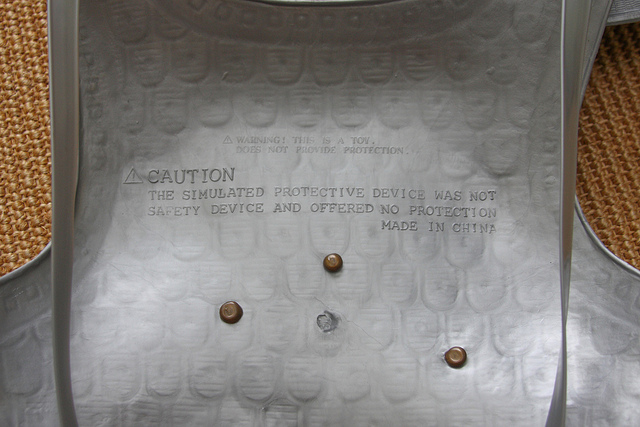
"Caution. The simulated protective device was not safety device and offered no protection."                                               photo by Sam Howzit

 鎧をつけている人は、転ぶと大きな音がする。

He who wears armor falls with a big crash!

This saying reminds me of medieval knights of old, encased in metal, then falling off their horses, only to bellow on the ground like a sick overturned tortoise. anyone who has worn yoroi may have experienced similar sensations. But the armour that really weighs us down most often and acts against us is in our own hearts. We wear our pride or technique on our bodies like it will stop bullets. Ninniku offers us a different choice. In our Bujinkan training this is some of the most powerful armour available.

Hatsumi Sensei has explained to us how he dissipates the attacker's energy. This is one aspect of three methods that make up 忍辱の鎧 Ninniku No Yoroi. We will look at these three strategies after we try to understand Ninniku.

Soke describes it this way,
Ninniku Seishin. There is a saying, "Enduring insults and humiliation, I drop all
rancor, I desire no revenge," which implies bearing no hatred and holding no grudges.

This word derives from Ksanti-paramita (Ninniku-haramitsu Bosatsu, "Arrival at the Other Shore of Patience"), Ksdnti in her Sanskrit name means "patience" and is translated into Sino-Japanese as ninniku. She is also called "Nin-haramitsu"

Ninniku is the third of ropparamitsu, the six paramitas or disciplines of Mahayana Buddhism.  Here the patient heart tempers and subdues anger and hatred. Enduring insults originating in men, such as hatred, or abuse. And surviving distress arising from natural causes such as heat, cold, age, sickness, etc. The symbol associated with ninniku is a flower.

Hatsumi Sensei also tells us,
The Ninja uniform is like the Kesa of the Buddhist priest,
and Takamatsu Sensei used to call it "a taste of Zen."
Buddhist priests wear a kesa or scarf which has another name, 忍辱鎧 ninniku-gai, or armour of patience. Or patience as armour. 忍辱の鎧 Ninniku No Yoroi - armor of perseverance.

The idea of ninniku no kesa comes from the Lotus Sutra, where the preacher is described as cloaked in "the thought of tender forbearance and the bearing of insult with equanimity."

This kind of armor shields you in ways that will seem supernatural. You cannot be insulted or degraded (fujō 不浄). You are also free from attachment to the uncertainty and undecidability of the cause and effect of a fight (fujō 不定). You float outside that cycle of violence with these three tactics:

  • Awareness: this allows us to evade an enemy's attack naturally and disappear. By showing no intention to fight you can be invisible. 
  • Hard training prepares you for any situation, so you may experience banpen fugyo in the midst of chaos. Then use natural principles and methods to prevail.
  • Have the perseverance of Ninniku Seishin: "hiding spirit" hide your intentions, don't show off everything, be patient, wait and endure to succeed.
"If your heart is small, one unjust word or act will make you suffer. But if your heart is large, if you have understanding and compassion, that word or deed will not have the power to make you suffer. You will be able to receive, embrace, and transform it in an instant. What counts here is your capacity." -- Thich Nhat Hanh


Sakura No Kaze II

From The Magick & The Mundane » Bujinkan by Shawn Gray

The second annual Sakura No Kaze (“cherry-blossom wind”) seminar was held in Surrey, BC, just outside Vancouver, on May 14/15. Bill Brown and I team-taught for the two days, alternating back and forth, sharing lessons that we’ve learned from our time in Japan training under Hatsumi Sensei. This included both unarmed taijutsu techniques as well as variations with the sword and the 6-foot bo staff. We also taught techniques from both the perspective of a defender using the technique against an aggressor, and also from the perspective of having the technique applied to you by someone else, turning the technique back upon them (this is known as kaeshi-waza, 返し技).

The turn-out was very good despite the threat of rain, and although it did rain at times over the two days, there were hot, sunny breaks as well – a nice smattering of variable Vancouver weather. As many Vancouver-area Bujinkan groups do, we were training outside. At times, training jackets came off because it was getting hot, and at other times those training jackets were dripping with mud. The Vancouver groups are used to training outdoors in all sorts of weather. I had the same experience in my 5 years of training in Vancouver before moving to Japan – sun, rain, snow, mud, concrete, gravel, ice – we trained on and in it all.

It was so encouraging to see many old friends and new ones as well, the new generation who have come up the ranks in the 19 years since I began my training in the area. At the time I think there were only 2 or 3 Bujinkan black belts in BC. The Bujinkan community was very isolated from Japan. Few made the trip to Japan for training, and there were swindlers around who would take advantage of people’s ignorance, keeping them in the dark and taking their membership and grading fees and issuing their own certificates and membership cards instead of the official ones that are supposed to come from the Bujinkan office in Japan. Over time, people began to see other instructors and make their own trips to Japan, aided by the spread of information via the Internet since the mid-90′s. Now there are many instructors who have taken groups of students to Japan to train with Sensei, and the exposure of more instructors to the training in Japan has, over time, resulted in a much greater skill level than existed in the province when I first started out. It’s good to see – relationships between local training groups have developed and people are cooperating on hosting and organizing events and showing up to support each others’ seminars. Such inter-group cooperation was rare back in the ’90s. I felt a great sense of happiness when I thought of this as I looked around at the faces of the participants as the seminar came to a close. The Bujinkan in Western Canada has come such a long way, due to people’s efforts and sacrifice, and is developing it’s own history, one that I’m proud to be a small part of.

It was great to have the honour to be invited to teach here again.

Namaste, Arigatou, Keep Going!

Shawn


三心の構 Sanshin no Kamae: Silent and Deadly

From Bujinkan Santa Monica by Bujinkan Santa Monica

photo by ngader
We can learn a lot from the Kamae in our art. For example, there are three Kamae that are often associated with hanbo that Takamatsu Sensei called 三心の構  Sanshin no Kamae. These three simple looking kamae contain important insights about the nature of fighting and combat that can change everything about the way you understand Kamae and Bujinkan Taijutsu.

Hatsumi sensei says these Kamae are "three phases:"

型破の構 Kata Yaburi no Kamae – form breaking

無念無想の構 Munen Muso no Kamae – no intention, no thought

音無しの構 Otonashi no Kamae – silent posture

The stances betray no outward signs of readiness for action, offensive or defensive. You stand exposed, weapons lowered, and your body square to the opponent. This emptiness makes these kamae positions of pure, unlimited potential from which all manner of henka can arise. These kamae all pass rapidly from stillness into motion and motion into stillness. Offense and defense are one and the same. Emptiness and reality are embodied in the stances with kyojitsu tenkan ho being a primary strategy.

With 型破の構 Kata Yaburi no Kamae you move in a way to break or destroy the opponent's form. Whether that be the form of his attack or breaking the "form" of his spirit. But this also suggests the destruction of your own form. Or the erasing of your own ego. Which leads us to,

無念無想の構 Munen Muso no Kamae, sometimes referred to as mugamae (non form), is the intention of no-intention, no-thought throughout your body or any weapon you hold.

So with 音無しの構 Otonashi no Kamae, you are lying low;  saying nothing and waiting for an opportunity. It is critical to use space, without showing your weapon, the form, the shape, or the sound. Use it in the unguarded space to take away the opponent's fighting power.

Soke describes this,
"you stand silently in otonashi no kamae (the silent posture) with both hands lowered. Even against a strong opponent you maintain this form. The cross style of this form has a secret meaning that includes both desperation and sacrifice."

The power of this stance often appears in cinema and theater.  Sawada Shojiro returned to Tokyo with Daibosatsu Toge, 1921-1922).  In this performance Sawada played Tsukue Ryunosuke, a ruthless and nihilistic swordsman who goes blind but his swordsmanship does not diminish. Ryunosuke's "soundless stance" (otonashi-no-kamae) sword-fighting style inspired many chanbara heroes that followed including the blind swordsman Zato Ichi.

The role of Ryunosuke Tsukue was reprised in the movie "Sword of Doom" by Tatsuya Nakadai in 1966. In this clip we can see Otonashi no kamae at work (WARNING graphic sword fight):


Fudōshin 不動心 or Fudōshin 浮動心 Floating Heart?

From Bujinkan Santa Monica by Bujinkan Santa Monica

photo by London looks
I was talking with Paul Masse about recent events in Japan. We were contemplating the appropriate "safe" distance from these disasters. Hatsumi Sensei often suggests to us that we evade by the width of a piece of paper. He gives us this image as a hint to take a small evasion, or, just as much space as needed. I have even heard him say that it should be the width of air. Now that seems risky for sure!

But there is another way to evade that isn't evading. And Sensei does this but it is not easy to see. To open our eyes let's look at one example from nature and one from Hatsumi Sensei.

While talking with Paul, I was reminded of a different kind of distance from a favorite poem. I shared this idea with Paul and he seemed to enjoy the feeling of it:
The Little Duck -----  By Donald C. Babcock
Now we are ready to look at something pretty special.
It is a duck riding the ocean a hundred feet beyond the surf.
No, it isn’t a gull.
A gull always has a raucous touch about him.
This is some sort of duck, and he cuddles in the swells.
He isn’t cold, and he is thinking things over.
There is a big heaving in the Atlantic,
And he is part of it.
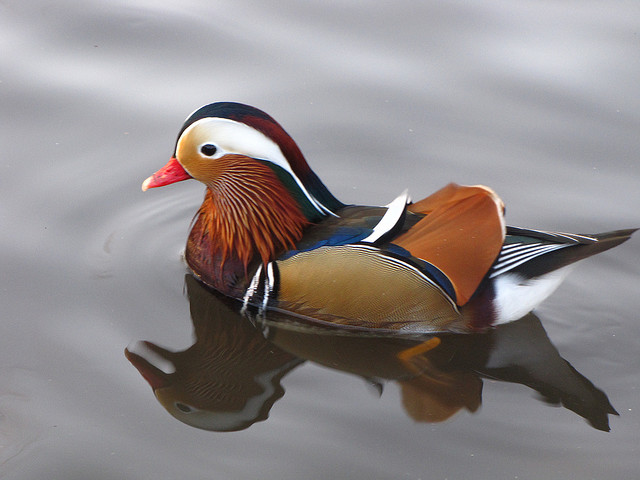
He looks a bit like a mandarin, or the Lord Buddha meditating under the Bo tree.
But he has hardly enough above the eyes to be a philosopher.
He has poise, however, which is what philosophers must have.
He can rest while the Atlantic heaves, because he rests in the Atlantic.
Probably he doesn’t know how large the ocean is.
And neither do you.
But he realizes it.
And what does he do, I ask you. He sits down in it.
He reposes in the immediate as if it were infinity—which it is.
That is religion, and the duck has it.
He has made himself a part of the boundless, be easing himself into it just where it
touches him.
Paul said this is like Fudōshin 不動心. Which is often translated as "immovable heart." But another reading of it could be Fudōshin 浮動心 "Floating Heart."

Well we had our conversation about The Little Duck a couple of weeks ago, and today I came across Hatsumi Sensei suggesting what seems to be the same kind of distance for muto dori:
Understanding muto as "Like a boat floating on water." Whether the waves are gentle or rough, it is good. Hicho no ken (the sword of the flying bird). Regard the opponent's attack as natural. This is Niten Itto, Niten Ichi-ryu. Board the floating boat, and stop the attack. The boat's motion prevents the opponent from moving freely.
I am humbled at this connection that appeared today. And it opened up some ideas for me that I have felt in Hatsumi Sensei's classes but been unable to get my mind around. I can't wait to explore this feeling in class tonight!


Kihon: The Heart of an Infinite Circle

From Bujinkan Santa Monica by Bujinkan Santa Monica

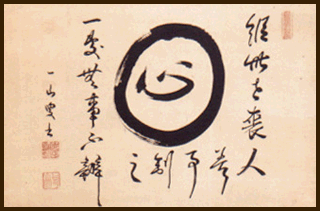
Enso by Isan Shinko (1740-1815) 
I'm sure you've all studied kihon happo. But it's one thing to study those eight basic fundamentals and a entirely different thing to study the kihon OF the happo. Hatsumi Sensei says this idea can be expressed very simply with a common Zen symbol of Enso which I will share below, but what will it mean to us?

Sensei has said that the word happo suggests infinity. He said that placing the number eight on its side gives us that symbol ∞. Soke goes on to explain that a technique does not have a beginning or end but just flows one into the other like the symbol.

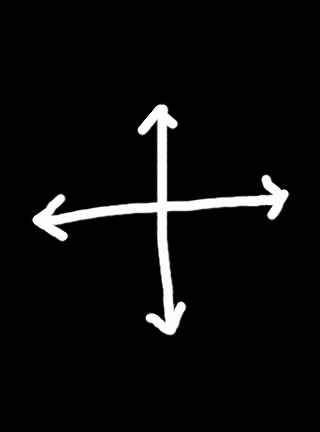
A simple way to consider this is with tai sabaki. In angling we often start with cardinal points for evasion or striking (please excuse my clumsy finger diagrams):


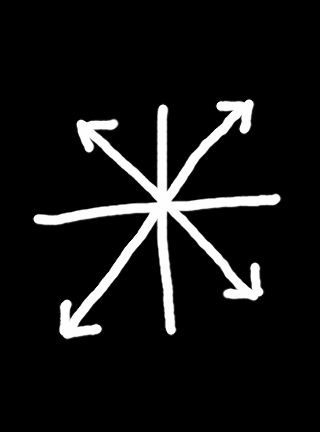
Then we split those four directions to make 8:
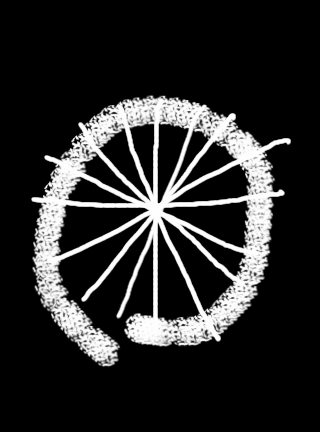
 Then split again:


You can see how it begins to get infinite... especially if you add the up and down directions so any angle in space is possible leading to a sphere:

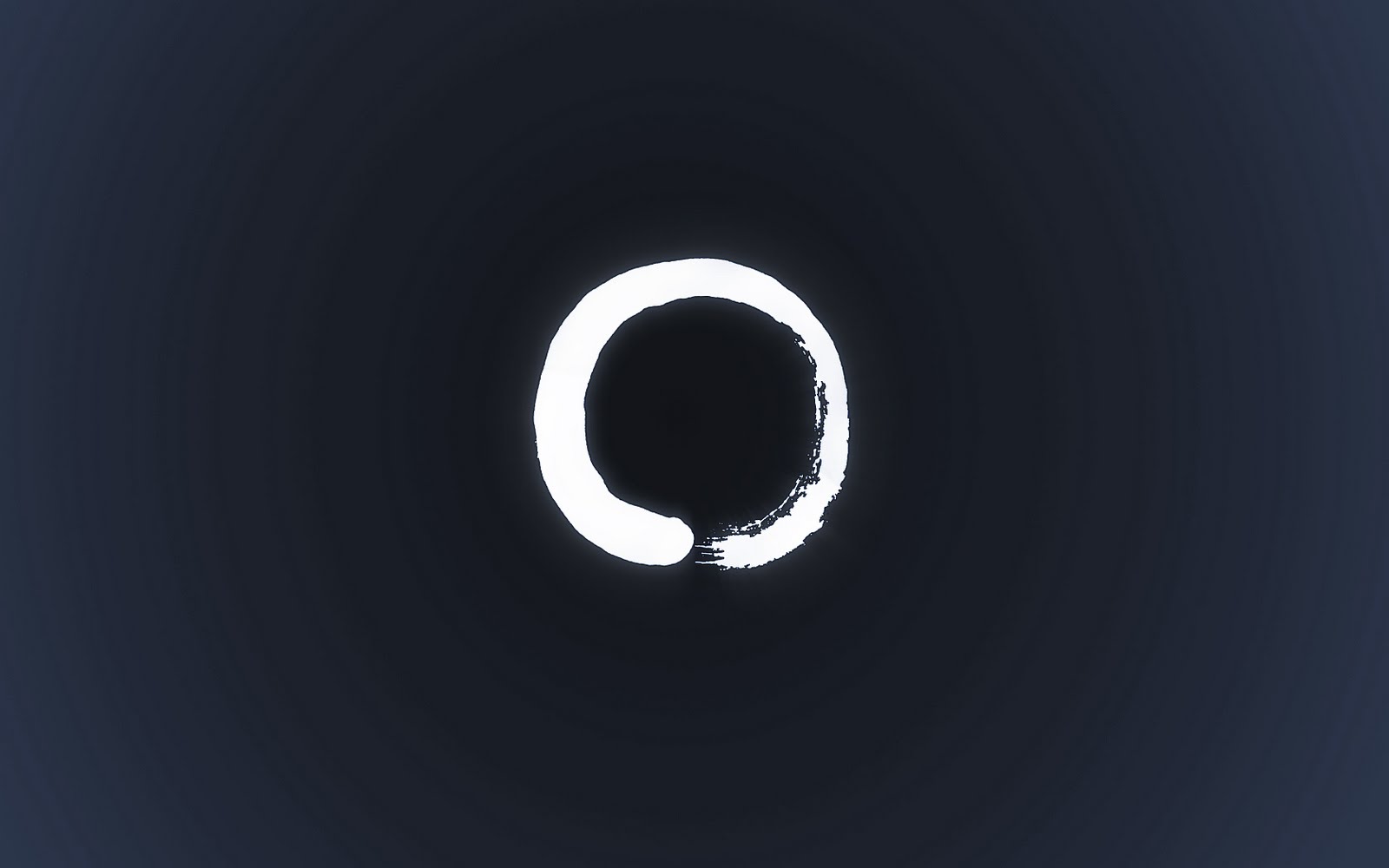
Or the Japanese Zen symbol of Enso:

Hatsumi Sensei says that kihon is like thrusting your sword into a point about which there is an Enso or limitless circle (happo) and existing in the space is the kukan.
If you want a clue to the study of that infinite space, you may read the calligraphy of the first Enso I posted at the top of this post by Isan Shinko. In the center is the character for heart, which you may recognize as part of our 忍 "nin" symbol. And the calligraphy says,
"Keep yourself firmly centered inside here and nothing will be able to shatter you. "


我無し Ware Nashi: No More Us

From Bujinkan Santa Monica by Bujinkan Santa Monica

Desi being shy.
My dog Desiree died this week after being part of my family for almost 18 years. Although not unexpected, I definitely feel her absence. As I sit with this feeling, I am glad for the heart found in our training.

Hatsumi Sensei said that Takamatsu Sensei gave him a calligraphy which read 我無し ware nashi or "no self." But there is another reading of that concept which can give us a different strategy in combat or life. And since this is a martial arts of distance, we can find a very intimate distance when erasing the self.

Something sensei often repeats is that there is no difference between attacker and defender. So one reading of 我無し ware nashi is "no opponent" or "no enemy"... no we or no us. No separation. How do we get that distance? Sensei explained this once in a class at Ayase,
"In training you have to understand the opponent's heart. If you don't read his heart, if you only read your own heart and do your own technique on him, you will lose. You have to be able to read his heart and match it. This distance is heart distance."
If you reverse the kanji for 我無し ware nashi, you get 無我 muga. This is one of the core ideas of Buddhism which is "No I" or Anātman. This is selflessness;  self-effacement;  self-renunciation or anatman (no-self, the Buddhist concept that in nothing does there exist an inherent self, soul, or ego).

In this old poem we can feel the intimacy of 我無し ware nashi. In 1025 Fujiwara no Nagaie wrote this after his wife died in childbirth,

Morotomo ni
Nagameshi hito mo
Ware mo nashi
Yado ni wa hitori
Tsuki ya sumuran

She who watched with me-
Ah, we stood side by side-
And I too am gone;
Now it is the moon alone
Whose shining fills our home.

I feel this loss of self in a very personal way this week. Strange feeling kinship with a Japanese courtier from 1025.


蝦蛄拳 Shako Ken: Strike Like A Hawk

From Bujinkan Santa Monica by Bujinkan Santa Monica

photo by shirokazan
Hatsumi Sensei was trying to help us understand an aspect of kosshijutsu while we were studying 隼雄 Shunū from Gyokko Ryu and he said to hold the opponent's kashira like a falcon.

He went on to explore henka using variations of 蝦蛄拳 Shako Ken and 指刀拳 Shitō Ken. Soke told us,
"Not using just your fingertips, but using your whole body here. Doing this with shuko- it becomes even more scary. It's like a hawk catching its prey.

This is not just your fingernails, it becomes like your canine teeth, incisors."
What are the talons of a hawk, or the canine teeth for? They are for piercing flesh and tearing it away from bones.

This is kosshijutsu. Scary indeed.
photo by MJ/TR (´・ω・)