Skip to content

History of Ninjutsu: Ninja Running Techniques

From 武神館兜龍 Bujinkan Toryu by Toryu
History of Ninjutsu: Ninja Running Techniques

Ninja Running Techniques, the importance of running for ninja is evident from the escape story of Nikuruma Inosuke, as mentioned earlier. Terms like “swift-footed” or “fast-footed group” are entirely fitting for ninja.

横走り Yoko-bashiri (Side Running)

A distinctive ninja running technique is side running. With their back against a wall, holding a sword facing forward toward an enemy, ninja run sideways. This method is ideal for navigating narrow spaces, such as those only chest-width wide.
The legs cross deeply in a zigzag pattern, then spread wide to the right or left in a large X-shape, repeating to move sideways, either running or hopping. In side running, even cutting through the wind, the mouth avoids air resistance, and there’s no worry of dust entering the eyes. One can eat, shout to communicate with allies, or even urinate while running. Once mastered, side running is said to be far more convenient than normal running.

斜め走り Naname-bashiri (Diagonal Running)

When ascending steep slopes, running straight up is less efficient than running diagonally. Zigzagging by running diagonally right, then diagonally left, is easier and helps evade enemy gunfire or arrows. Slightly lowering the face during diagonal running reduces air resistance at the mouth. Arm movement is crucial: crossing both arms broadly in front of the chest and swinging them wide imparts momentum, propelling the legs diagonally as if leaping, increasing speed and reducing fatigue.

後ろ走り Ushiro-bashiro (Backward Running)

While backward walking is possible, backward running is slow, and the terrain ahead is hard to see, making it frightening and impractical. I believe backward running is a ninja trick.
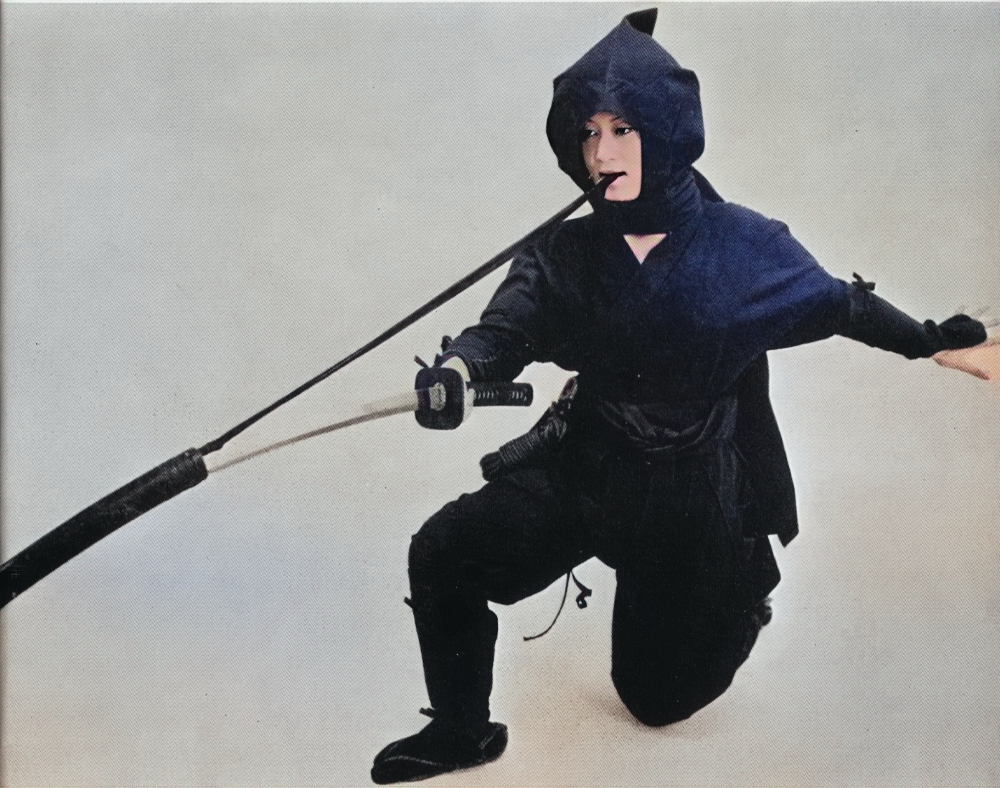
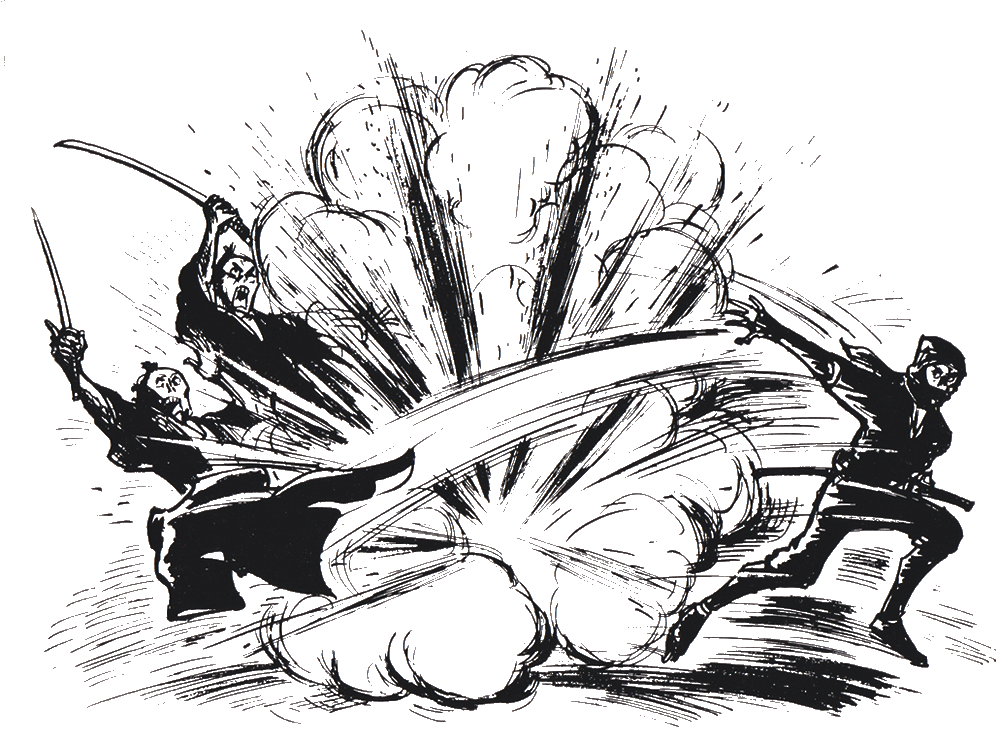
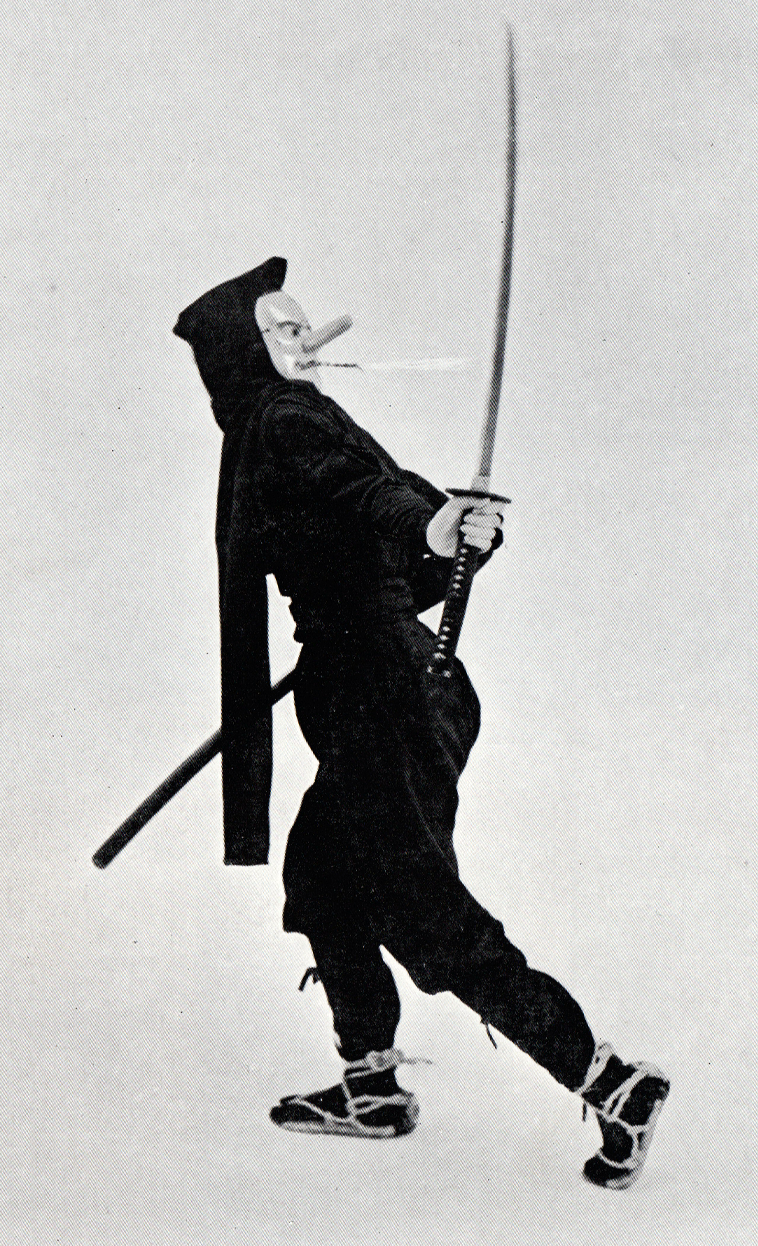
Experiments in dim light show most people fail to notice this ruse, supporting my hypothesis. Backward running is used when pursued and at risk of being cut down from behind. The ninja turns to face the approaching enemy, holding the sword in a seigan (eye-level) stance or spewing fire and smoke from the mouth, then flees backward at high speed while maintaining this posture (see frontispiece illustration).
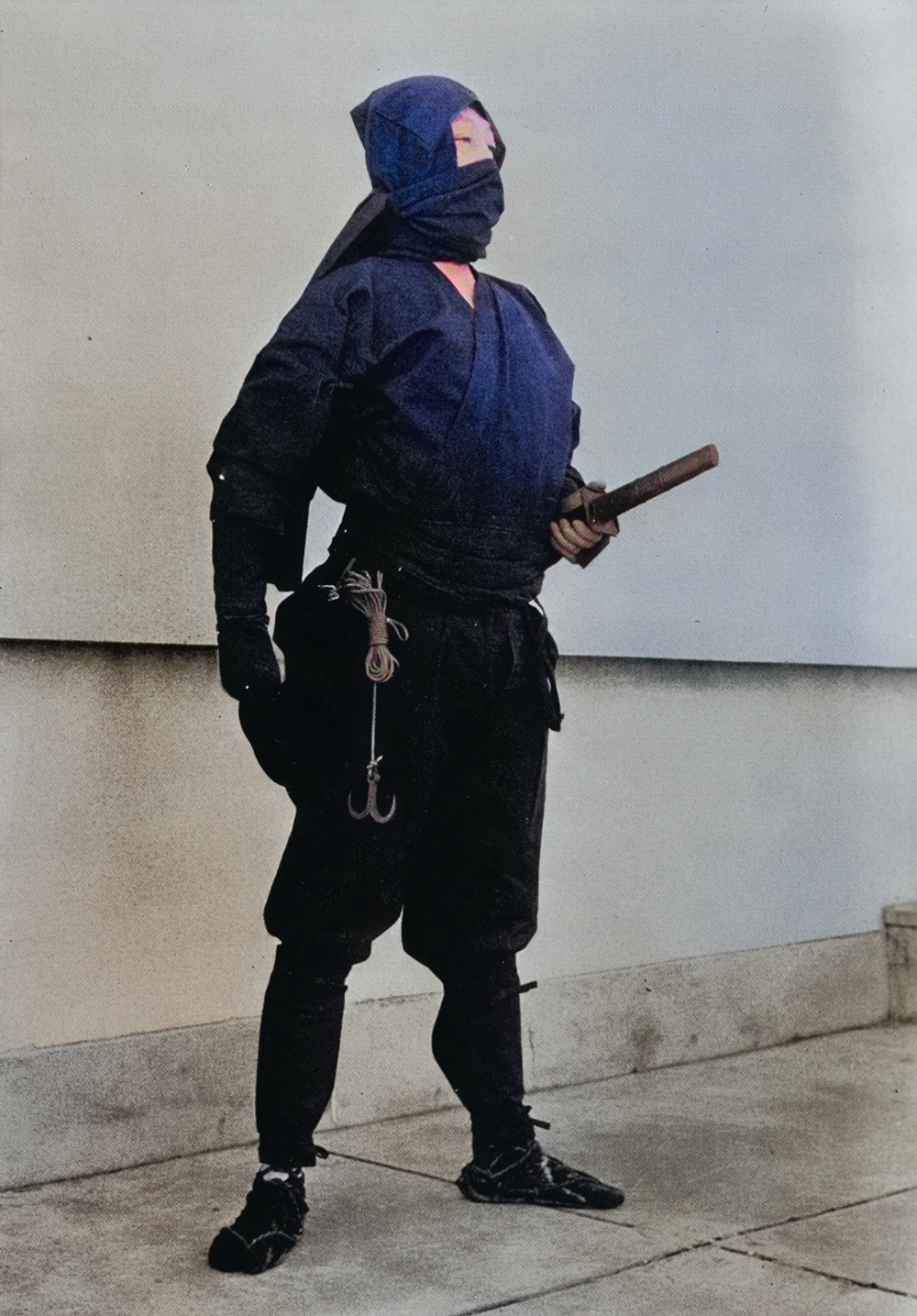
During infiltration, ninja carry a demon or tengu mask preloaded with fireworks in their chest. When pursued closely, they ignite the firework’s fuse, place the mask on the back of their head, and, while holding the sword backward, run forward. To the enemy, it appears the ninja is retreating backward while facing them with a sword. As noted in the attire section, sandals must have heel-stop fittings.

暗闇を疾走する法 Kurayami o Shissō suru Hō (The Method of Running Swiftly Through Darkness)

The infamous “Sermon Bandit” from Taisho-era crime history, who broke into homes, assaulted women, stole valuables, and stayed from midnight to dawn, offers a relevant example. He preached to households, advising them to brighten the outside and darken the inside for safety or to keep dogs, biding time until just before the first train, then fleeing at high speed through the dark, breaking through police cordons before they tightened, escaping beyond their reach. His knack for sprinting through darkness kept him elusive. This ninja-like figure, Tsumaki Matsukichi, claimed to be from the mountains.

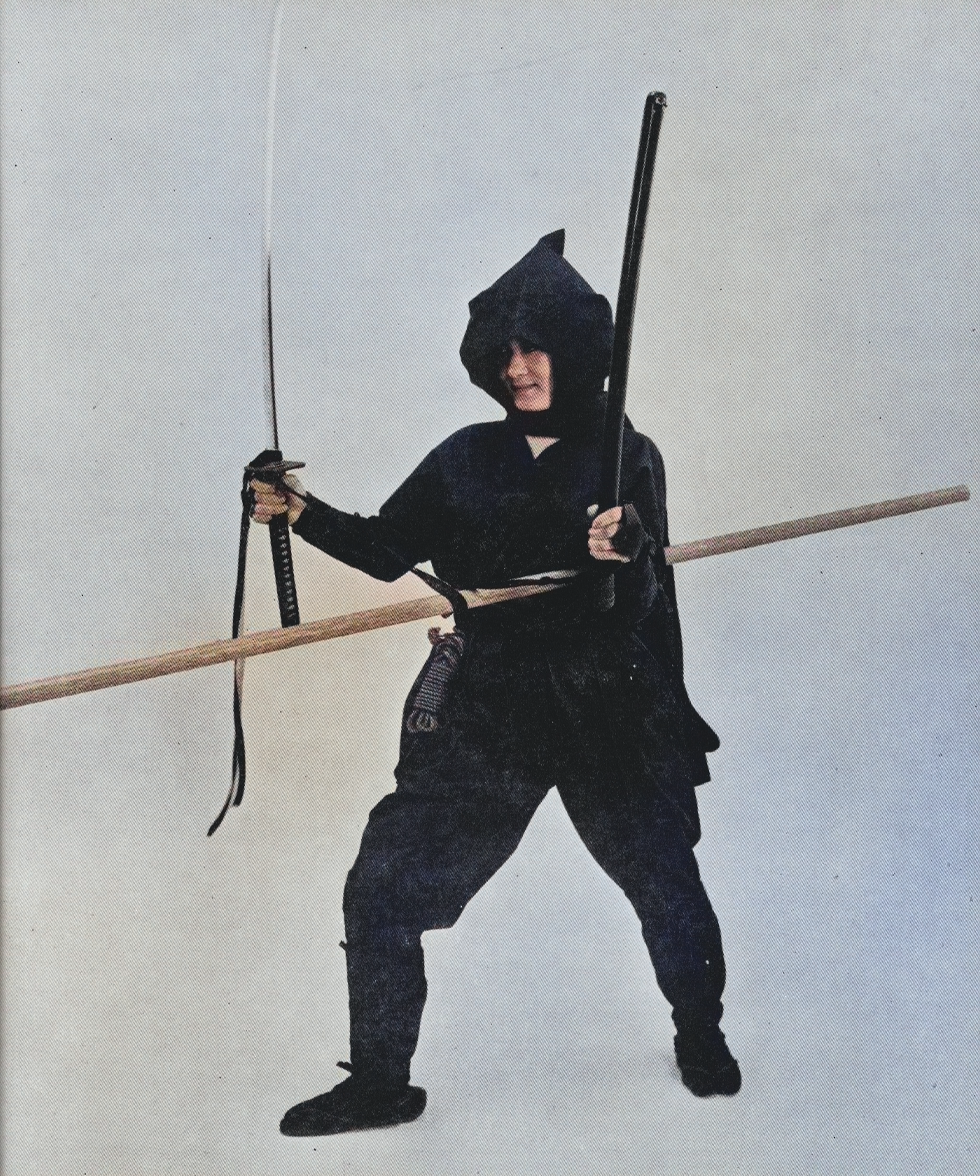
When captured and asked how he ran through darkness, Tsumaki Matsukichi’s response mirrored ninja techniques, prompting me to ponder the connection between mountain life and ninjutsu. He explained: Holding a bamboo sword or long bamboo staff straight ahead horizontally, he lowered his face (since the dark obscured vision) and ran. When hitting a wall or obstacle, he bent his arm to absorb the impact, changed direction, and continued running in the same posture. The bamboo acted as an antenna.

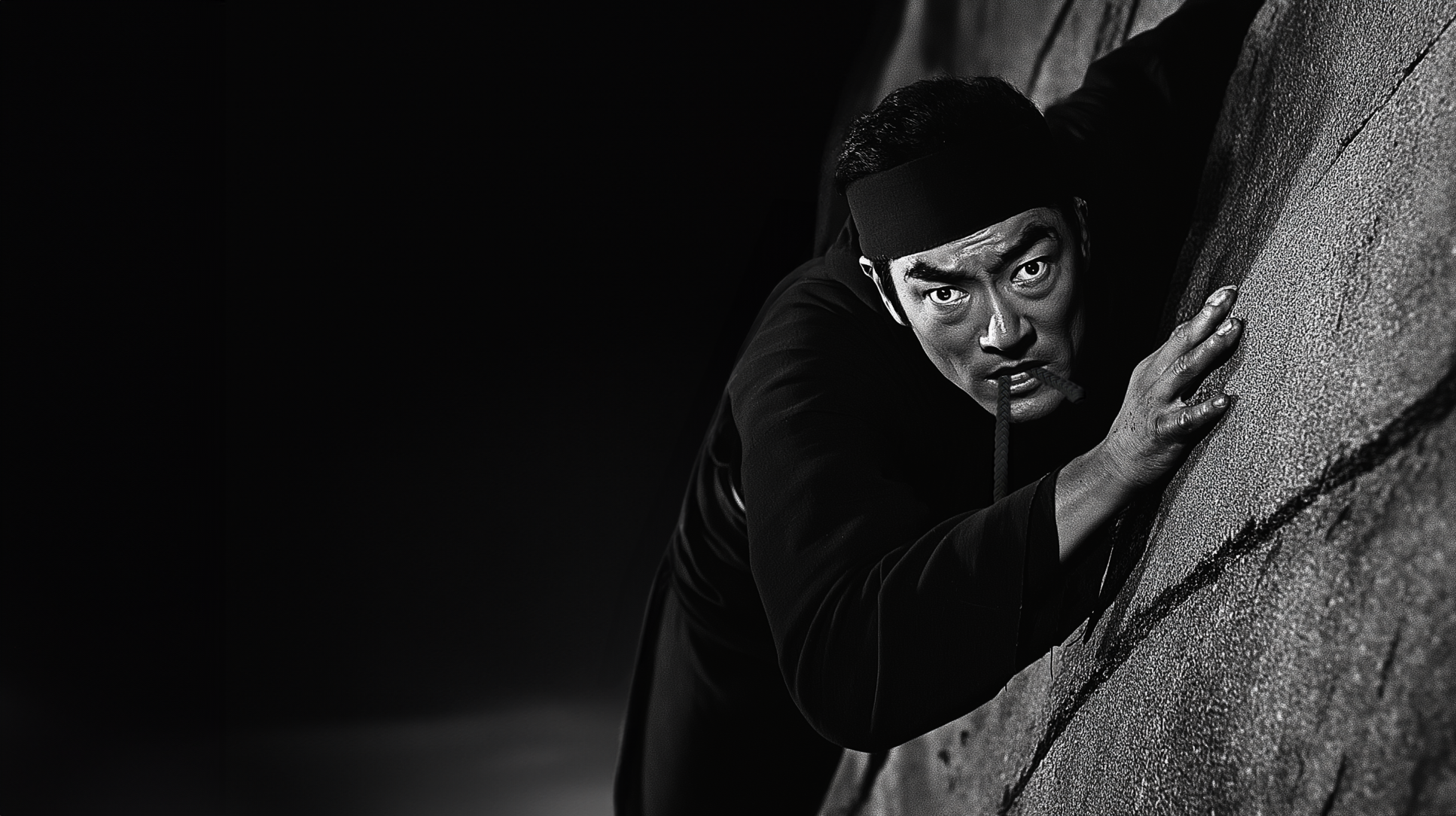
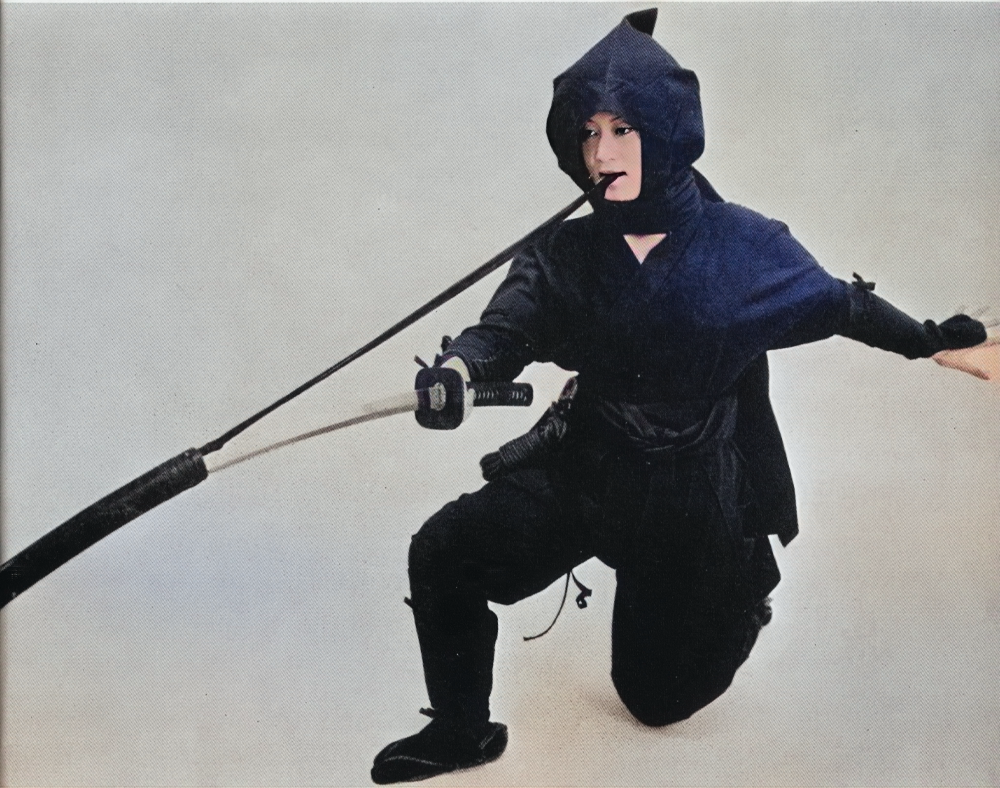
Ninja used the same principle to sprint through dark paths, but instead of a bamboo sword or staff, they employed the Zasaguri no Jutsu (probing technique) from the seven sageo arts. Holding the sword and scabbard horizontally forward, with the sageo’s end in their mouth to suspend the sword, they lowered their face and ran. When the scabbard’s tip hit an obstacle, it snapped back onto the blade, cushioning the impact as the scabbard slid. Ninja swords had sturdy iron kojiri (end caps), a reinforcing band, a ring-shaped kurigata (cord loop), and a robust koguchi (scabbard mouth) fitting, making scabbard damage highly unlikely.


This above about Ninja Running techniques was just one section translated from Japanese to English from the book…

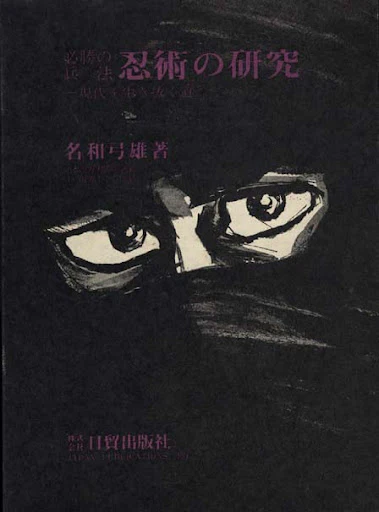
忍術の研究 Ninjutsu no Kenkyū by 名和弓推 Yumio Nawa

First published on November 1, 1972. It contains approximately 85,000 words across 377 pages, including around 50 pages of illustrations and index. The work explores historical ninjutsu, martial strategies, and their relevance to contemporary life.

About the Author
Yumio Nawa (real name: Sadatoshi Nawa) was born in 1912 (Meiji 45) into a samurai family of the Ogaki-Toda domain. He was the Sōke (headmaster) of Masaki-ryū Manrikigusari-jutsu and Edo Machikata Jitte-jutsu. His other works include A History of Torture and Punishment, Studies of Jitte and Hojō, and Weapons of the Shinobi, among others. He served as an executive director of the Society for the Research and Preservation of Japanese Armor and Arms, and a standing director of the Japan Writers Club. At the time of publication, he resided in Asagaya-Minami, Suginami Ward, Tokyo.
The post History of Ninjutsu: Ninja Running Techniques appeared first on 武神館兜龍 Bujinkan Toryu.…
History of Ninjutsu: Ninja Jumping Techniques

From 武神館兜龍 Bujinkan Toryu by Toryu

History of Ninjutsu: Ninja Jumping Techniques

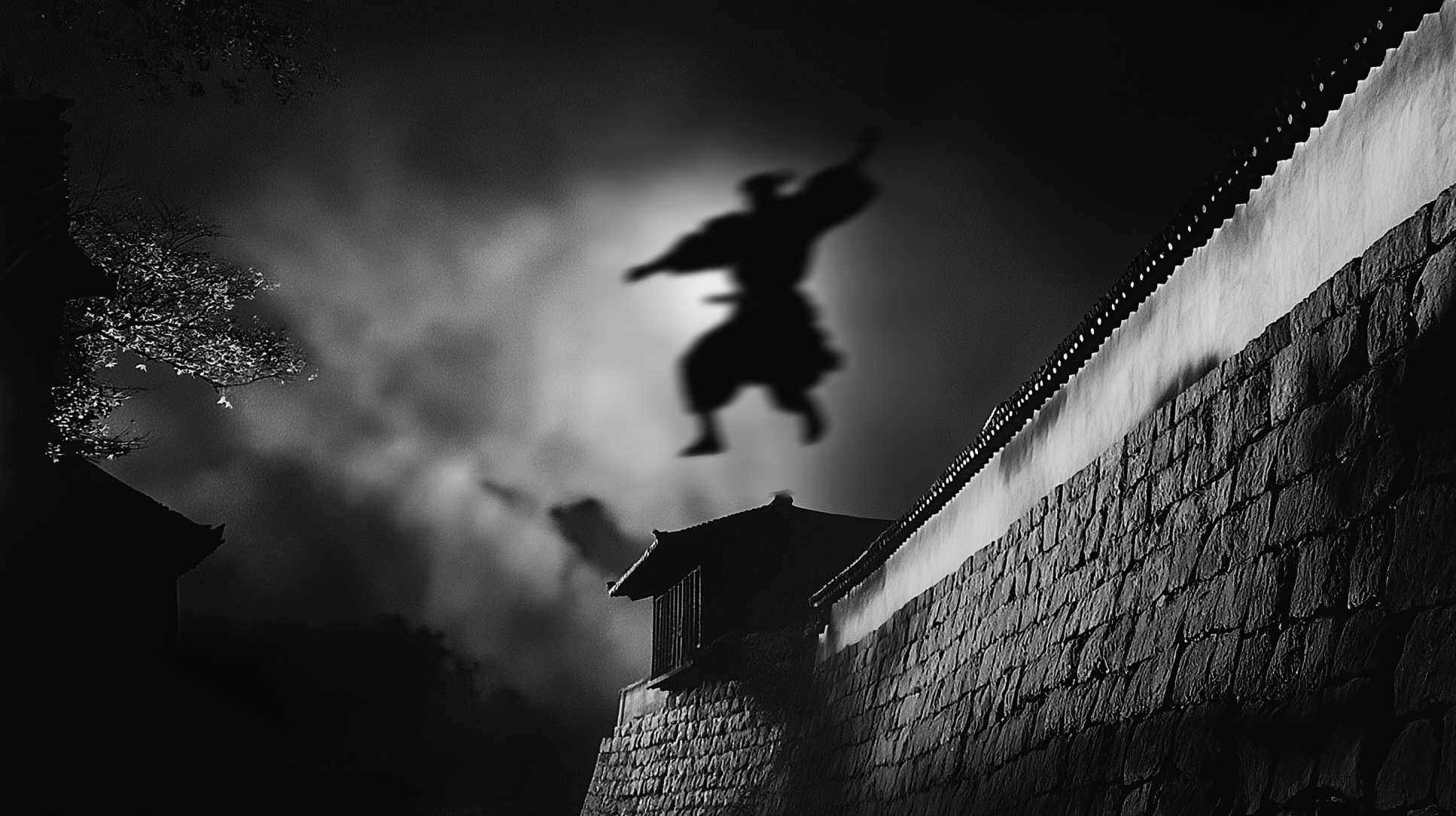
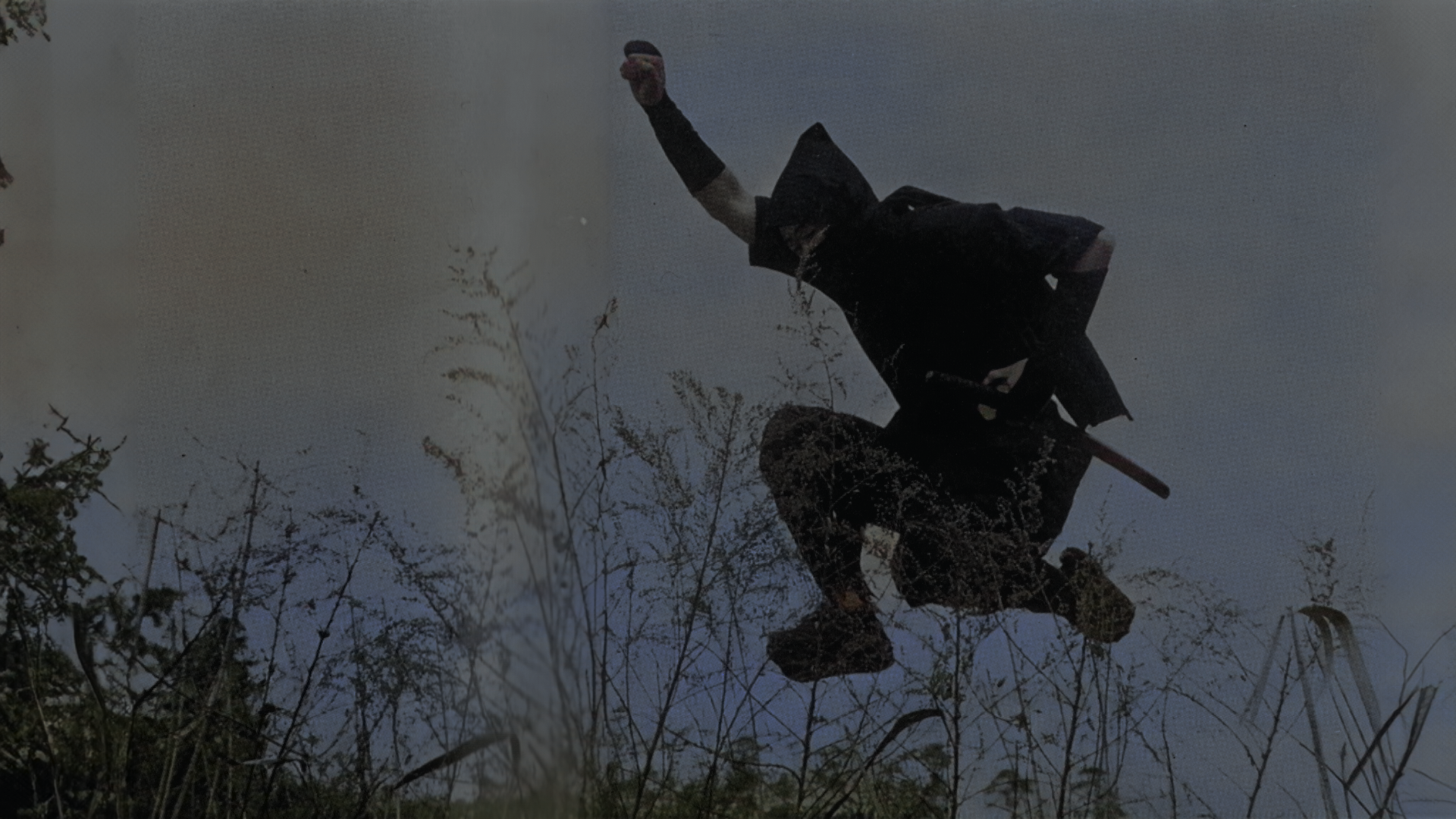
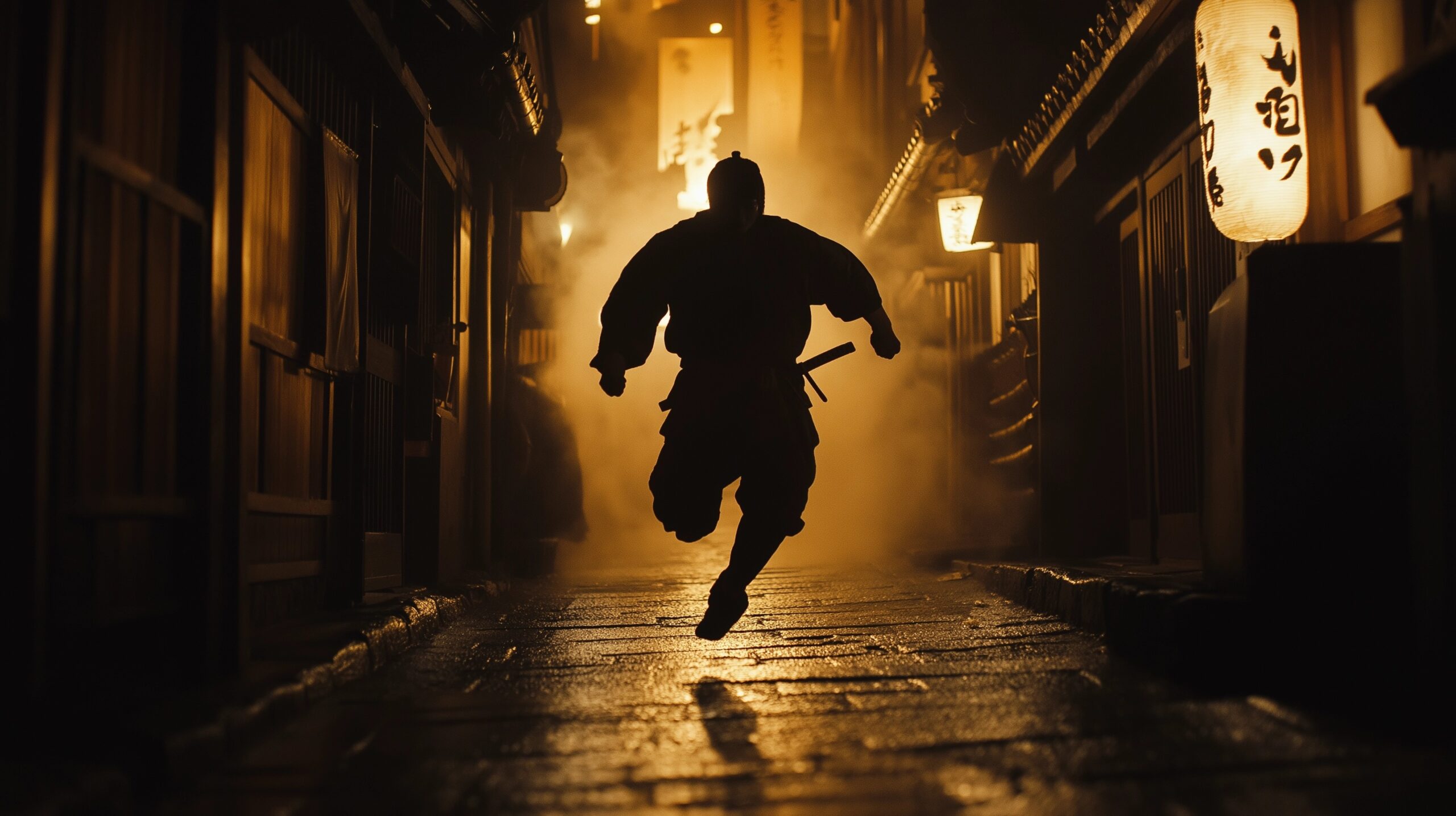
Ninja Jumping often need to escape by leaping over obstacles or walls, grabbing onto house eaves, or dodging sideways in the blink of an eye to hide from enemies. They may also have to jump across rivers too wide for pursuers or leap from low to high places to evade capture. When infiltrating enemy castles or houses, the ability to fly like a bird would render defenses and ambushes nearly irrelevant.

Ninja techniques include the Six Jumping Methods, encompassing six types of jumps:

  1. Forward Jump (Mae-tobi)
  2. Backward Jump (Ushiro-tobi)
  3. High Jump (Taka-tobi)
  4. Long Jump (Haba-tobi)
  5. Side Jump (Yoko-tobi)
  6. Diagonal Jump (Naname-tobi)

The standards are a high jump of 9 shaku (2.7 m), a long jump of 18 shaku (5.4 m), and a downward jump of 50 shaku (15 m). These figures likely represent ideal targets for ninja training. Beyond these, jumps were performed in pairs or trios or with tools.

忍びの跳躍訓練 Shinobi no Chōyaku Kunren (Ninja Jump Training)

To leap effectively, one must be light. Ninja regularly used slimming medicines made from wild coix seeds, ate tofu as a staple to maintain nutrition without gaining fat, and underwent rigorous, balanced daily training. This reduced excess fat, tightened muscles, and developed a flexible, resilient, steel-like physique.

During intense physical training, ninja reportedly wore deer leather undergarments. Sweating from vigorous movement wetted the leather, causing it to cling and constrict the body. Enduring this discomfort during training gradually slimmed the body and reduced sweating, as body odor could betray a ninja’s presence.

Jump training involved sowing hemp seeds in a plot of land and waiting for germination. Hemp grows rapidly, stretching taller daily. Ninja practiced jumping over it—forward, backward, sideways, and diagonally. Initially easy, the task grew harder as the hemp grew. Such training for about three years was necessary to become a competent ninja.

二人組人馬興業停止令 Futarigumi Jinba Kōgyō Teishi Rei (Two-Person Horseback Technique)

The term “ninba” (human horse) refers to a mid-Edo period spectacle, akin to modern circus acts, but I believe it originated as a ninja technique for leaping over high walls. Historical records claim it was devised in the Genroku era (1688–1704) for performances, but I suspect it’s older.

In Kyoto, a performer named Numa from Kinbuya Tabee, during the Genroku era, went to Edo, joined the equestrian Sasaki Heima’s school, and allegedly created the ninba technique inspired by equestrian skills. However, equestrianism and ninba share no technical similarities.

The Rakushu Genbun Taiheiki, Volume 4, mentions Sasaki Heima’s fame and ninba’s ability to astonish audiences. On July 24, Genbun 5 (1740), ninba performances were banned again. Though presented as derived from equestrianism, I believe destitute ninja, no longer receiving stipends, used their trained ninba skills in performances. Records show ninba was banned three times.

The Seihōroku, in an entry for April, Hōei 4 (1707), notes: “Recently, various acrobatics called ninba have gathered crowds, leading to imitators and potential misconduct, so ninba and other acrobatic performances are henceforth prohibited.” Another ban was issued in Genbun 5 (1740), and on May 11, Kanpō 2 (1742), the Asakusa-ji Diary records the dismantling of an acrobatics booth at Asakusa Temple due to concerns that “undesirable people learning and using it could lead to trouble.” The bans were issued because ninba could be misused by thieves if publicly displayed.

Was ninba such a shocking technique to warrant such scrutiny?

二人組人馬の技法 Futarigumi Jinba no Gihō (Two-Person Ninba Technique)

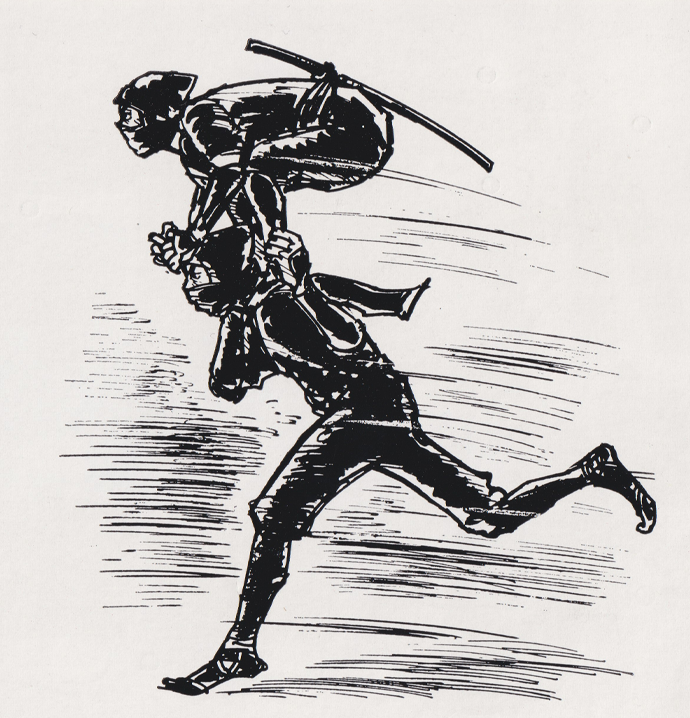
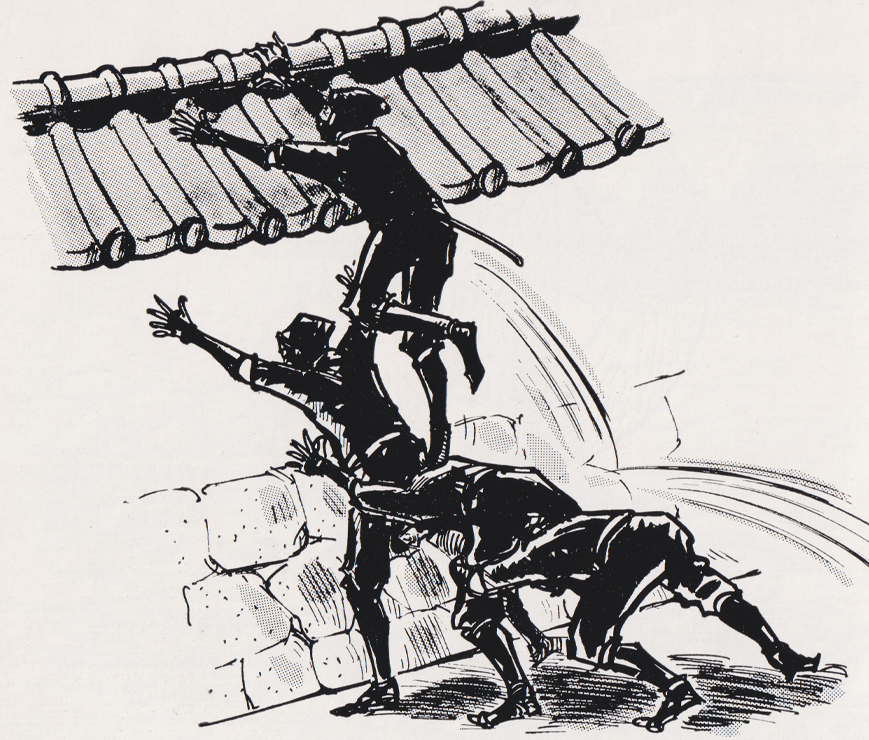
Jumping over a 10-meter-high wall or obstacle without tools is difficult, but with the two-person ninba technique, ninja could soar like birds (see frontispiece illustration).

One person stands with another on their shoulders, facing a high wall. For stability, the upper person places their feet on the lower’s shoulders, firmly grips the lower’s head, and crouches to avoid falling, timing the takeoff. The lower person holds the upper’s legs for stability. Both synchronize their breathing, sprint toward the wall or obstacle at tremendous speed, and at the optimal distance, the upper person kicks off the shoulders to leap, while the lower throws the upper’s legs upward. With the momentum of the sprint and elastic body movement, the black shadow arcs through the air like a projectile, clearing the obstacle.

For house infiltration, once one ninja lands inside, they throw a climbing rope outside, easily pulling the other over the wall (see illustration).

三人組人馬の技法 Sanningumi Jinba no Gihō (Three-Person Ninba Technique)

For obstacles over 10 meters that a two-person ninba cannot clear, a three-person technique is used. One person sits on a stone 4–5 meters from the obstacle, facing away, knees aligned horizontally. A second person stands naturally on the seated person’s back. The jumper starts a sprint from as far as 10 meters away, steps onto the seated person’s knees as a launch platform, and leaps upward. Just before, the seated person supports the jumper’s soles or thighs, and the standing person grips the jumper’s torso, all synchronizing to hurl the jumper high over the obstacle (see frontispiece illustration).

These flight techniques are most dangerous during landing, and until mastered, they reportedly cause frequent fractures, sprains, and bruises. I once saw the Soviet Russian Ballet perform a Cossack dance where dancers leaped high from the stage’s back, soaring over others to land at the front, using a method nearly identical to the three-person ninba. This technique likely originated in mainland China, spread north to the Cossacks, and eastward to Japan with ninjutsu. The claim it was devised from equestrianism in the Genroku era is likely a ninja cover story or jest.

Hop, Step, Jump

With a four-person team, jumping onto a 3–4-meter wall is simpler. One person leans against the wall, hands on it, head lowered, standing naturally. A second person firmly grasps the first’s waist, braces their feet, tilts their head right or left, and flattens their back. A third person hugs the second’s legs, crouches low, and flattens their back. The jumper sprints, using a triple-jump approach, stepping on the first, second, and third person’s backs, then leaping from the third to grab the wall’s edge (see frontispiece illustration).

Tool-Assisted Methods

Using a sturdy long board and a stone, create a seesaw. The jumper stands on one end, and another person jumps from their shoulders onto the raised end, launching the jumper over the wall. Pole vaulting with a spear or pole, or swinging across with a climbing rope like a pendulum, were also used.


This above about Ninja Jumping techniques was just one section translated from Japanese to English from the book…

忍術の研究 Ninjutsu no Kenkyū by 名和弓推 Yumio Nawa

First published on November 1, 1972. It contains approximately 85,000 words across 377 pages, including around 50 pages of illustrations and index. The work explores historical ninjutsu, martial strategies, and their relevance to contemporary life.

About the Author
Yumio Nawa (real name: Sadatoshi Nawa) was born in 1912 (Meiji 45) into a samurai family of the Ogaki-Toda domain. He was the Sōke (headmaster) of Masaki-ryū Manrikigusari-jutsu and Edo Machikata Jitte-jutsu. His other works include A History of Torture and Punishment, Studies of Jitte and Hojō, and Weapons of the Shinobi, among others. He served as an executive director of the Society for the Research and Preservation of Japanese Armor and Arms, and a standing director of the Japan Writers Club. At the time of publication, he resided in Asagaya-Minami, Suginami Ward, Tokyo.

The post History of Ninjutsu: Ninja Jumping Techniques appeared first on 武神館兜龍 Bujinkan Toryu.…
History of Ninjutsu: Evolution of Ninja Terms

From 武神館兜龍 Bujinkan Toryu by Toryu

History of Ninjutsu: Evolution of Ninja Terms

Ninjutsu history begins with terms like 忍者 Ninja and 忍法 Ninpō, the most commonly accepted in modern times, which are newly coined words from the 昭和 Shōwa era (1926–1989). The term 忍術使い Ninjutsu Tsukai (Ninjutsu user) is a newly coined word from the 明治 Meiji (1868–1912) and 大正 Taishō (1912–1926) eras. In the 江戸 Edo period (1603–1868), the representative terms were 忍び Shinobi or 忍びの者 Shinobi no Mono (Shinobi person), and the techniques were called 忍術 Ninjutsu.

Using the term お庭番 Oniwaban (garden guard) in the same way as Shinobi no Mono is a mistake. Oniwaban is a job title in the shogunate, but since Shinobi were assigned to this role, the shogunate’s covert agents were called Oniwaban. However, it is strange for television or movies to feature Shinobi as the Oniwaban of the 上杉家 Uesugi family or the 伊達家 Date family. The names for Shinobi varied across different domains and regions.

In general, even in China, the homeland, the names for Shinobi varied across different regions with various designations.

  • 遊子 Yūshi (In 大橋 Ōhashi, Shinobi are called Yūshi. Does this mean one who travels between enemy and ally, or one who takes the form of a playful figure?)
  • 行人 Kōjin (In 陰経 Inkyō, Shinobi are called Kōjin. Like Yūshi, it likely means a person who goes back and forth between enemy and ally.)
  • 遁形 Tongyō (In 五雑爼 Gozassho, they are called Tongyō. Shinobi are not combatants; their essence is to gather information and escape, meaning a person who masters the form of passing through.)
  • 間 Kan (In the state of 具 Chu, they were called Kan. The meaning of Kan is as previously described, and from this, Japan created the term 間者 Kanja [spy].)
  • 課 Saku (In the 春秋 Spring and Autumn period, they were exclusively called Saku. The literal meaning of Saku includes “to spy.” It refers to the role of spying on and probing the enemy’s situation.)
  • 遊偵 Yūtei, 細作 Saisaku, 姦細 Kansei, 好細 Kōsei (After the Warring States period, in China, Shinobi were called Yūtei, Saisaku, Kansei, Kōsei, etc. This likely means traveling between enemy and ally in a playful form to spy on the enemy’s situation, probing the enemy’s situation in detail and reporting to the general, who then uses this to devise detailed strategies. Additionally, calling Shinobi 森細 Seisai or 妊細 Ninsei likely means a job that appears ordinary on the surface but involves deep, cunning schemes behind the scenes.)

In ancient China, they were called as above, but after being introduced to Japan, from the Muromachi period (1336–1573) to the early Warring States period, they were called:

  • 草 Kusa (Grass)
  • かまり Kamari (Spy)
  • 水彼 Suppa (Water Other)
  • 乱破 Rappa (Chaos Breaker)
  • 突破 Toppa (Break Through)
  • 出抜 Denuki (Exit Pull)
  • うかみ処 Ukami Dokoro (Spy Place)

武田玄 Takeda Shingen called Shinobi the 三つの者 Mittsu no Mono (Three Types of People). He divided them into three roles, and collectively referred to them as the 三つの者 Mittsu no Mono (Three Types of People).

… and so on.

  1. —間見 Kanmi (observer),
  2. 見分 Mikewake (inspector), and
  3. 目付 Metsuke (overseer)

上杉謙倍 Uesugi Kenshin called Shinobi 猿 Nokizaru (roof monkeys).

織田長 Oda Nobunaga called Shinobi 製談 Kyōdan (conversers).

In the Tokugawa period, Shinobi themselves used the characters 獺盗 kawai nui (otter thief) to read as Shinobi, or, seemingly disliking the sound of the word Shinobi, they tried to avoid using the character 忍び Shinobi as much as possible. They used terms like:

  • 早道の者 Hayamichi no Mono (fast path person)
  • 早足組 Hayaashigumi (fast-footed group)
  • 忍び目付 Shinobi Metsuke (Shinobi overseer)
  • 物聞き Monokiki (listener)
  • 黒はばき Kurohabaki (black leg guards)
  • 小隼人組 Kohayato Gumi (津軽藩 Tsugaru Domain, a Shinobi group led by 中川小隼人 Nakagawa Kohayato, a 200-koku retainer)
  • 鳥組 Tori Gumi (Sendai Domain, a guerrilla unit led by Shinobi 細谷十大夫 Hosoya Jūdayū)

These names make it hard to think of them as groups of Shinobi. Even in modern times, people from Shinobi lineages strongly dislike announcing that their family has Shinobi blood.

If a Shinobi is known to be a Shinobi, they can no longer fulfill their role. In other words, they become useless, and simply being a Shinobi led to discriminatory treatment by ordinary samurai, being shunned, and even having marriage proposals rejected—a dark past they carry. Why this happened will be explained later, but the essence of a Shinobi is inherently such, a matter of fate, and nothing can be done about it.


This above was just one section translated from Japanese to English from the book…

忍術の研究 Ninjutsu no Kenkyū by 名和弓推 Yumio Nawa

First published on November 1, 1972. It contains approximately 85,000 words across 377 pages, including around 50 pages of illustrations and index. The work explores historical ninjutsu, martial strategies, and their relevance to contemporary life.

About the Author
Yumio Nawa (real name: Sadatoshi Nawa) was born in 1912 (Meiji 45) into a samurai family of the Ogaki-Toda domain. He was the Sōke (headmaster) of Masaki-ryū Manrikigusari-jutsu and Edo Machikata Jitte-jutsu. His other works include A History of Torture and Punishment, Studies of Jitte and Hojō, and Weapons of the Shinobi, among others. He served as an executive director of the Society for the Research and Preservation of Japanese Armor and Arms, and a standing director of the Japan Writers Club. At the time of publication, he resided in Asagaya-Minami, Suginami Ward, Tokyo.

The post History of Ninjutsu: Evolution of Ninja Terms appeared first on 武神館兜龍 Bujinkan Toryu.…
Masaaki Hatsumi: Dojo Art (Kickstarter Project)

From 8þ Kabutoshimen by admin

Masaaki Hatsumi: Dojo Art will be a professionally designed book of paintings and calligraphy by Bujinkan Soke, Masaaki Hatsumi.

This is a book in the planning by Steve Olsen, he is looking for people backing his book on Kickstarter. If he gets enough backers he will make the book, if not it won’t be a book. It is up to you if there will be one.

BACKGROUND

During break in his martial arts classes at the Bujinkan Hombu Dojo in Noda City, Japan, Hatsumi-Sensei paints for his students. He paints calligraphy and pictures. His art contains advice to his students and historical influence from the nine Japanese martial traditions he is the head instructor of

BOOK DESIGN

7504d495979ea290e9e6588215adb469_largeOur designer, Dan Saal, is a real pro. He’s an award-winning art book designer and he knows how to design beautiful books that bring the essence of topics to life. Dan’s sample layouts already look great and I look forward to working with him to finish the project.

For an idea of the quality you can expect, take a look at some of Dan’s work here:
http://www.studiosaal.com
http://www.studiosaal.com/awards.html

Support the project here… http://www.kickstarter.com/projects/1780878098/masaaki-hatsumi-dojo-art

The post Masaaki Hatsumi: Dojo Art (Kickstarter Project) appeared first on 8þ Kabutoshimen.…

Shoninki books

From 8þ Kabutoshimen by admin

20121030-125323.jpg

I got a question today about these books, if they are important for Bujinkan practitioners.
http://www.coloradospringsninjutsu.com/Shoninki.html
http://www.shoninki.com/home/Welcome.html
For what it’s worth here is my answer.

Hello. I don’t think it is very important today, but probably very interesting in historical view. I know Don lived in Japan for many years and probably discussed the book with the Shihan when he run into problems in translation. I don’t know who the other person is, he might be better in Japanese, but if he haven’t been training he might have missed some things. Both books probably have errors, why not get both?
But I don’t believe it is that important, the knowledge is old. There is better modern books about survival skills, medicine, tools etc today.

Thanks for the links, I didn’t know Don also had a translation.

Happy training!

Mats

The post Shoninki books appeared first on 8þ Kabutoshimen.…

Hatsumi Soke’s new Budō no Gokui book

From 8þ Kabutoshimen by admin

The Essence of Budo: The Secret Teachings of the Grandmaster The new book Budō no Gokui by Hatsumi Soke is available for pre-order now for only $23.60, it will be shipped in the end of June.

Hardcover: 208 pages

Publisher: Kodansha International Ltd (May 1, 2011)

ISBN-10: 4770031076

ISBN-13: 978-4770031075

In a quick hirameki of what is to come in this book (without giving too much away) is the artistic look at the bigger picture of the mindset of Hatsumi Soke in his interpretation of the Pinnacle of Martial Arts. The message to Bujinkan practitioners will be standardly consistent as ever, if you are of the “Keep Going” tribe in the sense that the secret to martial arts can be found in…

- Doug Wilson (one of the translators of this book)

Budo transcends simple combat techniques to ultimately attain a world of peace. Budo includes an array of martial arts developed in Japan, among them Aikido, Judo, Karatedo, Kyudo, and Kendo. In this book, grandmaster Hatsumi explores the essence of Budo, and demonstrates a range of important techniques relating to this essence. The author also reveals secret techniques and the hidden principles of the martial arts, and elucidates the words of his master, Toshitsugu Takamatsu, on Budo and life. Including some three hundred beautiful pictures depicting the author demonstrating his techniques, and around one hundred pictures of rare works of calligraphy, illustrations, and hidden documents on the martial arts and their role in Japanese culture, this book will be relevant and insightful to practitioners of all martial traditions including Judo, Aikido, Karatedo, Kendo, Kenjutsu, Jujutsu, Iaijutsu, and other various fighting sports.

About the Author

Masaaki Hatsumi was born in 1931. After progressing through various martial arts, he found his life's mentor, Takamatsu Toshitsugu, and studied under him for the next fifteen years, becoming the 34th Grandmaster of Togakure-ryu Ninjutsu and eight other arts, which he unified into the Bujinkan system. While travelling the world, teaching thousands of individual students as well as law enforcement agencies, he received numerous accolades from politicians and spiritual leaders of many nationalities.

Click here for more of my recommended Bujinkan book!s

The post Hatsumi Soke’s new Budō no Gokui book appeared first on 8þ Kabutoshimen.…

TCJRNM Sanshin no Kata (warm-up drill video)

From Kabutoshimen by Toryu

I just uploaded a new video on YouTube, please check it out, give comments and ratings :-) .

This is from the forth coming Ten Chi Jin Ryaku no Maki DVD coming sometime this summer. I’m not sure if exactly this segment will be on the DVD (it is a little too long I think?), I will decide this later when I have all the material filmed and edited.

TCJRNM Sanshin no Kata (warm-up drill)
http://www.youtube.com/watch?v=_A63TvGQAYg

/Mats…

Bujinkan.ME News #39 (New Year, new DVD at Budo Shop)

From Kabutoshimen by Toryu

Akemashite Omedetou Gozaimasu!
(Happy new year!)

This year is Heisei 21 and 牛年 ushi-doshi, the year of the buffalo, cow or ox in the zodiac calendar and the element of earth. Buddha invited the animals to participate in a race. The prize was a coveted position on the Chinese Zodiac calendar. The first 12 animals to cross the river would appear on the Chinese Zodiac calendar in the order in which they completed the race …. the rat used his brain rather than his brawn. It hitched a ride on what it perceived was the mightiest swimmer. Just before the buffalo reached the shore, the rat jumped off the buffalo’s back and crossed the finish line before the buffalo, putting the rat in first place, and the buffalo the second place, followed by the tiger…

The cow is is also associated with the deity 虛空藏菩薩 Kōkūzō Bosatsu (Ākāśagarbha in Sanskrit). Kokuzo (also written Kokuuzou, Kokuuzoo) symbolizes the “vast and boundless” Buddha wisdom that permeates the universe. Believers pray to Kokuzo to grant them wisdom on their quest toward enlightenment. People also pray to Kokuzo to improve their memory, technical skills, and artistic talents, for Kokuzo is revered not only as the deity of wisdom, but as a protector of craftspeople and artisans.

About this years Bujinkan theme… I don’t know so much other than what has been stated on websites (here, here, here and here), apparently there is no particular theme for techniques concerned (the philosophy you can read on the links above). However I heard there will be more sword as this is a thing we in general need to practice more, sword is also my favourite weapon :-) .

I will be off to Japan tomorrow, and will probably make a few blog posts on my web site… http://kesshi.com about the trainings and stuff.

.

Web Site Updates

I’ve been working on a a new seminar list, completely new code. I’d like to call it Bujinkan Seminar List v2.0 beta, check it out (webmasters check the page source).
http://kesshi.com/seminars/bujinkan.php

I also set up two new rss feeds. I’d like to keep updated with everything new so I merged all kinds of blogs and forums I’d like to keep an eye on in one single feed. There is two different ones, first one is in English, the second one is in Swedish.
http://feedproxy.google.com/SuperfeedEN
http://feedproxy.google.com/SuperfeedSE

.

Hankyou 2008 – Christmas seminar DVD

Christmas seminar 2008
Instructors: Paul Waserbrot, Mats Hjelm, Steven Helling, Daniel Bodin, Fredrik Markgren, Arvid Karlsson, Jens Lindstrand, Richard Maier, William Ustav

Theme: Reflections of this years Bujinkan theme, Togakure-ryu ninpo taijutsu

Many instructors from Sweden went to Japan to train with Hatsumi Soke and the Shihan. Many of these instructors came to share their knowledge and feelings from their training trips.

Recorded in Stockholm, Sweden December 2008

Format: DVD/R- which plays on all computers using and ordinary DVDRom. It also plays on most DVD players (check your manual!).

100 Minutes playing time top quality, available in NTSC only.

Language: The instructions is in Swedish!

Click here if you want to buy it!

I will be away for training in Japan and back January 20′th when I will be able to ship all orders right away.

.

Upcoming seminars

International Bujinkan TAIKAI 2009

2009-01-16/2009-01-18 – Helsinki, Finland
Shihan Moti Nativ Seminar, with Shihan Moti Nativ
For more information (price & schedule) please contact [email protected] More info… http://shinden.fi

2009-01-24/2009-01-25 – Stockholm, Sweden
Seminar with Sheila Haddad, with Sheila Haddad & Thomas Franzén
Bujinkan To Nan Dojo invites you to a Sheila Haddad Seminar 2009! Sheila returns once again to give one of her popular seminars with focus on women in Budo. Men are of cource welcome to train as well. Most welcome. More info… http://www.budogruppen.nu/

2009-02-07/2009-02-08 – Stockholm, Sweden
Keiko seminar intro to this years theme, with Mats Hjelm
Introduction to this years theme. Mats is planning his annual January trip this year also. More info… http://www.kaigozan.se/seminars/

2009-03-14/2009-03-15 – Stockholm, Sweden
Keiko seminar with Holger Kunzmann, with Holger Kunzmann, Shihan
Shihan Holger Kunzmann from Germany will be in Japan during February, after this trip he will come here to share what was being taught there. More info… http://kaigozan.se/seminars/

2009-03-20/2009-03-22 – Helsinki, Finland
Shihan Arnaud Couserque seminar, with Shihan Arnaud Couserque
For more information (price & schedule) please contact [email protected] More info… http://shinden.fi

2009-04-18/2009-04-19 – Stockholm, Sweden
Seminar with Pedro Fleitas, with Pedro Fleitas
Bujinkan To Nan Dojo invite you all to a great happening. Pedro Fleitas will be giving a seminar in Stockholm, Sweden. Mostly welcome. More info… http://www.budogruppen.nu/

2009-04-18/2009-04-19 – Szeged, Hungary
Bujinkan Budo Taijutsu (Chuden kata), with Mats Hjelm
Chuden kata techniques from the schools of Bujinkan. For more info see the web site More info… http://szeged.bujinkan.hu/

2009-05-01/2009-05-03 – Stockholm, Sweden
International Bujinkan TAIKAI 2009 (Kaigousuru), with Many instructors from the whole world
To date the following instructors is coming… Duncan Stewart, Shihan (Japan). Juan Manuel Serrano, Shihan (Spain). Lauri Jokinen, Shihan (Finland). Mariette vd Vliet, Shihan (Holland). Mats Hjelm, Shihan (Sweden). Morten B. Østenstad, Shihan (Norway). See the web site for latest info! More info… http://www.taikai.se