Skip to content

Chikara o Nuku

From TENRYU by jorgevaccaro

CHIKARA O NUKU

力を抜く

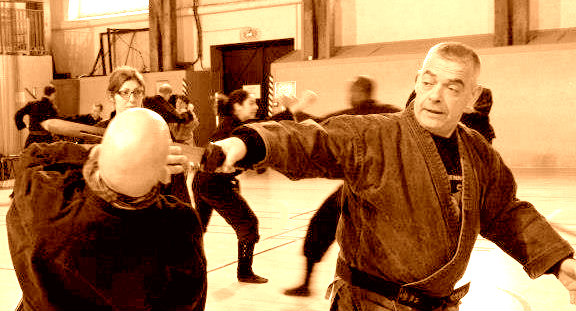
During the classes on friday and sunday  (23/25 -11- 2012) Sôke was pointing out the aspect of working with the fingers, reminding us that this part was one of the themes of 2012, In every moment highlighted that techniques must be done without strength. In a form of joking, reminded us that 15 dan are getting old and we’re going to loose physical strength, but that wasn’t his intention to tell us, but that it came by divine inspiration.

Sôke has been taken different Uke ans showing us that force is really unnessesary. Relaxing the muscles (Chikara o Nuku 力を抜く) and executing the techniques withouth forcem is made by a contraction and then relaxation. This is known as Chikara o Ireru & Chikara o nuku 力を入れる, 力を抜く. Chikara o Ireru is contracting, using the muscular force.

Moving the muscle requires strength and intention, and in the case of martial arts tecniques, this  can be perceived by the adversary. Managing to relax and not showing intention, is something vital in the path of the martial artist.

The idea of being able to use a sword without force (Katana o Nuku 刀を抜く) since yesteryear was one of the targets that masters wanted to achieve. Kokoro o Nuku 心を抜く, not forcing the mind nor the heart, is a key point to the Mushin 無心. Leaving the mind without intention, without the intelect and racionalization ruling us, can allow receiving the Shinden 心伝 from the master.

The techniques without force, mind without effort, was the escense to achieve the Shinden, highlighted Soke in one of his clases. Showing techniques without strength, Sôke achieves the misterious power of colapsing bodies and minds of his attackers. Without intention, adapting to each person in their different attacksm controls without expectation, even leaving the sword unsheathe and cut without harshness. This is a clear example of Katana o Nuku.

The connection (Tsunageru 繋げる) was highlighted on this past classes, not just from Tori and Uke, but also in “everything”, Soke said “everything is connected”.

Confusedly, we’ve tried to understand the wise words of Sôke, among them that the techniques must not depend from time and velocity. This two aspects don’t pertain to tecniques. Yukkuri…taking your time, going slowly. Sôke always highlights it, “Yukkuri” and gives us examples like music and spaces within each note.

In the interpretation of some of the things that Sôke was saying, I feel that time could be an illusion.  That is, past time (Kako 過去), the future ( Mirai 未来), coexist in the very instant of present ( Genzai 現在) of technique. Budo has no time, but happens in several dimensions at the same time.

Nuite Kudasai !! relax please….. let us enjoy life and Budo a little more.

Christian Petroccello


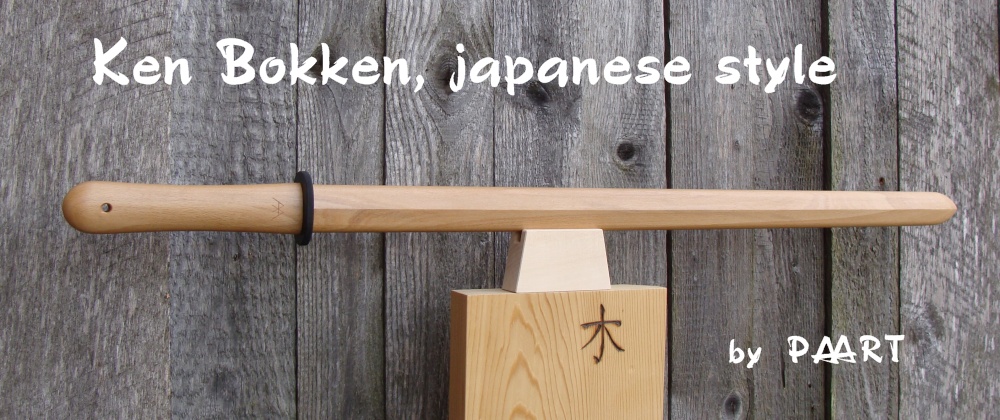
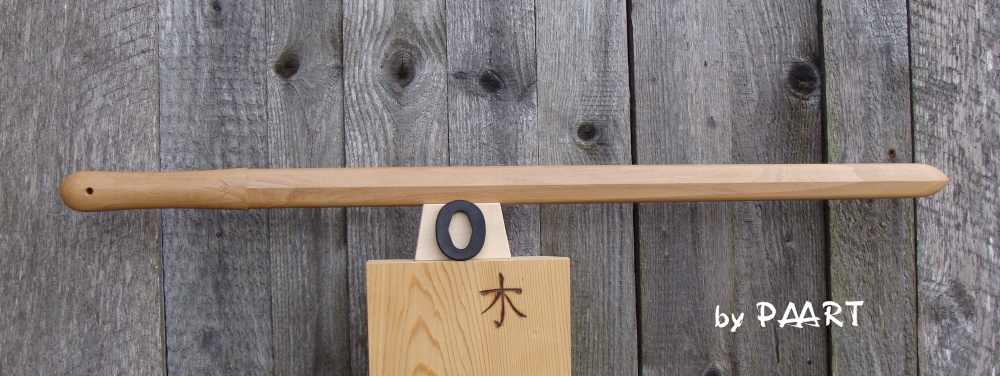
Sandard PAART Naginata

From Paart Budo Buki by buki stolar

Dear  Buju's,

after long time I menage to make some pics of Naginata which I make for years with some modifications,

so what you could see below this is last version from last year, this year I will make one more modifications to complete this Standard PAART  Naginata with Koshirae look.

Koshirae look means that this practice Naginata have all important details like is on real Naginata (ishizuki, kabura maki, tsuba)

Colour of wrap you could chose, and colour of kabura maki, gold and red is common colours of kaburamaki  (dark blue is available too) 


if you need more info about this Naginata contact me by e-mail


Mangetsu 満月

From TENRYU by jorgevaccaro


Imagen

3 Years agoSôke Hatsumi Masaaki sent me a beautiful painting that says: “Mature Fruit, Full Moon”

From time to time, I read the letters again and I behold Soke’s paintings. My feeling is that time shows in out path, if the maturation is at it’s right moment to taste the present at it’s maximum. Just like the moon comes only in a day at it’s full figure, likewise the fruit gets eaten when it has the right time of maturation. You can eat lots of fruits, but only when one it’s on it’s right time of maturity, is when the most tastefull it is. You can look at the moon all the month, but the day that it is full is when it’s beauty is at it’s maximum flow.

Running  after the effort ot others, o trying to live the experiences of others, is a futile race. Many want to fly and yet have not learned to walk. Running after the foreign effort might keep them away from the own escense. Playing with the children of others does not make you a father unless you gave birth your own children, nor wanting the students of other teachers make you a good master.

Looking always the light of the moon, may not let you see where you’re standing. Having gluttony for the fruits, might no let you appreciate the light of the moon. The moon and the fruit are connected as Budo and Life.

Sôke once shared a precious teaching during the Alicante Taikai: “Forget the meaning of why you practice, don’t think about it. Though the martial arts have a sole purpose and is at the end of the life to find truth, finding God. Only at the end of life, in the last instant, will happen everything you’ve done, what you’ve lived”.


Bufu Ikkan

Christian P.


詒変の棒 Ihen No Bo: My Bo Stands Against the Wind

From Bujinkan Santa Monica by Michael

Raising a Pole, Japan 1914-18. photo By A.Davey
During the 2012 Daikomyosai, Hatsumi Sensei showed us some very mysterious forms of bojutsu. He was showing things most of us had never seen before. After watching one that was very surprising to the whole crowd,  Nagato Sensei turned to some of us and said, "Sensei has been reviewing his training notes from Takamatsu Sensei and he is remembering new things that he studied."

This statement can be interpreted in different ways. But my own feeling about what I witnessed Soke do with the bojutsu he learned from Takamatsu Sensei, is that it is connected to 詒変の棒 Ihen no bo. So I resolved to study this when I returned home.

How to study ihen no bo? If you have a basic grasp of bojutsu, then adding ihen requires tossing aside what you think you know. This is a scary starting place, because you must abandon what you thought were kihon. Why does ihen require this?

詒変の棒 ihen no bo can be defined as the deceptive or changing bo. Hatsumi Sensei says the "詒 i" in ihen can be read as 詒 azamuku or 欺く, which is deception. But you cannot deceive with just your own intention.

The deception comes from 虚実 kyojitsu, truth and falsehood, two sides of the same reality in the opponent's mind. In one of my recent classes, when we made a Bujinkan ► video of me demonstrating this, I explained this type of striking. It is an echo of the opponent's mind. If he believes you are striking him, you do not. The strike becomes false. If he doesn't believe you will strike, then it becomes real or true, and you strike.

With ihen the "hen" is the same as 変化 henka. It is the bo constantly transforming every moment in the kukan. This is reflecting life. Every moment is unique and the life of the bo changes with it.

Right now, one of my rokushakubo is leaning against a window shade to keep the wind from blowing through. It is not being used to beat up a swordsman. This is a natural henka for the bo.

詒変の棒 Ihen No Bo: My Bo Stands Against the Wind

From Bujinkan Santa Monica by Michael

Raising a Pole, Japan 1914-18. photo By A.Davey
During the 2012 Daikomyosai, Hatsumi Sensei showed us some very mysterious forms of bojutsu. He was showing things most of us had never seen before. After watching one that was very surprising to the whole crowd,  Nagato Sensei turned to some of us and said, "Sensei has been reviewing his training notes from Takamatsu Sensei and he is remembering new things that he studied."

This statement can be interpreted in different ways. But my own feeling about what I witnessed Soke do with the bojutsu he learned from Takamatsu Sensei, is that it is connected to 詒変の棒 Ihen no bo. So I resolved to study this when I returned home.

How to study ihen no bo? If you have a basic grasp of bojutsu, then adding ihen requires tossing aside what you think you know. This is a scary starting place, because you must abandon what you thought were kihon. Why does ihen require this?

詒変の棒 ihen no bo can be defined as the deceptive or changing bo. Hatsumi Sensei says the "詒 i" in ihen can be read as 詒 azamuku or 欺く, which is deception. But you cannot deceive with just your own intention.

The deception comes from 虚実 kyojitsu, truth and falsehood, two sides of the same reality in the opponent's mind. In one of my recent classes, when we made a Bujinkan ► video of me demonstrating this, I explained this type of striking. It is an echo of the opponent's mind. If he believes you are striking him, you do not. The strike becomes false. If he doesn't believe you will strike, then it becomes real or true, and you strike.

With ihen the "hen" is the same as 変化 henka. It is the bo constantly transforming every moment in the kukan. This is reflecting life. Every moment is unique and the life of the bo changes with it.

Right now, one of my rokushakubo is leaning against a window shade to keep the wind from blowing through. It is not being used to beat up a swordsman. This is a natural henka for the bo.

New Shinobi Tanto

From Paart Budo Buki by buki stolar

first model of this kind of shinobi tanto was made 2000 for Taikai in Holland, since then there have been several modifications, and this is the last one, enjoy,

more photo soo, more info soon


two versions

New Shinobi Tanto

From Paart Budo Buki by buki stolar

first model of this kind of shinobi tanto was made 2000 for Taikai in Holland, since then there have been several modifications, and this is the last one, enjoy,

more photo soo, more info soon


two versions

Introducing Rojodojo and 五法 Goho Video Preview

From Bujinkan Santa Monica by Michael

I'd like to begin this post by thanking all of you for your presence and support over the past few years. This blog started because I have a deep abiding passion for the Bujinkan, which has been an integral part of my life's journey for well over half my life, and will remain so for the duration. And every one of you has been a part of that.

I care so much about the Bujinkan because it's a dynamic, living art. One which spoke to me as a skinny, awkward boy, and one which has evolved with me and for me as I've transformed physically and spiritually to embrace all aspects of this wonderfully rich lifestyle. It has given me grace as well as strength, balance and wisdom.

I don't practice Bujinkan; I'm immersed in it fully. It's not a study, it is, simply put, a transformational relationship...one of the most enriching and enduring relationships I have.

I teach Bujinkan as an extension of this relationship. I blog for the same reason. And I am so honored and proud to announce the launch of my new website which takes this union to the next level. It is intended to realize the vision I have for my Bujinkan life, and hopefully for yours, too.

At Rojodojo.com, I will continue to blog, publish my heartfelt training notes after every class, and explore the culture of our art through as many mediums as possible. I'll bring my love for the arts, film making, philosophy, and travel to the table. And I will produce training videos from my unique perspective. I will also travel, providing seminars and documenting these experiences for you to share.

This is my way of expanding and enriching what I give back to the community I'm so proud to be a part of. As with my classes, I pledge to keep the membership fees reasonable and affordable. They exist to enable me to continue to provide you with the best possible content.

I invite you to join me. I'd love to see you at one of my Bujinkan Santa Monica classes or in a seminar at a dojo near you. And I'd love to share it all with you through an exclusive membership to Rojodojo.com, where you can embark on every step of this dynamic journey.

Please accept this invitation. Come take a look. Together, let's continue the journey!