Skip to content

Can You Spend 22 Cts/day For Your Art?

From Shiro Kuma's Blog by kumablog

KOI MARTIAL ART

ALL Courses Koi.png

Since I was a kid, I always loved libraries. At home, I have more than 2600 books (I read them all). I love books.

But this is the 21st century and new tools are now available for those who want to develop their knowledge. This is why I’m writing e-books and streaming videos.

Our streaming unit was created in India in 2010 but the UI was not very good. So after many months of hard work, we have finally launched the new Koi Martial Art streaming platform.

Koi Martial Art gives you access to nearly 2000 techniques of the Bujinkan.

Our Online Bujinkan Library as I like to call it, regroups:

  • ALL unarmed combat techniques from the Bujinkan Ryūha: Koto, Gyokko, Shinden Fudō, Takagi Yōshin, Kukishin, Togakure.
  • ALL weapons: kunai, shotō, katana, tachi, tsurugi, hanbō, jō, bō, yari, naginata, manriki gusari, nawa.
  • ALL basics and fundamentals of the Tenchijin Ryaku no Maki.
  • All Buki Waza basics of the major weapons.

For less than 22 cents per day (i.e. 80 euros/year), you can review and remember any technique of the Bujinkan.

Videos are better than texts because they show you more than a description.
Our 80 Go of videos will help your training better than any book.

But Koimartialart doesn’t replace the regular training in your dōjō, with your qualified instructor. Koimartialart is not an online course; it is just a new tool fitting the way we live today.

Our new platform plays equally on any computer (PC, Apple, Chromebook), tablet, or smartphone.

Join today!


Katana Is Not For Beginners

From Shiro Kuma's Blog by kumablog

Biken 12 (1)We often hear that Katana is not for beginners. Obviously, when you begin training, training with a metallic sword would create more problems than giving solutions.

My advice in this is to limit the use of metal weapons, to the black belt or Shidōshi.

I have been using a real sword since the nineties, and I cut myself a few times, although not terribly.

My point here is that, even if you’re an experienced practitioner, there is always a risk to get cut when using live weapons.

A weapon is a weapon, and it doesn’t know if you’re a good guy or a bad guy. A live arm will behave like a live weapon and do as a live weapon do.

In my dojo, I prefer the students to use padded and wooden weapons, as it is safer for practice.

Students are expected to have three different type of “sword,” each one being used for various situations and parts of the training.

Each weapon has benefits and inconveniences; I am reviewing them with you now.

Padded weapons:
They are the best for learning the waza with a partner.

Positive side: you can be able to move it in your exchange with your opponent.

Negative side: padded weapons are often round in diameter which prevents you from knowing where the cutting edge is.
This is the major drawback to using padded weapons.

Training note: always match the type of padded arms to avoid accidents. Bamboo against bamboo, foam against foam, plastic against plastic. The resistance of the components of your padded weapons should be a perfect match.

Wooden weapons:
They are the best when you need to feel the momentum of the attack, the quality of your counters, or of the blocking of the assault.

Positive side: the weight of the weapon is developing your awareness of the momentum. As it is shaped like a real blade you know when you are using the cutting edge, the side, or the back of the blade.

Negative side: you might crush your knuckles or uke’s fingers. When I was a beginner, it happened to me quite a lot. Honestly, I think it is useless as it is slowing down the speed of the exchange with your partner.

Training Note: use a Tsuba to protect the fingers. We’re not training Aikidō. Add a scabbard to learn Nuki gatana.

The non-sharp metallic weapon is the real thing as it has the look and feel of a real sword.

Positive side: the weight is correct and teaches you not to overdo your movements (momentum, balance). Also, the sori (curvature of the blade) gives more than when doing the techniques. The scabbard becomes part of the art of swordsmanship.

Negative side: even if your blade is not sharp, a Tsuki will stab your partner.

Training note: avoid to buy a cheap one as it often has a poor balance.

For the advanced practitioners, if you buy a real sword, make sure it is not a modern sword designed for cutting straw poles. These swords do cut well, but they do so because they are modified with extra weight in the head of the blade. So it will not teach you the proper way to use a Japanese sword. Also, consider that buying a real sword is, financially, worth a few trips to Japan.

The title of this article says that “Katana is not for beginners.” I would add that Katana is not for training whatever your technical level.

There is another aspect to keep in mind. You need to take care of a live blade.
At the beginning of my Bujinkan training, I had an excellent friend who was a professional sword polisher. He studied sword polishing in Japan. I spent a lot of time with him in his shintō workshop (the area is like a shrine). There, I could feel and hold dozens of real blades.
When you have an actual Japanese sword, every year or so, you have to bring it to the polisher and pay a few hundred euros or dollars to get it sharpened, remove the rust, and to get it realigned.

Now, if you wish to get one, do it, but it means that you won’t train in Japan with Sōke for a long time.

Is it worth it?


Black Belt Comes With Responsibilities

From Shiro Kuma's Blog by kumablog

sutemi

It is important to understand the responsibilities that are bestowed upon you when you become a black belt.

In the Bujinkan, it is easy to get a black belt after three to four years of regular practice. But things are more complicated than you think. When you train in the martial arts you are on a quest for yourself, you are not only training to get a reward.

A black belt comes with responsibilities. Too often, I see students freshly promoted to Shodan, stopping their training. Before they achieved this “precious rank”, they were attending every class. Today, we hardly see them during practice. And when they come, it is to teach their lack of knowledge to those who are still in the process of getting it.

The real training begins when you get the black belt. Everything else is a total misconception.
For the Japanese, becoming a black belt means that you are accepted in the dojo as a beginner. You still move poorly, but your teacher, your sensei, recognized that you have acquired the fundamentals of the given martial art that you have elected. Shodan is the first step.

Before it is like kindergarten, you learn how to read, write, and do basic maths.

As a result, it is not uncommon, to see only beginners training in the dojo and not so many black belts. Even though, the dojo has many of them. Suddenly, they do not have to attend training, as regularly as when they were trying to get this black belt.

In French, we have this saying “noblesse oblige”, (a translation could be “Nobility obliges your actions”). It comes from feudal times but remains still valid today. As a black belt (a nobleman), you have a duty. You must behave as an example to the beginners (the ordinary people).

Whether you think of yourself as being a samurai or a ninja, it doesn’t matter. What does matter actually in the dōjō, is that your Black Belt forces you to excellence. The ancient Japanese Samurai called that your “duty.” This duty is better known to martial arts practitioner as 限 “giri,” the sense of duty and honor. (1)

In the Modern world, a Samurai would be the equivalent to an army’s officers.
In the military, an officer leads by example in front of his men. He demands what he can do.

As a black belt, you should behave like an officer, when you are on the mats and be an example for everyone.

Having a good technical level is expected of you, but having high ethics and morality, commitment and resiliency is even more important.
These values are showing that through training, you have developed as a human being. It indicates that intense practice has impacted your attitude in life. But if you are a black belt and not attending class anymore, how can you show it? How can it last?

As I said above, the Shodan is the first step in your progression. When are you going to begin to climb the staircase to excellence, if you are not attending classes regularly?

The Hagakure, says that what is expected from a Samurai is to “live today as if it was your last day.”
So, next time you are on the mats, keep that in mind and train as if it was your last day.

The Bujinkan is like water, if you don’t keep training, it will evaporate, and your diploma will simply be a meaningless piece of paper.

Be Responsible!

________________________
1. Giri: duty; sense of duty; honor; honour; decency; courtesy; debt of gratitude; social obligation

Photo by Cédric Le Goff, Annecy, France


Datsu Ryoku

From Kasumi An Study Center  霞庵 スタディセンター by Kasumi An Study Center

In the dojo you may hear terms like `chikara wo nuku` or datsu ryoku suru.  They refer to the idea of relaxing, or releasing tension at a certain moment in the flow of movement with an opponent.  Some teachers, in Japan, try to teach this by making their students release all tension from their bodies and wiggle around and shake like dancing puppets.dancing puppets Sensei joking remarked, `this type of datsu ryoku is only good when wrestling in bed with a blow up doll.`.  Of course we all burst out laughing.  But Sensei`s datsu ryoky is just like this, whether in conversation or physical movement.  A moment of release when you can forget yourself.  Done in coordination with the use of tension.

Using just power, your technique can be reversed. Likewise, complete relaxation and you find yourself at the mercy of the opponent.  A subtle manipulation of the two can create the datsu ryoku of which  Sensei speaks.  When you feel or purposely create tension between you and the opponent, releasing the tension for a brief moment can often create gaps in not only the physical kamae of the opponent but mental gaps as well.  Often we try to create a flow of movement where the opponent is physically supported by us. Then a skillful release of tension will allow the opponent to fall on his own accord.    If you are physically trying to throw the opponent,  you often create the very power which the opponent will use to reverse the technique. A skillful creation and release of tension – this is the difference between a dancing puppet and a martial artist.  You must be able to, as a martial artist, create tension and power and then be strong enough and willing enough to release it.

A skillful application of datsu ryoku will conserve energy and can often change conflict into congeniality. I hope you will find this useful in not only your physical training but your everyday life as well.

Out with the demon! In with Prosperity!

From Kasumi An Study Center  霞庵 スタディセンター by Kasumi An Study Center

The Japanese festival of Setsu Bun.  According to the Japan tradition, this the day before the start of spring and it is celebrated by family members throwing roasted soy beans at a person dressed as a demon and shouting `out with the demon! In with the prosperity!`. Oni wa soto! Fuku wa uchi! The roasted soy bean pelted demon must run for his life.  oni

What is this Demon who has cow horns on his head and tiger skin fundoshi (Japanese loincloth)? Well, Demon is pronounced Oni in Japanese.  It is said the this oni come from the character 陰, pronounced `on`。It could be associated with the the dark or inability to see. Metaphorically, some one who can not see or is in the dark, bad energy.  Interestingly this is also the character used in the expression In/Yo or Ying/Yang. Further, we can look at the characters 隠人=on nin, a hidden being, some thing or some form that can not be seen by the eye, an essence transcending our human imaginations bringing disasters and sickness. This is the demon we are sweeping out. As for his horns and tiger skin underpants, he is said to arrive from the direction of the Ki Mon or the demon`s gate. Perhaps you have heard of ki mon in the martial arts as well?  According to the Asian zodiac, kimon is in the direction of the cow and tiger.  Now you know. Poor Cow and tiger!

But you may ask, `why the beans?`.  Beans is pronounced mame in Japanese.  There are several play on words here. One reading of the character for demon 鬼 is ma and the character for eye is 目 me. Throwing mame at the demon to crush his eyes and drive him out.  Also the character Metsu 滅 means to a abolish, destroy, or die.  Ma 鬼 Metsu 滅. Abolishing the demon. Mame, mametsu, close enough, right? There are more hidden meanings in all actions of this festival. One charming and funny example is to place a roasted sardine head on skewer with holly thorns in front of your house because the Oni hates all bad smelling things and holly thorns! So your house is protected now!  Better than that expensive alarm system you installed! And Cheaper! But seriously, I wish everyone a joyous, healthy, safe, and happy new year. Happy Setsu Bun!

Art for your Happy New Year!

From Kasumi An Study Center  霞庵 スタディセンター by Kasumi An Study Center

This year`s training started at the honbu with Sensei unveiling his latest art acquisitions. As Sensei often remarks the greatest martial artists are inevitable great painters and proficient in many fields of art. In a recent conversation over lunch, Sensei generously invited my visiting sister and I to lunch, he spoke of how, when he was a young man, he studied with a famous film director in Tokyo and had dreams of becoming a director himself. As well, after the end of World War II, he played the steel guitar in a music band. They were so poor that they had to make their own instruments and play together.
I remember a time, Sensei was not satisfied with the pictures being taken by the photographers for one of his books and decided to take matters into his own hands. He brought in a ladder and a collection of his cameras. Someya San was up on the ladder with the camera and Sensei was giving him a hard time yelling things like, `next increase aperture and decrease shutter speed!` `rotate the camera as you shoot` `time your arms to my movement and move the camera as you shot`. And poor Someya San was having all sorts of trouble trying to keep up. Those photos eventually made it into one of his books. He says he uses all the arts as reference to deepen his study and practice of the martial arts.
Of course we all know that Sensei is a very prolific painter. I watch him on a weekly basis whip out up to 100 pieces of calligraphy in less then thirty minutes as presents for his visiting students. His teacher Takamatsu Sensei was also a brilliant painter. But did you know that Miyamoto Musashi, the swordsman famous for his use of the two swords, was also a great painter? My first introduction to Musashi`s work was thru my 90 year old ink painting teacher who is from the same town as Musashi. Musashi was famous for his Daruma, Hotei and bird paintings among other compositions. He seems to like to create tension with the birds by having them intent on a nearby insect. Either staring at the insect or perched with a patient air as the insect unknowing crawls closer. musashi
Sensei unveiled a copy of one such painting. Here you can see the bird patiently waiting on the branch above. At first glance, you may not notice the tiny caterpillar (which could be mistaken as a leaf or unrelated scribble) crawling his way up the branch. As explained, it is important to look at a scene and see or sense the subtleties or you may miss the whole essence of the situation. In life as well, if you can not sense these small things at a glance, you may end up putting yourself unknowingly in great danger or life threatening situations.
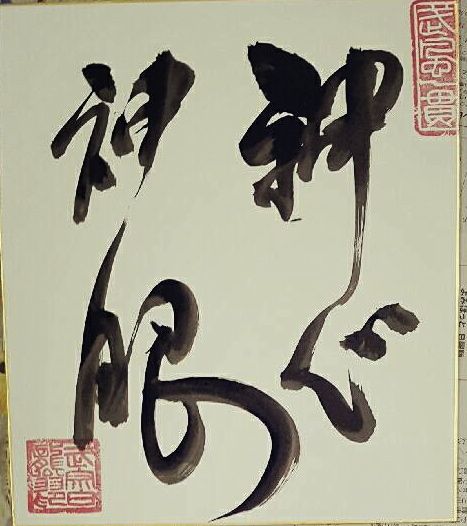
Further Sensei also unveiled at the first few trainings of the new year a great collection of `room dividers` with the beautiful calligraphy of Yamaoka Tesshu. Yamaoka Tesshu was a famous swordsman of Japan know as a Master of the Sword, Zen, and the Brush. He also founded the sword linage the School of No Sword. I truly enjoy spending time in appreciation of their art and often try to copy their works. It is my sincere hope that you too can use these great artists a reference for the deepening or your practice as well. 1937216_10207120131775658_6125079003358590059_n

Thank you Doug Wilson for this picture! You may also want to check out this book dedicated to the art of Miyamoto Musashi.musashibook

Art for your Happy New Year!

From Kasumi An Study Center  霞庵 スタディセンター by Kasumi An Study Center

This year`s training started at the honbu with Sensei unveiling his latest art acquisitions. As Sensei often remarks the greatest martial artists are inevitable great painters and proficient in many fields of art. In a recent conversation over lunch, Sensei generously invited my visiting sister and I to lunch, he spoke of how, when he was a young man, he studied with a famous film director in Tokyo and had dreams of becoming a director himself. As well, after the end of World War II, he played the steel guitar in a music band. They were so poor that they had to make their own instruments and play together.
I remember a time, Sensei was not satisfied with the pictures being taken by the photographers for one of his books and decided to take matters into his own hands. He brought in a ladder and a collection of his cameras. Someya San was up on the ladder with the camera and Sensei was giving him a hard time yelling things like, `next increase aperture and decrease shutter speed!` `rotate the camera as you shoot` `time your arms to my movement and move the camera as you shot`. And poor Someya San was having all sorts of trouble trying to keep up. Those photos eventually made it into one of his books. He says he uses all the arts as reference to deepen his study and practice of the martial arts.
Of course we all know that Sensei is a very prolific painter. I watch him on a weekly basis whip out up to 100 pieces of calligraphy in less then thirty minutes as presents for his visiting students. His teacher Takamatsu Sensei was also a brilliant painter. But did you know that Miyamoto Musashi, the swordsman famous for his use of the two swords, was also a great painter? My first introduction to Musashi`s work was thru my 90 year old ink painting teacher who is from the same town as Musashi. Musashi was famous for his Daruma, Hotei and bird painting among others. He seems to like to create tension with the birds by having them intent on a nearby insect. Either staring at the insect or perched with a patient air as the insect unknowing crawls closer. musashi
Sensei unveiled a copy of one such painting. Here you can see the bird patiently waiting on the branch above. At first glance, you may not notice the tiny caterpillar (which could be mistaken as a leaf or unrelated scribble) crawling his way up the branch. As explained, it is important to look at a scene and see or sense the subtleties or you may miss the whole essence of the situation. In life as well, if you can not sense these small things at a glance, you may end up putting yourself unknowingly in great danger or life threatening situations.
Further Sensei also unveiled the first few trainings of the new year a great collection of `room dividers` with the beautiful calligraphy of Yamaoka Tesshu. Yamaoka was a famous swordsman of Japan know as a Master of the Sword, Zen, and the Brush. He also founded the sword linage the School of No Sword. I love spending time in appreciation of their work and often try to copy their works. It is my sincere hope that you too can use these great artists a reference for the deepening or your practice as well. 1937216_10207120131775658_6125079003358590059_n

Thank you Doug Wilson for this picture!  You may also want to check out this book dedicated to the art of Miyamoto Musashi.musashibook

After You’ve Taught Everything, You are Left With 意識 Ishiki

From Bujinkan Santa Monica by Michael

Hatsumi Sensei TV interview last month. Photo by Michael Glenn
Right now in the Bujinkan, we are starting from zero. Hatsumi Sensei  says he has taught us everything. What will come next will emerge out of zero.

Sometimes there is this weird incongruity when training with Soke. He tosses me around the Bujinkan honbu effortlessly and I am almost 40 years younger than he is. His mind and wit are quicker than most people I know. But the fact is, he is an old man. He himself remarked that “I'm kind of stupid so I didn't realize I was getting older.”

Last month when I was in one of Hatsumi Sensei’s classes, my friend Silvio Herasme asked Soke how does he feel right now?  Hatsumi Sensei said that right now he feels very satisfied or content.

He continued to say that he felt happy that Takamatsu taught him and he could experience this life of budo. He was content to be surrounded by many friends who have been studying for 20-30 years or more. Then he mentioned how dangerous it is to be Soke.

One of these dangers is the onset of age. when we are young, we just train and don’t really think about what is next. Soke has grown old and IS thinking about what comes next. And even though Soke can knock me over easily and put me in great pain, he recognizes his age. He said,
“of course my physical body is deteriorating and getting weaker, but my spirit is unbalanced with the flesh.” 
Hatsumi Sensei says his memories of the years of training with Takamatsu are like images in a dream. When he looks at old photos and the 8mm film of himself with Takamatsu Sensei, he recognizes how bad he was.

Hatsumi Sensei described these days of training,
“Takamatsu Sensei wasn't very specific or hung up on form. He probably saw that I was just so bad at form and I couldn't do anything so he didn't care about the form. Maybe so I wouldn't feel bad.” 
Can you imagine being a young man like Soke was then? Just training hard and fumbling through what his teacher was trying to share. Then suddenly, Soke said,
“About a year before he died he said I'll pass everything onto you. I was kind of disappointed when he did that to be honest.”
This must have been a strange time. One day you are just a clumsy student, the next… you are in charge of the entire legacy. Today Hatsumi Sensei reflects on this time with humility when he describes his younger self,
“They say if you flatter a pig he'll jump up a tree, but then he'll fall out again. That's like me. I'm sort of like that.”
We all burst with laughter. The whole dojo was amused by this country adage. But this great humility was coming from our Soke!

During my whole trip last month Hatsumi Sensei was very reflective on the past 42 years. He said it has taken him 42 years to internalize what Takamatsu Sensei taught him. During those years, he said he has taught us everything that was taught to him.

There’s nothing left to show. No more to teach. We are at zero again.

This brings us to an odd kind of reassurance from Soke. He says that within zero there’s 意識 ishiki. This awareness or consciousness will guide us forward. He speculated that maybe this comes from kami.

Moving forward in the Bujinkan, we are going to continue with this zero feeling. The important thing will be how to internalize that. If you do it with clarity, then what comes next will be born from that.

呼吸 Kokyuu: How Hatsumi Sensei Caught My Breath

From Bujinkan Santa Monica by Michael

Michael Glenn Joins Hands with 大鵬幸喜 Taihō Kōki at the Fukagawa Edo Museum
I made sure to grip my sword well. My opponent stood before me, almost daring me to come in. I knew that if I didn’t cut in the space of that breath, I would be too late.

I cut, and I was stunned in an instant. I stood helpless at the point of my opponent’s sword… my own blade was slammed to the floor like the earth was a giant magnet.

My “opponent” was Hatsumi Sensei. He laughed as he drove the tip of his sword into my body. This forced my back up against the wood paneled wall.

This flash is burned into my memory from earlier this month. Soke was demonstrating to me a principle of 無く力を合わせ Naku chikara o awase that he was teaching that night. Meeting my attack without power. This principle was a thread that ran through many of my classes this month in Japan.

For some background, one night at Senou Sensei’s dojo,  Senou used the terms 姿勢 shisei: attitude; posture; stance; approach; or carriage (of the body)... And 態勢 taisei: attitude; posture; preparedness; or readiness. This means you can't just do a kata. It all depends on the attack... or the shisei or taisei of the opponent.

In another class Hatsumi Sensei effortlessly threw a series of opponents around the dojo. Each student he called out to attack him was bigger than the last. He was purposely choosing bigger and bigger bodies. He did this to demonstrate the slight changes in technique he used for each person. Soke said,
"When you catch a large fish, you have to change. You have to play the fish."
But how does this happen? If you’ve ever hunted or fished, you know how important it is to harmonize with the movements and mindset of the prey. It’s almost as if you merge with them as you stalk them. Then the moment of the kill creates an incredible concurrence. An incongruous reverence for life appears when you also see your own death in that moment. The body of your prey is your body.

Right after Hatsumi Sensei “killed” me, he said 呼吸から愛人 kokyuu kara ai jin. This is the merging of the breath between two lovers. But Soke used his humorous analogy to suggest you match your movements or your breath according to the way your opponent breathes. You become one with him. Like with a lover.

This was strange to me because it was like he disappeared in front of my cut. By matching me, he became nothing. He met my attack with emptiness. Then my next impression was the sheer force that dropped my own sword to the ground. But it was not his force, it was the shattering of the breath. My own breath. My own life which he had taken in that instant.

Bujinkan Japan Training Winter 2015

From Bujinkan Santa Monica by Michael

Below I share a preview of my Bujinkan video exploring the kata 片胸捕 kata mune dori using concepts from my training in Japan over the last couple of weeks.

Hatsumi Sensei has been very reflective. Part of this comes from his birthday. And part of it is due to the end of a 42 year cycle that he says began when Takamatsu Sensei passed away.

In the full video at rojodojo I share many of the stories Hatsumi Soke shared with us. Some of the details include:

  • What the future holds for the Bujinkan;
  • Hatsumi Sensei’s funny opinion about his 8mm footage with Takamatsu Sensei;
  • How Soke feels about his age;
  • The responsibility of our generation for Budo;
  • Two profound lessons from the 天津鞴韜馗神之秘文 amatsu tatara kishin no hibun;
  • A hidden meaning for 親切 shinsetsu;
  • How does Senou Sensei consider 姿勢 shisei and 態勢 taisei in training?
  • Hatsumi Sensei’s stories of lodging at Takamatsu Sensei’s house;
  • Stories of the terrifying training that Soke did with Takamatsu Sensei;
  • How Hatsumi Sensei survived a live blade attack from Takamatsu;
  • How Takamatsu demonstrated deadly force to Hatsumi Sensei;
  • Why Takamatsu didn’t really teach Hatsumi Sensei form;
  • How “bad people” are dealt with in the Bujinkan;
  • How to keep from being controlled by religion;
  • One of the most important purposes for the dojo;
  • My own experiences as uke for Hatsumi Sensei;
  • Turning accidents into fortune;
  • Cutting through truth;
  • Don’t confuse Fudoshin with kamae;
  • Using the eyes for evasion;
  • Throwing the self away and finding what is hidden in zero;
  • The importance of the “next one.”

Hatsumi Sensei said that he has taught us everything there is to teach in the Bujinkan over the last 42 years. But he added that we will be continuing from zero. Over the coming weeks, I will share more about these details from my experiences in Japan. But I made this video for rojodojo to get this information out quickly. You can enjoy the full length video and help support my teaching over at Rojodojo.com