Skip to content

balance your tachi, balance your life

From Shiro Kuma's Weblog by kumablog
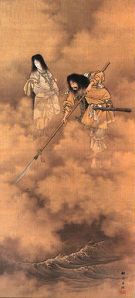
Tachi kumiuchi is fighting with sword and yoroi but tachi alone also means standing up. In fact tachi kumiuchi is about acquiring the ability to keep our balance. The tachi (sword) too is balanced but on a horizontal plane, sensei insists on this in each class. When the tachi is in the belt with the cutting edge down, it protrudes more than the katana. The way it is balanced in the belt is linked to the size and weight of the weapon.

Datô no kamae

By having your body standing up vertically (ten ryaku) and your sword balanced at the hip (chi ryaku) you link the ten and the chi through the jin (adapting the movements to the situation).

You are free to move in all directions balanced by the tenkan (axis, pivot). Juppô sesshô is created because your movements can go in any direction during the encounter with the opponent (kumiuchi). Adding the perception of the dragon to the movements of the tiger, you are fed by the kaitatsu and flow (nagare) naturally with things.

Training in tachi kumiuchi develops the knowledge on how to use the weapon but enlighten us also on how to handle our life better. What sensei is teaching is to bring things to life, ikasu and get a happy life.

Rokkon shôjô!


Tachi tips & tricks (2)

From Shiro Kuma's Weblog by kumablog

picture taken from http://www.teppojutsu.com/The tachi is not a katana and therefore should not be used in the same way.

Sensei explained that we have to understand the evolution of warfare in feudal Japan in order to be able to adapt our techniques to the moderne world. He was mainly referring to the goshin. At first there was 1) the chinese ken, then 2) the tachi, then 3) the the ju (rifle), then 4) the katana, then 5) the cannon. These are the five spirits of warfare.

When you look at this list of periods, you are surprised that you can actually put dates on them. The chinese ken preceded the muromachi period. The muromachi was mainly tachi. Then with sengoku jidai the rules changed by the extensive use (Nobunaga and his followers) of the rifle (teppo – musket type) that led to the Tokugawa/Edo period. It is only when peace time was established and heavily controlled that the katana  began to widely used by the samurai.

The muromachi and azuchi-momoyama periods were times of nearly permanent wartime. Samurai would wear the yoroi everyday and a heavier weapon like the tachi was of good use. The sengoku jidai introduced the rifle and the yoroi was no more the safest outfit. One day in his home, sensei showed the helmet of a shogun‘s personal guard. Even though this antique helmet was in a  very bad shape, sensei pointed out to me a big inward bump the size of a musket ball (approx. the size of a kid’s marble). The helmet was not pierced through but we can imagine that his former owner did have huge headaches afterwards.

So the introduction of teppo into the wargame created a major change in battlefield experience. It must have been painful to the samurai to discover that their techniques were not good anymore after the introduction of rifles. Eventually this is how the Nobunaga, Hideyoshi and Tokugawa managed to get the unification done.

When the Tokugawa period began, there were no big battle anymore and the yoroi was abandoned. No battlefield, means no need for yoroi anymore. The regular gi (reminder kimono is only for women) was no more protected. This was the beginning of the katana period when cutting abilities were developed (battôdô). This led to Meiji (1868) and the use of heavy cannons, the fifth big change.

From all that it is easy to understand that the tachi and the katana being used in two different periods, their practical use should also be very different.

A few tips and tricks to remember when using the tachi:

1. the tachi is a shield and the yoroi is the weapon, use the tachi more like a stick than a sword. This is also why you can flip the blade from one hand to the other the same way you use a hanbô.

2. the tachi being held cutting edge down, hontai nuki gata is the only logical way to draw it.

3. the tate nuki gata, doesn’t mean vertical as in modern japanese but shielding as in the ancient understanding of the term.

4. the koshiate *(holster hanging down from the belt onto the thigh) made it possible for the samurai to have more freedom in his movements.

5. as the tachi is used katate, the other hand would carry the yari. In this case, the yari becomes the shield and the tachi is the weapon.

So please during your tachi trainings do not use the tachi as if it were only a big katana. With the year of tachi kumiuchi you are learning a totally new way of fighting.

As sensei was saying recently: the real sword masters are the tachi masters. The samurai who were using the katana did it because the didn’t understand the tachi.”

_______________________________________________

*to see drawings of various koshiate, please refer to “Samurai Sword Fighting” by Hatsumi sensei. Page 19 in the English edition.

picture taken from http://www.teppojutsu.com/


Tachi tips & tricks

From Shiro Kuma's Weblog by kumablog

Look at the tsuka and therope hanging from it

The tachi is mainly used katate (one hand), often when riding a horse.

The tachi was used to hit the opponent so that he would lose his balance. Sometimes the violence of the hit would create a reflex that would open the fingers and make him drop the weapon.

This is why there is a rope on the tsuka kashira (top of the hilt) to keep it tied to the wrist.

This device also existed on the saber used by the 18th century riders in Europe. The picture displays a “chasseur” from the 5th Dragon (model 1790).

As always, the same problem comes with the same solution.


Japan seminar April in Paris

From Shiro Kuma's Weblog by kumablog

Flexibility is in the body and in the mind

Tachi Kumiuchi

and Rokkon shôjô seminar in Paris

April 23rd – 25th

As always after all my trips to Japan, I give a seminar in Paris with the students who came with me to Noda to share the latest insights collected in Japan.

If you are interested come to Paris Fri 23-Sat 24-Sun 25 of April 2010.

Fri 20h-22h30

Sat 10h-17h30

Sun 10h-17h30

Lunches are included, free sleeping at the dôjô.

Information and online pre-booking available at www.budomart.com

Arnaud Cousergue

Bujinkan Shihan Jûgodan, Menkyo Kaiden Tachi Waza


Do not fix your mind

From Shiro Kuma's Weblog by kumablog

get him to fix the ind and attack somewhere else

With the study of tachi kumiuchi we entered this year into a new dimension of sword fighting. This is why this year is really important for your martial evolution.

Zen masters have explained martial arts things better that some practitioner. Takuan is one of them and his explanations are so simple that I am quoting here a paragraph of  one of his books.

In the “unfettered mind” Takuan writes: “Although you see the sword that moves to strike you, if your mind is not detained by it and you meet the rhythm of the advancing sword; if  you do not think of striking your opponent and no thoughts or judgments remain; if the instant you see the swinging sword your mind is not the least bit detained and you move straight in and wrench the sword away from him; the sword that was going to cut you down will become your own, and, contrarily, will be the sword that cuts down your opponent”.

In budô if your mind is stopped on the weapon attacking you, on your hand holding the sword or if you give power to your fear, you will not be able to react freely. This is the whole point of sensei‘s teachings. If you want to handle the fight correctly (sabaki) you have to be free in your mind (see the post on isaku kaitatsu) and the solution adapted to the situation will manifest itself freely in your actions.

Being free means not trying to do anything, if you try to do a technique you will die and Hatsumi sensei‘s budô is about staying alive.

Train with no preconceived idea and you will be free. This is the gokui (essence) of budô.


Inyo kyojitsu

From Shiro Kuma's Weblog by kumablog

credit: Stéphane OzounoffThese days sensei speaks a lot about inyo kyojitsu. “inyo” is the Japanese name for yinyang and “kyojitsu” refers to falsehood/truth, similar to when we played with “menkyo kaiden” a few years ago.

Beyond these terms there is another reality that I would like to explore further.

inyo”:

Many things have been said about this Chinese principle on which Taoism is based. The first thing you should know is that those two concepts should never be separate. Where there is in, there is yo. In ancient China (as the kanji shows) these words defined the two sides of the sacred hill. They were created to define the two sides of a mountain: the sunny side (yo) and the darker one (in). It is impossible to cut the first one from the other. If you could split a mountain into two parts you would still have a dark side and a sunny side! This inyo principle is like the two sides of a sheet of paper, or a coin, one side implies the other. When you say “in AND yo” you create duality and do not see the whole picture.

The two kanji gives us more information:

The kanji for yo is 陽 and it is composed of three groups of strokes. The one on the left side looking like a “B” symbolizes the sacred hill where rituals were performed. The second group of two characters one on top of the other, is made out of  hi, the sun (日) on top, and of ame the rain (雨) below. They are separated by a horizontal bar meaning that things are changing and that after rain (dark time) the sun is coming (light time). This is not a judgment on things but merely an observation of the natural evolution of things in Life.

The kanji for in is 陰 and begins with the same “B” showing that the two are linked together. The group on the right is also made of two characters. On top is ima (今, now), and below is a simplified kumo (雲, cloud). It means that clouds are building up now and that change is being expected. This in is quite similar to the “I” of the I Ching used to indicate “a change, a transformation”.

The clear meaning of inyo therefore is that Life is changing permanently and switching from one state to the other. There is nothing negative or positive in this inyo (conversely to the understanding commonly used in the West), it is only a crystal clear observation of nature’s cycles (seasons, days, weather). Remember that the Chinese never invented the gods as we did in the rest of the world. For them Nature was permanent and evolution, and change was its main rule. They invented the I Ching in the first place to help make decisions on agricultural matters and render the invisible world (implicate) visible (explicate).

This is what sôke means when saying: “art is the ability (saino) to render the invisible, visible”.

Kyojitsu is another nice concept. Kyo is 虚 “false, untruth” and jitsu 実 is “truth”. Linking them both gives the idea of playing with falsehood and truth to deceive the opponent, or better, to confuse him so that he is always taking the wrong decisions.

Sometimes in Japan, during classes sensei speaks of “kyojutsu” instead of “kyojitsu”. Truth (実, jitsu) is then replaced by martial technique (術, jutsu). But as it goes with the inyo concept false implies the existence of truth too. Defining something also defines its opposite. As they say “badness is an absence of goodness”, cold creates hot, dark creates bright, female defines male etc. Interestingly, it is always the negative understanding of things that defines the positive understanding as if we were programmed to be optimistic. I use here the terms “negative” and “positive” not in opposition but in the same merging approach as in inyo, this is like the bipolarity of the magnet.

So when they speak of kyojutsu you should understand it as “kyojitsu no jutsu”, jitsu being created by completing kyo. Read between the lines. This is the definition of balance. Inyo kyojitsu allows us during training to understand the permanent flow of changes in Life and on the mats the nagare between uke and tori. Actually all our actions have to be balanced (kyojitsu) to be able to switch naturally into the inyo. Balancing everything we get rid of the thinking process and develop the ability (saino) to react to the non manifest aspects of things. Thinking would stop this process and prevent us from reaching what sensei tries to make us understand this year with rokkon shôjô, the logical consequence stemming from the saino kon ki of last year.

Having developed the ability (saino), and our spirit/soul (kon/tamashii), we encompass the container (utsuwa/ki). Please note that the bigger the container, the bigger the kûkan. Being alive in the kûkan we understand the balance of all things and react accordingly.

Having no intention we develop happiness and protect Life.

Rokkon shôjô