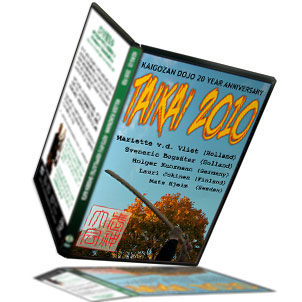
Kaigozan 20 Year Anniversary Taikai DVD
From Uploads by budoshop by budoshop
…From Uploads by budoshop by budoshop
…From Uploads by shugyou by shugyou
|
There is not much to say about this DVD, we trained and had fun. There was no particular theme for the whole seminar, the teachers taught everything from basics to more advanced techniques and feeling. Mostly Taijutsu, but also weapons such as the Katana, Tachi, Yari, Kusari-fundo. It is 2 hours playing time. Buy it here... bit.ly There is also a bonus segment that we couldn't fit on the DVD, so we released it as a downloadable format... bit.ly |
From:
shugyou
Views:
703
![]() 4
ratings | |
| Time: 01:03 | More in Sports |
From Budoshop by BUDOSHOP.SE
New DVD from the Kaigozan Dojo 20 Year Anniversary Taikai is released and ready to be shipped. For more info click here.
We also released material that we couldn’t fit on the DVD as iPod movie for Download.
In this video Holger taught the history and the proper way of cutting with the Tachi, and Katana. Sveneric shared his wisdom and a few taijutsu techniques.
…From blogurl:tazziedevil.wordpress.com - Google Blog Search by Duncan Stewart
JAPANESE WHITE OAK TACHI BOKKEN. Tachi Bokken (shown here under a standard bokken for comparison). Your custom tachi bokken will be ready and waiting for you to pick up in Japan on the first day of training at Daikomyosai 2010. ...…From blogurl:tazziedevil.wordpress.com - Google Blog Search by Duncan Stewart
Yūgen. Yūgen 幽玄 is an important concept in traditional Japanese aesthetics. The exact translation of the word depends on the context. In the Chinese philosophical texts the term was taken from, yūgen meant “dim”, ...…From Shiro Kuma's Weblog by kumablog
I just read a nice article by my brother Pedro Fleitas and I would like to dig deeper in its direction.
When we began training in the Bujinkan martial arts we couldn’t fathom how much it would bring to us as a human being; how much it would transform us. We were more interested in learning a “martial art”. Through the last 26 years we learnt the martial art but we also learnt to become true human beings.
Too many practitioners today are training for the wrong reason as muscle power is limited in time so it shouldn’t be our main objective while training. What is definitely more important is to develop our own potential, our own abilities. All through these years people have been focusing too much on the omote where in fact only the ura matters. Knowing thetechniques can be interesting for a while but knowing yourself is more vital to live a happy life.
How many teachers in the bujinkan are only teaching “forms” and do not get the essence of the bujinkan? A lot! I remember once speaking with sôke who told me that the important thing he has been teaching in the last years were not the schools but the concepts they conveyed. These concepts of san jigen no sekai, yûgen no sekai, kasumi no hô, shizen, etc have taught us more on how to live our lives than fighting techniques. Even though this apprenticeship has been the key to learn to defend ourselves efficiently. By understanding the ura side of things, the omote becomes obvious.
In 2010 we have entered a new era in the bujinkan with the arrival of many high ranks. Things are changing as always and now is the time to ask yourself the good questions. Long time ago I have decided to put aside the “ninja” stuff and to follow the teachings of a man, Hatsumi Sensei; I decided to become a disciple and not only a good technical martial artist.
Is it what you are doing? And if it is not, do you think it is worth spending your free time collecting forms instead of developing the fantastic human being hidden within you?
Hatsumi sensei might be the last true budô master of Japan and his teachings go far beyond simple body mechanics. Maybe it is time to think about it.
From Shiro Kuma's Weblog by kumablog
Sensei said that “the secret of budô is 武風一貫 bufû ikkan (translated in “unarmed fighting techniques of the samurai” p.51, by the way of war is survival*). This is the yang secret. In a fight the opponent is often aggressive (i.e. yin) therefore by opposing softness to hardness you can defeat the enemy. When facing a strong and violent opponent you have two options: be more aggressive and violent than him or be so soft that his own intentions and actions will defeat him. This is the secret of fighting.
It reminds me of the encounter between the yamabushi monk Benkei and the young Minamoto no Yoshitsune during the Hôgen disturbance (保元の乱, Hōgen-no-ran1156). Benkei was a fierce warrior monk who defeated 99 samurai crossing a bridge he was standing on. Benkei had made the wish to take a 100 swords from samurai and to give them to the Buddha. When the young Yoshitsune arrived at the bridge, Benkei had already won 99 swords. Yoshitsune, defending himself with a simple flute overcame the big giant who then became his disciple.
This is the typical example of how yin can defeat yang. In the bujinkan this technique is called goja dori and sensei details it in his book: “Togakure ryu ninpô taijutsu” (p.237).
Sensei insists also on developing 五心術 goshin jutsu instead of 護身術 goshin jutsu. We should develop the heart/spirit if we want to ensure a true self-protection for ourselves.
Brutal force is nothing compared to mental strength. In order to survive learn to use the yin within you.
* 武風一貫 means “the martial winds blow every day” but when written 武風一管 it means “martial wind (tone) of one flute” thus the connection with Yoshitsune.
From Bujinkan Santa Monica by Bujinkan Santa Monica
![]() |
| photo by ajari |
The Inscription reads, “ Ninjustu is on your eyebrow.... the spider`s thread, so close, the village of Togakure”. Sometimes things are so close to us that we can not perceive them.Hatsumi Sensei has continued to reference this web from the heavens. If Ninjutsu is on one's eyebrow, or there is a thread to heaven dangling down but we do not see it, how can we use that in Budo?
The Daruma`s eyes are staring inward. This is a form of “Happo Nirami” or “Staring in Eight Directions” . It is also a form of “Ma Yokei” or “warding off evil”.
From blogurl:tazziedevil.wordpress.com - Google Blog Search by Duncan Stewart
Soke pictured with a memento of the ” Wall of Honour ” unveiling ceremony at the Royal Society of Medicine. Peter King attended the event on behalf of Soke. Peter King -. “attended the unveiling ceremony of the Wall of Honor ...…