Skip to content

Ageru – Give.

From 自然行雲流水 by 自然行雲流水

Give.

"Having the chance to be Uke for Soke is an Honor" - Nagato Sensei.

It is often that I feel that I will never understand his teachings or absorb the transmissions into my soul.
Sokes class always ends for me with a pleasant fatigue of the body and mind while vaguely smiling at the inner confusion of the experience.
To me, the role of Uke is the " art of surrender ". As uke, we take on the role of walking forward into death. With the correct mind, we can understand this as a lesson in Sutemi and developing the "guts" of the warrior. To be uke means to "give" yourself to tori. We can view this as also "give and return ", because we are recieving lessons from our selflessness. Those that cannot let go of the Ego and cannot allow their training partner to throw,kick,punch, or inflict pain on them have, in a sense, turned their back on learning. The first move to transcend the ego is to acknowledge it. We must then have the "guts " to step aside of ourselves and become an empty tea cup ( if you will ) to recieve direct transmission from the body ( taiden ) Sprit/Heart ( Shinden ) and Verbal lessons ( Kuden ). These are like a Sanshin ( three hearts ). It is so important to develop the heart of Sanshin, I feel. This heart is like that of a three year old child. It is said that the heart of a three year can live on for a hundred years. So, we must try hard to capture this correct heart for the chance to learn the "Art of correct living."

It is easy to become annoyed or frustrated with oneself for not immediately being able to understand Sokes teachings. I think it is important to acknowledge the fact that, these teachings are not meant for everyone.
Even those that recieve regular time as Sokes uke, does not automatically guarantee that they will "get it". Everyone is on their own Shugyo.
Absorbtion of the Art is a lesson also of the principles - Distance,Angles and Timing. Please look at these three principles in a manner like a human relationship or that of the way of Society and how people and communities grow.
In my eyes, I view being uke as a " conditioning for the future ". For me, I try to just open myself as much as possible. As a result, I hope that I will naturally absorb the transmissions into my subconscious and hara.
From there, I just keep training. I believe if one intellectualizes this Budo too much, the conscious mind will create things that are not really there. Over time, ones movement will develop in a direction different to that of the teachings. It is important to understand that Taijutsu is the Art of the Body. Learn through "doing", not "thinking". The thinkers in the dojo become stagnate in their taijutsu, they become narrow minded, yet still think they are doing the right thing. The proof is in the pudding.
This opens us to the concept of Rokkon Shojou or the purification of the six senses. Our training is always revolving around this. We aim to purify our sense to be able to "see" what really is. As a result, we will make correct decisions, know when and when not to act, and move freely.
The initial stages of learning requires people to mimic. This is an essential skill to have. If one cannot mimic, one cannot learn. This relates to Sainou Kon KI - the Talent, Soul and Capactiy of the person.
The greatest compliment in the initial stages of training in the dojo is to move like your teacher. This shows the teacher that you are open to learning and his instruction. Is this not what every teacher wants?
The more pure of heart the student is, the greater capacity. The student can absorb teachings without the clutter or distractions of the mind and what IT thinks IT has seen, heard or felt.
We often see that self purification practices are listed at the beginning of training in the Ryuha. If the student of the martial arts does not have a clear and pure heart, eventually, they will act with clouded judgement and cause problems. Peace is the foundation of budo. We must first make peace with ourselves. Eventually we may be lucky to obtain the "Mind and Eyes of God" - Kanjin Kaname.

Soke has recently used Gan Shi Nankotsu as the theme for the past year. It has a relationship with Womans Self Defence, of which was taught to him directly by Takamatsu OSensei. This type of training is as applicable to men as it is to women. As men age, so to does their abilities of strength. If one required strength to defend oneself during old age, they would surely loose to a younger, more stronger opponent. This is common sense. And, the progression of budo training over the years is a logical one as well. All we have to do is watch Soke.
Soke, however, has instructed the 15th dans to ensure that their students understand taijutsu before teaching "finger techniques". If not, the students will misunderstand that teachings and just use "finger power" and not taijutsu. In fact, this skillful use of the fingers is possibly the result of mastering Shin Gi Tai Ichi - the unification of the spirit,technique and body.
Shin Gi Tai is the base behind everything we do. We can also possibly acknowledge that giving the Godan test is in fact a test of this unified ability.

I often have seen hight ranking instructors being held down by Soke, trying to "stop" him from applying pain with the fingers to various parts of the body. This is terrible. Wen one thinks about it, the person trying to avoid the pain is in fact trying to avoid the teachings. It is important to "give yourself" and trust Soke. He is giving you lessons of the highest.
It is an honor to recieve pain from him!
Soke once said after inflicting pain on me quite hard, " I can do this on Duncan because he trusts me." I am speaking from experience.
I am not trying to make myself sound better than anyone else, I am just stating my belief on what it is to be uke within the Bujinkan.

You may not understand why you are being called upon to be uke, and you may not even understand what was done to you. The most important thing is that you accept the teachings. Eventually, I believe, when the time is right, the answer or knowledge will come. But, if you stop training, it will not. You have to keep training!

Don`t ask questions with your head, let the questions and answers come through the body. It is when the answer comes from within, that you know it is the truth and you have really understood it. This answer will never be forgotten because it has been learned through Shin Gi Tai, and not your brain. It is called Tai-jutsu NOT Atama -jutsu.

南虎

Be Aware!

From Shiro Kuma's Weblog by kumablog
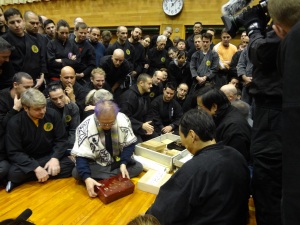
For the second day of dkms, it was raining so we had to retreat to a nearby building. Space was limited and sensei began his teaching by telling us to be aware of our environment. In a crowded area accidents might occur and like in a battlefield he asked us to add this element to the techniques we were doing today.

Warrior awareness was the theme and the introduction of today’s classes by sensei and he displayed many small weapons (kusari, nekote, and other shuriken) and asked us to be aware of these kinds of weapons, and to learn how to use them in order to know how to defend ourselves against them. Hidden weapons are very common in today’s street fights so we should develop our awareness in that respect.

To summarize this day of hard training (the floor was concrete), I would quote one sentence he repeated a few times during the training: “this is not about power, this is about control”.

Too often in martial arts, emphasis is put on physical power instead of the control (space, mind and body). Controlling the opponent means controlling his body and his brain (jin) and his environment: chi (floor), ten (weather or light conditions). Without controlling the outside, the above, or the behind of the attacker a winning action can bring defeat. This is why the bujinkan arts are more interested in controlling Uke than showing strength or force that are often mistaken for power.

On a ryôte dori type of technique sensei once again used the wave like movements of his shoulders and his body to control his attacker. This type of movement is done nearly without moving. By solely moving the shoulders up and down and turning around Uke at a very close distance uke is defeated. This shoulder movement would be effective in a very confined environment like a hole or on the battlefield.

Like he did yesterday he played again with the concept of kûkan no kyûsho. But Kû which is not only emptiness is encompassing all things within, and kû is the leading path to “zero”.

Sensei often speaks about becoming “zero”. This state can only be achieved once kû is understood and integrated in our body. He asked us to find the kûkan no naka no nagare (空間の中の流れ) because within this kûkan exists a flow that is kû and which is allowing us to transcend the form and to move naturally.

This is achieved by finding the kûkan no teko (空間の梃), the leverage or the various leverages (teko) to use to open Uke and to defeat him. By using these teko (familiar concept studied in the kukishin ryû), or their opposite known as “teko gyaku” (梃逆) we unveil all possibilities naturally and submit the opponent without using any strength. Our body if relaxed allows the natural movement to appear and to be used without any thinking process or any preconceived motion. I admit that I find it hard to put that into practice in my taijutsu but this is the goal to achieve.

He illustrated that by biting into the flesh of his opponent (hand, forearm, tit) and Tim’s reactions were quite self expressing.

From there we moved to some shime waza (締め技). A short reminder here, shimeru (shime) applies not only to the chokes but to any kind of constrictive action on the body. The basic hon jime and gyaku jime were demonstrated with the whole body (karada) and were sometimes completed by hits to the face or crushing actions to the throat and the body.

Sensei insisted also that we should use the whole body when applying those chokes, “karada no shime” he explained, while choking his opponent by moving around him. Footwork is the key element in the success of these movements. By moving the elgs you off balance Uke and cerate opeinings for the chokes or the hits.

What I understood today was that chokes are:
a) dynamic;
b) done with the whole body (and not only the arms);
c) can be completed by fists attacks.

Pain by sôke is a good teacher!

He was also changing his grip from one choking waza to another using pushing (oshi -押し) movements of the choking hand. Depending on the opening he was pushing or pressuring Uke’s upper body (not only the throat) with his pinky used as a blade to cut the flesh; with the heel of the palm to crush Uke’s Jûjiro or with the tip of the fingers to dig into the face or the neck. This ability to change the way to hold the opponent became obvious when he added a hidden knife and pulled it of his sleeve so that it was appearing like by magic in his hand. This metsubushi action (目潰し) was done while already applying the choke.

He warned us to learn these “bad guys” techniques in order to survive a real fight. The bujinkan, he said, is not teaching “bad guys” techniques but is teaching these things to be able to react correctly in a life threatening situation.

To avoid defeat, learn the ways of your enemy.

The way he was revealing the tantô hidden in his sleeve was very interesting. He was not pulling it out of the sleeve instead he was levelling his shoulder so that the weapon would pop out by itself. The karada was pulling the weapon not the hand. This is also how we should learn to draw the sword as in the nuki gata (drawing the sword) the blade is expelled from the scabbard by the body action not with the hand. This is quite different from regular and traditional sword practice.

Leaving the weapons we went back to unarmed combat and from the original ryôte dori technique we learnt how to use the pressure of the thumb and the pinky to dig into Uke’s skull, face, eyes, ears, etc. We did also a few nasty pinching techniques combined with striking hits to the chest.

In a limited space the “gan shi nankotsu” system finds here a logical application. Space being limited, the movements do not have the same momentum and pain is not coming from a distance but at very short range. Once again he insisted on finding the “kûkan no kyûsho” of the situation.

We did many techniques today around these principles and sensei said that this was a very important training for the jûgodan. No strength is used in these techniques, there is no power at all as Sôke is controlling Uke only with micro movements and mega pains. Pain without injury is the best way to calm down a dangerous situation.

On a side note, Sôke insisted that we should pay attention to avoid injuries and of the importance of being aware of our environment (reminder).

This apparently effortless full control he has at all time of his opponent(s) is always amazing to watch and to think that tomorrow he will be turning eighty is even more surprising. Sensei is not using any strength but he keeps full control of anyone attacking him.

This is why the bujinkan martial art is “not about power, (but) about control”.

Be aware and live happy!


Senpen Banka

From Shiro Kuma's Weblog by kumablog

dkms 2011 - during the first break

dkms 2011 - during the first break

Today was a fantastic Autumn day. The sun was shining, the 300 attendees full of joy to be together again for this very special bujinkan moment, and sensei was joyful and playful like a kid.

The whole was dedicated to the depth of the Kihon Happô and he asked many 15th dan to demonstrate their understanding of it. As an introduction he said that this day (and maybe the following ones) would be a “Jûgodan test”…

After speaking about some writings by Takeda Shingen (http://en.wikipedia.org/wiki/Takeda_Shingen) who said that men until 20 were working to be strong and then to understand weakness, he moved on to some very interesting concepts.

From this whole day of training I did my best to remember three things that he said and showed the depth of his budô.

“Gyokko Ryû is up and down, inside and outside”

Pedro trying to explain what he felt after being used as Uke by sensei, said that he had the feeling that sensei was up and down him, inside and outside his distance, to finally realized that he (Pedro) was alone as sensei was not even there (zero state). Sensei reminded us that this particular feeling of attacking the Ten and the Chi and the ura and the Omote was the main concepts of fighting of the Gyokko Ryû.
Distance being short the only way to use the body efficiently is to play with all these directions and deceive Uke on your real intentions. He added (as for everything this day) that no chikara (strength) was to be used and, as he said in our previous classes, that holding Uke without actually holding him was the key of true taijutsu.

As a joke he added that being 80 years old, he had no more physical strength and that his minimalist movements done with the whole karada (body) were creating the same effect as the use of the force. Age advancing physical strength is replaced by mental strength. Once again to way to control Uke it is not about using force but on the contrary to give him the feeling that you have disappeared.

“find the Kûkan no Kyûsho”

At some point he spoke extensively about finding the kûkan no kyûsho (空間の急所) or the weak point of the empty space in which the fight is happening.
In a movement, you should be able to understand where the Kyûsho is located, to avoid it and to throw Uke into it. He said that this was the real mastery of budô and that not so many martial artists couls even understand that.

In whatever situation you encounter in life lies a kyûsho somewhere. Being able to discover this kyûsho and to use it to our own benefit is the key to happiness and safety.

“senpen banka”

But the most amazing thing that sensei told us today concerned the concept of “senpen banka”.
Senpen banka is another “Hatsumism” composed of three different concepts reshuffled together to create something new.

“sen” is 千 thousand
“man” (here “ban”) is 万 10000
“ben + ka” is in fact 変化 henka cut in two halves (hen and ka are separated)..

Senpen then is “1000 changes” and “banka” is 10000 changes. note that both hen and ka mean “change”.

The concept of senpen banka is quite similar to the concept of “banpen fûgyô” (10000 changes no surprise) from the Gyokko Ryû but stronger. Sensei said that we should move in a relax manner with no preconceived ideas on what to expect or what to do, in order to be able to find the kûkan no kyûsho hidden in the situation.

Also if we think a little further it can also mean that whether there are 1000 changes or 10000 changes our attitude should not be modified. Losing or winning is not the point (he reminded it to us in a recent class saying that this win/lose vision of the world was childish). By keeping the proper attitude in life one could overcome any difficulties (here the changes) that he might find on his way and lead a happy life.

Once again it was for me the proof, if need to be, that the bujinkan is much more than a simple bio mechanical martial art but a real school of wisdom from which one can grow the true warrior spirit and become a true bujin.

Thank you sensei for this fantastic Autumn day on the inner secrets of the kihon happô.


Use a Telescope to see through Space and Time

From Shiro Kuma's Weblog by kumablog

On Sunday I did a technique at the opening of the class that sensei used to teach us the shizen karada – the natural body movement.

Karada – body ( 自然 体) is a often used by sensei during his classes as everything we do is based on a body or “non body” movement.
On a ryôte dori ( 両手取 り) slide your arms inside Uke’s arms and take his balance. When sensei did it to me I felt nothing he just vanished (melted?) in my grab in such a natural way that I had the feeling that my grip was returned against me.
There was so much softness in his counter action that there was no way for me to counter it or to think on how to react to it.
This feeling is quite strange and happens every time you have the chance to be his Uke. There is power within softness.

To achieve that Hatsumi sensei was simply joining his shoulders between my arms as if he had no bone structure, no rib cage in the middle! By moving the shoulders in a wave action back and forth he slide himself in between my grip and took my balance. The naturalness of his body movement was amazing as nothing could be done to avoid it. Using the karada (体) without chikara – force, strength (力), he then used the gan shi nankotsu (眼指軟骨) to inflict excruciating pain to my eyes and mouth, forcing me to bend backward and therefore to lose my balance.
I can understand it what he did to me but I wasn’t able to reproduce it. As always it is one thing to understand and another one to be able to do it.

When sensei was in between my arms I felt I was facing a wall advancing towards me and I couldn’t avoid it as I was stupidly still grabbing his lapels. Funnily I know I could have let it go but I didn’t. He was controlling my body and my brain together. The only thing I could do was watching my demise. Using the whole body is not moving the body it is being one with your body and Uke’s body at the same time so no free space is available for you to escape.

If I try to describe the feeling a little more it is like there is no strength at all opposing yours and then nothing to fight against. The simple shoulder wave movement together with a body that has been polished for tens of years is what is doing it. Once again, your rank doesn’t prevent you from training and you have to train for a very long time in order to get this ease in action that comes from pure consciousness.

Later during the class sensei used the image of the circle and of pi. Actually when continuing the movement your footwork should be in accordance together with uke’s movement of attack so that you pivot in a circle inside Uke’s attack at a 180° angle to go with him where his body is leading him. By doing so, Uke is not aware of where you are and loses his balance because nothing is opposing him. This pi application has been developed in many other martial arts like Aikidô for example but here in our case there is no grabbing of Uke. Sensei merely used the space created by this dynamic and natural body positioning to stick to Uke so close that he is invisible to Uke’s awareness. Sensei’s body moves like in cloud. It is at the same time a mienai waza, a kûkan and a nagare with nothing to stop Uke’s body but diabling him to perceive you. As they say in the Takagi Yôshin Ryû and the Kukishin Ryû: “ahead lies paradise”. As nothing prevents Uke’s movements Uke falls by only fighting his own strength.

To summarize the whole training that day sensei used a nice image. He said: “don’t be strong, don’t be weak, be zero and through this zero you can see the solution”. Saying that he put his hands in a circle and looked through them as if using a telescope.

Once again everything is linked. telescopes are used to see through sideral space and the stronger they are, the further back in time they can see. You should become a powerful telescope and see through time and space in order to be aware of what is coming next even before Uke knows about it.

Then gan shi nankotsu of this year (眼指軟骨) turns into gan shi nankotsu (眼 其 軟 骨) where shi (其) is oneself; nan (軟) is soft; kotsu (骨) is knack, skill, secret. The “eye, finger, cartilage” is now through our telescope a means to see through yourself, the secret of softness that will defeat the opponent.


A Needle will not Blow a Balloon

From Shiro Kuma's Weblog by kumablog

In any Japan trip the first classes with sensei give some insight on what is going to be taught next. My first classes last days were fantastic, full of insights … and full of pain!

About 80 students are attending the classes (and more are arriving every day) and I have the feeling that the dkms 2011 will be a hispanic one as many friends from Spain and South America are there: Alex, Christian, Nestor, Rafael, Marcello, Jose and many others.

I must say that sensei is in a very good mood and shape and that his minimalist taijutsu is getting more and more impressive.

I had the honor to open the classes and once again he went into the “gan shi nankotsu” concept that he has been unveiling since last summer. I already wrote about this “add-on” t to the kihon happô theme and concept on my Facebook notes, check it if you didn’t read it it is called “ken tai ichi jo”.

As I said the class was full of insights, I will try to explain three things that Hatsumi sensei explained during the class:

A needle will not blow a balloon  i.e. Kosshi and Koppô are complementary:
This was really mind blowing! Westerners have a tendency to split everything in closed boxes were in fact reality is based on a more higher understanding of these concepts. Even though Kosshi and Koppô are different they mix nicely together to create a flow that is like a third reality. From now we should see these two concepts as the “plus” and “minus” of some magnetic field.

Hatsumi sensei explained that our fingers controlling Uke softly were actually the Kosshi jutsu and that our bone structure, our squeleton moving freely around this point of control would allow us to deal “softly” with the opponent’s intentions. He said,that,when this Kosshi/Koppô mix is mastered, you are able to deal with any opponent whatever his body shape. This is when he used this image: “when you master this you can push a needle so softly into a balloon that eventually itwill not blow up”. This controlling action of the whole body is so soft that no force at all is used in the process.
Intellectually easy to get, but I still don’t know howto do it.

Time is now  i.e. create time when you are in a hurry:

In each class sensei insists a lot on being able to create time within time. If you have been training long enough you already have experienced this feeling. Uke attacks full speed and you have the impression that he is moving in slow motion.
What sensei explained was about the same except that the use of the little pains generated by the “gan shi nankotsu” movements prevent Uke of carrying out his attacks at the normal speed. This hindering of his intentions delays his actions and therefore creates time that you can use to control, hit, or destroy him.
Since Einstein we know that time is relative and when our actions are forcing uke to think and to adjust his intentions in order to survive then we force him to “slow down” his efficiency. In a way this is E=MC² where E = extermination; M = mind, C = control. Then we can write that the Extermination of Uke equals Mind Control to the square!

Tenmon (天 門), Chimon (地 門 ),Gakumon (学 門):

But the main point made by sensei was when he spoke about the trilogy of Tenmon, Chimon and Gakumon. As far as I understood, We can see the martial art as a mix of biomechanical techniques – Chimon (waza) and of higher understanding – Tenmon (kûden – nearly spiritual). These two aspects are completed by another one Gakumon or knowledge. Hatsumi sensei said that many martial arts are stuck at the Chimon level and that others are focusing more on the spiritual level. The Bujinkan is including the Gakumon from the real beginning and the three become one.
How is it possible? It is simple if you think that two levels of Gakumon are there. The first Gakumon is basic knowledge allowing you to link the first two aspects of Chimon and Tenmon.
The second one, taught in the bujinkan by sensei is beyond forms and words and can nly be reached when your taijutsu has been polished for more many many years.
When the three are mastered a new dimension you reach is that of pure consciousness – shiki ( 識).
Thereforeand if my interpretation is correct we understand sensei’s last comment at the end of the class: “I teach you the three together because they are one, and this is the bujinkan and the higher form of martial art”.

Be Happy!


New DVD: Knife & Pistol, Fighting & Tactics with Dean Rostohar

From Budoshop by BUDOSHOP.SE

Click HERE to order! Dean Rostohar - Shinken kata vol 9 - Knife & Pistol / Fighting & Tactics

New DVD from BUDOSHOP.SE – Click HERE to order!

Dean Rostohar – Shinken kata vol 9 – Knife & Pistol / Fighting & Tactics

Click HERE to order!
Dean taught us how to use the knife and pistol. How to carry them, how to draw them, how to use them against unarmed or unarmed opponent. He also taught how to defend against the same kind of attacks.

By learning how to use a knife and a pistol and getting to know how they can be used against someone, you also get a far better understanding how to defend yourself against these weapons. Dean taught us how to use the knife and pistol. How to carry them, how to draw them, how to use them against unarmed or unarmed opponent. He also taught how to defend against the same kind of attacks. These techniques is done with the knowledge and principles of what we learn in Bujinkan Budo-taijutsu from grandmaster Masaaki Hatsumi Soke. Hatsumi Soke have asked Dean to teach us the real fighting principles from his experience as he see that many people in Bujinkan only play around without really understanding the true fighting principles that he teach. This seminar was organized in Stockholm, Sweden on 29th and 30th of October 2011.

About the Instructor

Dean Shihan has a lot of experience from real fighting in the independence war of Croatia, and also from his time in the police force. He was born 1965 and started training Martial Arts at the age of 10. He have experience from many martial arts styles but he was not completely satisfied with them until he found the warrior art – Bujinkan Ninjutsu/Ninpo Taijutsu. For his full resume, check out his websites. http://www.bujinkan.hr and http://www.specwog.bujinkan.hr

Freedom & Happiness

From Shiro Kuma's Weblog by kumablog

This is Daikomyo sai time again and I cherish this moment of the year more than any moment.

I arrived yesterday afternoon for another Daikomyo sai in Japan. After a fex hours I alrready met with Hugues, Cédric, Philippe, Indrek, Peter and Sheila. It is always a very nice moment and brings me a lot of happiness.

Being happy is what Hatsumi Sensei has been teaching us since the beginning but many bujinkan followers don’t get it and it is sad. Freedom and happiness is the core teaching of the bujinkan. As Epictetus said “those who are looking for power and money will fail, the only objective of human beings is to find freedom and to be happy”.

Everything in Life is changing, as it is said in the I ching, change is the only permanent thing on earth. But why is it that we are always looking for permanence when change is everywhere? Bujinkan followers often get lost on their search for power and money. Instead of focusing on the things we can influence, we often force things that are not in our power to serve our own selfish interests. By doing so we lose our freedom and become unhappy.

Epitectus said: “What bothers humans is not reality but the judgments we make on reality”. Then stop judging others try simply to be happy with them. We have to train only for ourself with no expectations and then freedom will be achieved and we will find happiness. Each time we replace personal actions by selfish desires we get lost. Our desires, our attachment (power, money) are enslaving us. Be what you are and stop trying to be someone you are not. Everything is created in our brain. This is not reality this is an illusion.

An Indian sage called Ashtavakra wrote:

It is true what they say:“You are what you think.” If you think you are bound you are bound. If you think you are free you are free.

Choose to be free and Happy. Being happy is a personal choice and nothing can give it to you if you don’t make this choice.

I really think that Hatsumi Sensei is a philosopher more than a martial art teacher. His martial art classes are only an excuse and a tool to help us get the proper attitude in Life that will make us happy.

This year of kihon happô was dedicated to the start of a new cycle. Decide now to be what you are, choose to be happy, walk the path of freedom.

So enjoy these magic days of Daikomyo sai and start anew in this new cycle by taking the good decisions and being open minded.

“You are pure Consciousness— the substance of the universe.
The universe exists within you. Don’t be small-minded” Ashtavakra

Be Happy!


五行の型      Goygō no Kata – five movement forms

From 自然行雲流水 by 自然行雲流水

The following footage is a way you can practice developing a better structure and understanding of the Gogyo no Kata.
The aim is to isolate specific areas such as Te sabaki, Ashi sabaki, and Tai sabaki ( Sanshin ) and develop a working knowledge and better ability/control of these areas. The three areas are then unified to form the fundamental movements/kata that we practice normally.
Good repitition is the key to improvement. There are many Kihon within these Kata. To make them natural, one has to learn them ( shu ) to forget them ( ha ) before using them from a state of Mu ( Ri ) - absolute naturalness free from thought. )

This Dvd is available at the Toku Bu Ryu Sui Dojo in Japan only.…

Show the Truth in Your Training

From Bujinkan Santa Monica by Michael

The Robbery photo By gcfairch
Here I will share a story I heard from Kan Junichi during Daikomyosai that proves Hatsumi Sensei is not a superhero who can dodge bullets. Of course I joke, but the story does prove something very important about the essence of training. First let me explain why I am not a superhero myself.

I screw up often when I teach. I get things wrong, I slip, stumble, misspeak, let myself get hit by my students, use the wrong words, or misremember facts. If a mistake can be made, I've made it. But I always do my best to acknowledge and recognize this humbly. My mistakes are my most important teachers. Training is not real if there are no mistakes. Teachers are not real if they don't allow themselves this honesty.

I've met many martial arts instructors who are terrified by this. They must always project some kind of superhuman perfection to their students and others. They only demonstrate with uke's who make them look good. And they won't try anything that could make them look bad in front of their students.

Show truth in your budo. The only way your budo can be effective is for you to train honestly. Be honest with yourself and with your training partners or students.

Kan Junichi told us this story about a visit to a U.S. military base with Hatsumi Sensei:

"Near Albuquerque there's a military base. We all visited that base with Sensei and as we were walking in there were cameras everywhere. Sensei said, "Don't speak with words, speak with your eyes." And then Sensei was giving us directions without speaking but by using his eyes. 

There were many people watching and Sensei asked us to do a demonstration. Then a military instructor came and stood three meters behind Sensei and pulled out a gun, then asked, "What would you do in this situation?" . Sensei replied by putting his hands up and saying, "I can't do anything. I leave my life up to you."

Then everybody watching began to clap. The instructor told Sensei that many other martial arts instructors had done demonstrations before and they all tried something like a back kick or grabbing dirt off the ground to throw it. The gunman said to them, I am much faster on the trigger than you are with that kick.

So then he bowed to Sensei and said, "Thank you. You are real."

He continued on to say, "There are three ways to make martial arts teachers from Japan happy: One is with Sake; Another is by letting shoot exotic guns; And the third is by having pretty women there." But Sensei turned down all of these.

They had all manner of weapons and machine guns available. They brought a bunch of ammunition, rounds… They said here, go ahead shoot all these guns. Sensei said, "I don't need that." I don't need women. I don't need Sake."
The truth is like this. It's really nothing. At three meters here, of course the gun is faster. You try to throw sand or kick, you're finished, right? And so Sensei showed the truth here in his gesture. And I thought that was very important when I saw this."

Show the truth in your training. Show it to your students, but more importantly... to yourself.