Skip to content

Searching for Toda Shinryuken Masamitsu

From Blog – Bujinkan Kokusai Renkoumyo 武神館國際連光明道場 by Mats "Toryu" Hjelm

40387407_1732831433496398_4280024864259047424_oToda Gosuke is historically recorded as working in the Oniwaban intelligence agency as well as being a head falconer for the Shogun.

We can see his name alongside that of a Hattori family member in marriage and divorce cases held internally within the super-secret spy group.

The members of the Oniwaban were not allowed to intermingle with people outside of the group so records for things such as marriages, divorces, births, deaths, etc. were all handled internally within the Oniwaban. This is indisputable proof that Toda Gosuke was at least involved with known members of the Oniwaban.

These men (and women) of the Oniwaban were direct descendants of the Iga (Togakure), Koga and Kishu ninja. Positions in the Oniwaban and Onmitsu were almost always hereditary.

Toda Hisajiro (our Shinryuken), later took over the head falconer position for his father, Toda Gosuke, until the end of the Bakufu government.

Based on the records left behind by Katsu Kaishu, what we do know about Hisajiro for a fact is that he served as head falconer to the Shogun and he was also a swordsmanship professor at the Kobusho from the time that it opened until 1858 when he resigned for mysterious reasons. Reasons I will discuss in more detail in my upcoming book “Hidden Lineage”.

I have found quite a bit of evidence implicating that Hisajiro, Gosuke’s son, was also working closely with the Oniwaban and Onmistu secret service groups serving the Shogunate.
The most interesting thing is that after Hisajiro’s role at the Kobusho as sword instructor, his trail goes dead. Except for this (pic) from the Tokugawa Chronicles (續徳川實紀: 第4篇 経済雑誌社, 1906, P. 1038), This page records that on December 4th, 1861:

Toda Gosuke – GREEN BOX
(Head Falconer at the time and Hisajiro’s father)
Received 3 pieces of gold from the Shogun

Toda Hisajiro – YELLOW BOX
(Head Falconer’s apprentice, son of Gosuke)
Was issued 2 sets of Jifuku (時服) or clothing gifts from the Shogun in the summer and winter seasons.

Mukai Shogen – RED BOX
(Ship Captain at the time, Born as Toda Kinzaburo, Gosuke’s 2nd son and brother to Hisajiro, 23 years old at the time of this record)
Received 2 pieces of gold and issued 2 sets of Jifuku (時服) or clothing gifts from the Shogun in the summer and winter seasons.

This means that in 1861, almost 3 years after leaving the Kobusho as a swordsmanship professor, Toda Hisajiro was still serving the Shogun in Edo as the head falconer.

But soon after this a multi-year manhunt known as the Ansei Purge during which the Tokugawa shogunate imprisoned, executed, or exiled those who did not support its authority and foreign trade policies took place. This movement’s leader was Chief Elder Ii Naosuke, and his enforcer was no other than Matsudaira Noriyasu (Toda Hisajiro’s sponsor to the Kobusho).

In 1860 Ii Naosuke was assassinated for his role in the purge and his stance towards opening up Japan to trade.

From this time Noriyasu is said to have left Edo in fear of his life and laid low until his death. We never hear of Hisajiro again in the public record. Could this be the same reason that Toda laid low??? Out of fear of being assassinated like Ii Naosuke.

If Noriyasu was Naosuke’s Ansei Purge enforcer and Toda was serving Noriyasu…it seems logical to think he may have needed to hide.

Togakure Ryu oral tradition says that after leaving the Kobusho, Shinryuken never took up another official position in the government.

I believe Toda Hisajiro left Edo with the Kuki family when Kuki Takahiro resigned from the Kobusho as Director in 1861.

Immediately after this the Kuki family and the Ayabe Han (Along with the Toda) switched sides and supported the emperor and his new imperial army.

Due to the transition of power from the Shogun to the Emperor, on the 4th of July the following year, the Shogun’s Navy was officially dissolved.

Mukai Masayoshi (Toda Kinzaburo) was quickly recruited along with Katsu Kaishu to head up the Emperor’s newly opened Imperial Military Academy (軍艦操練所). This goes a long way to explain why Takamatsu Sensei said that Toda Shinryuken (Hisajiro) had a close relationship to Katsu Kaishu and the two others of the famous triad known as the “Bakumatsu no Sanshu” (幕末の三舟).

Over time Masayoshi left the Imperial Navy and joined the Imperial Army and served as an “Otsukaiban” (御使番) and as an infantry magistrate.

Katsu Kaishu went on to continue to run the training at the Imperial Military Academy.

The “Otsukaiban” were advance scouts and messengers on the battlefield so obviously, some ninja skills learned from father (Toda Gosuke II) would come in very useful here.

As an Imperial Infantry Magistrate, he is recorded as Mukai Buzen no Kami (向井豊前守), a title awarded to him in May of 1865. On October 23rd of 1867, he was again promoted and given the title and rank, Mukai Izunokami (向井伊豆守).

In 1868 he left the Army and conceded his family naval traditions over to his adoptive father’s 2nd eldest son, Mukai Masayasu (向井正養). As of April 1st, 1868, he became a regular citizen of modern Japan and again changed his name to Mukai Akimura (向井秋村).

He moved to Shizuoka and cleared some land to plant tea but it failed to cause him to move to the Port of Shimoda. There he taught students from Meiji Gakuin (University) swimming in the summer. From 1876 he spent the rest of his life as a substitute judge at the Shimoda courthouse.

Toda Kinzaburo died March 24th, 1906 at the age of 68.

Could Toda Hisajiro’s (Shinryuken) grave be near his brothers???…

Still digging for more……
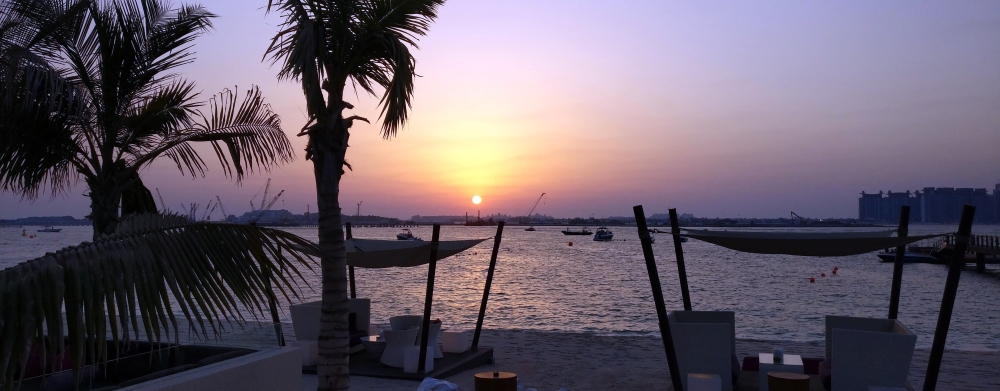
Was Odysseus in Dubai?

From Shiro Kuma by kumablog

dubaisundown - Edited
After two weeks in Tōkyō, I am now giving a few classes here in Dubai. The group of Bujinkan UAE, led by Anjaan is doing well, and new faces have appeared on the mats. The beauty of this training group is that it changes a lot as people come to work in Dubai for a limited time. Also, it is a melting pot of nationalities from the Middle-east, to Asia, Europe, and the Americas. They should call it the “Babbel dōjō!”

I’m often travelling to Dubai when I’m back from Japan or India. I love to stop here for a few classes when I can. However, my post today is not about Dubai, but about how wrong we can be as a result of expectations and overconfidence.

We know the tale of Odysseus coming back from the Trojan war. And his neverending 10-year trip back home to Ithaca. (1) During his adventures, Odysseus had to pass the dangerous Strait of Messina (Sicily). The legend said that two sea monsters the protected it: Charybdis and Scylla. (2) (3)

I was sad to leave Japan but happy to get out of the deadly heat wave. Training on this trip was more demanding and resembled a sauna experience. Naively, I thought that the Dubai heat would be drier. I was wrong! Like Odysseus, I went from one heat monster into another one.

The same lack of awareness or discernment is common when we train. In Budō, we call these “sea monsters”: expectations, and over-confidence. In Mutō Dori, expectations are wrong because there is no technique, thus nothing to expect. Moreover, if you are overconfident in your abilities, the wake-up call can be painful.
dubaiheatDo not expect anything, but be prepared for everything.

Speaking with Anjaan yesterday, he said, “this is like mixing the Dunning-Kruger effect with Murphy’s law!” That is so true!

Reminders
“In the field of psychology, the Dunning–Kruger effect is a cognitive bias in which people of low ability have illusory superiority and mistakenly assess their cognitive ability as greater than it is.” (4) Murphy’s law needs no explanation. (5)

On Expectations
Before I left Tōkyō, Anjaan wrote that many students are on holidays. However, yesterday thirteen participants joined this first class. So that was unexpected. Do what to do to the best of your possibilities even if you are alone. Excellence doesn’t need an audience!
On Overconfidence
At the Bujinkan UAE dōjō, I did my best to share what Sensei did in Japan, but I couldn’t. Because I understood what he did, I presumably thought I could do it. I was wrong.
An extended period of maturation is necessary to transfer new knowledge from the brain to the body. A few months are needed, at least, to get that in my taijutsu, if I can ever incorporate it.

Expectations and Overconfidence are not the proper Mutō Dori.

In the Bujinkan, we learn that failure is always Ok. When I took off from Narita, I knew that it would not be easy. The oracle told Odysseus, before leaving, that his return trip would take years. So, both Odysseus and I knew our fate before leaving (except that I didn’t need an oracle).

At the Bujinkan UAE dōjō yesterday, I was not “expecting” to “have it,” but I tried it anyway. There was no surprise; it was like “Banpen Fugyō” of the Gyokko Ryū. Hatsumi sensei with his Mutō Dori prepares us for it! Be always ready and never surprised!

On a side note and between you and me, Odysseus didn’t make it to Dubai. The Suez canal was not built yet, and I’m not sure that the beautiful Dubai existed yet. (6)

____________________
 
6. I read that a “Suez canal alternative” existed during Greek and Roman times. Naval exchanges linked East and West through the oceans. In Cairo, a canal connected the Nile to the Red Sea. The Egyptians called it “the customs’ canal” for logical reasons. Since then, the canal doesn’t exist anymore. But I read that, in Cairo today, you can still see a greenish line caused by higher humidity in the soil. The green line is perpendicular to the Nile and heads towards the Red Sea. But, our friend Odysseus would have needed another ten years to go to Dubai and go back home.
PS: sorry for the picture. 🙂
You want to stream? Join www.koimartialart.com today!
…

Good Or Bad, Keep Laughing!

From Shiro Kuma by kumablog

Only 40 participants yesterday night at Sōke’s class. We had so much space to train that the Dōjō felt empty.
It was my last class for this trip, and Sensei taught control with taijutsu, hanbō, knife, sword, and bō.

He insisted again on the importance of control being the theme for this year practice. Controlling is beyond action. At the beginning of the class, he said that “It’s not about taking or not taking, it’s about control.” When we train, we try to copy his movements and do not focus enough on the invisible aspects of what he does. By copying the visible, we cannot grasp the subtle essence of the control. Often he will repeat the same action a few times, but he will adjust it depending on how his partner reacts. Even though we see the different movements, we only do one of his many variations.

When this happens, we tend to forget that control is not about a given technique. About Mutō Dori technique, he said, “I’m not avoiding, I’m just controlling.”

We also trained with two swords. Sensei blocked and controlled the sword of Uke, then swept it away. The sweep action was done by one body movement. This body flow creating a whiplash effect. After letting us try it a few times, he said that “I’m not spinning the sword but going with the flow. It is the body and not the sword that controls the attack.” A whole body movement is the only way to get this. To do that, keep your arms close to the torso and move the body.

Alex Meehan from Ireland was training next to me. He told me that some physiotherapist watched some videos by Sensei. This therapist doesn’t train martial arts at all. But after watching a few clips, he said, “this man [Sōke] is amazing. He has the rare ability to move each part of his body independent of the rest.”

This comment from an outsider is fascinating. We are used to seeing Sōke move the way he does. Because of habit, this prominent aspect of his body movement is so natural to us that we don’t see it anymore. Moving one part of the body, while being fully relaxed in the rest, is what makes the Bujinkan a fantastic martial art.

Unfortunately our insistence in “doing a waza,” doesn’t allow this to happen. If we want to move like Sensei one day, we have to train this.

The “nonchalance” of Sensei’s body, is how he is able to control us. He is not fighting (Tatakai wa Janai) but he is not avoiding either (Yokeru Janai). He said, “I’m teaching all aspects of control, not how to attack.” Control is a complex ability in which our actions can “fool” Uke without the mind even trying to. It is not a decision put into motion, it is a natural body attitude. To reach this, we need to train more, and for a long time.

This is why we fail so often. And this is good. Failing a lot on the mats is the only way to get it right, the day we will need it. In training, there is no right or wrong, only learning. We do our best and fail until we succeed. This is the “fake it, until you have it” principle.

In any case, good or bad, we have to be happy to train.

During the class, Sensei took the knife from Tezuka san and asked him to explain what he had felt. Tezuka san was going to speak when Sensei threw the knife at him. Still caught in his thoughts, he grabbed the knife. He was not watching and was surprised to see it in his hand. Sensei laughed and said, “It is essential to laugh whether it is good or bad.”

Sensei was in an excellent mood, and we laughed a lot. That was a memorable Bujinkan moment. I’m leaving today with this in mind, and I cannot wait to be back in a few months to continue my training with him.

“Good Or Bad, Keep Laughing!” and be happy!

__________________________

I will be back in November 2018 for Sensei’s birthday. Thank you for reading my posts,  I hope they help you. Please share your thoughts and experience in the comments. I hope to meet you on the mats one day, in Japan or during a seminar.

Join www.koimartialart.com today and get immediate access to more than 90 Go of Bujinkan techniques.…

Move Right Instead Of Left

From Shiro Kuma by kumablog

nagatojul2018
Nagato sensei always surprises me by moving his legs reverse to what I am used to doing with Noguchi sensei.
 
Each time I repeat his movements I have to think hard not to move wrong.
 
I was training with Martin from France (Naka Ima Dōjō, Lyon), he was Nagato’s “meatbag” of the day. (2) And as he trained a lot with me over the past years, he has acquired the wrong footwork to train with Nagato Sensei. Both, we had a difficult time doing the correct first step when receiving the attack. 
 
When Nagato sensei receives an attack, he steps backwards with the right foot. Then again sideways with the same leg. This creates a space in which he takes Uke’s balance in a natural manner. The distance created in this way, allows him to protect his body from the other fist and to dodge any second attack. Also, it prevents the attacker to kick immediately as Uke must first maintain his balance. A simple movement like that is why each class in Japan is important. Too often we keep doing the same moves, In fact, it is demanding to change our habits. Do not forget that coming to Japan is not a holiday. It is a time to rethink your taijutsu.
 
Humans are reluctant to change, we know it. You need to put your ego aside to get new ways to train. Coming to Japan is a chance to improve your taijutsu as a whole. I wrote many times about how boring some classes may be if you don’t try to do what the teacher is asking. When you are capable of “opening your eyes”, you discover a lot more than if you only come for an “exotic experience”.
 
The classes with Nagato sensei, Noguchi sensei and Senō sensei, are a perfect example of how you can learn from easy techniques. When the Japanese Shihan do a technique, it always looks simple. But when you try to copy what they want you to do, the simplicity vanishes and you find yourself lost on the mats.
 
During the break, Nagato sensei repeated what Hatsumi Sensei keeps saying. “at the Mutō Dori level, there is no technique.” Each time we want to do a technique we are trapped in our mind, and our body is stuck as a consequence. Apply the Muishiki concept. (2)
 
Trying to reproduce consciously the technique, is a paradox. How can you move “unconsciously” when you want to copy a technique. But still, it is the way to go. These conscious movements will become unconscious. But only when timing, angling and body flow are good.
 
My advice, after this class. Try to reverse your steps (left to right or right to left) in your next training. Whichever leg you use to be moving first, change it, and move the other one instead. You will discover a new facet of your taijutsu, hidden in plain sight.  
 
Hatsumi Sensei said once that Budō is the art of making the invisible, visible. Do that, and some invisible side of your taijutsu will come to light!
 
The Japanese Shihan have been training with Sensei more than any of us. Those great teachers were not good at the beginning. If they are good today, it is because they kept going and remodelling their certitudes into new ones. We call that progress. If you don’t progress, you stagnate.
 
Do the same and spread your wings. Budō is endless, it only ends when you die.
 
And remember, in your next class, to move the right leg instead of the left leg.
_______________________
 
Note to Koi ALL ACCESS members: You can see some of the movements we trained on http://www.koimartialart.com in the “Dōjō: Tips and Tricks” section. HERE
You want to join? CLICK HERE
…

Rekishi: History

From Shiro Kuma by kumablog

IMG_20180729_120812
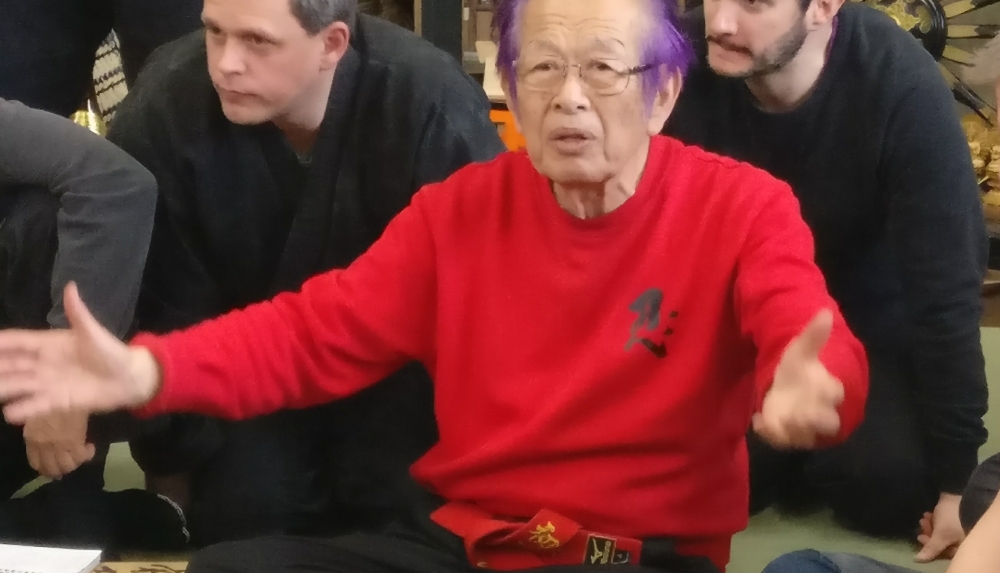
As far as I remember, Sunday classes at the Honbu are special. When at the old Honbu, Hatsumi Sensei always invited a few of us to lunch with him. We moved to the new Honbu in February 2015, and this tradition stopped. Sensei is now more talkative.


I used the word “tradition” voluntarily here. What is a tradition? Google says, “the transmission of customs or beliefs from generation to generation, or the fact of being passed on in this way.” What he did was to share the Bujinkan spirit with his older students (October 1997 and February 2015).
At lunch, he would take the temperature of the Bujinkan, and speak about the Bujinkan. I have good memories of those moments.

IMG_20180729_120905

But in the recent Sundays, Sensei moved from “tradition” to history. He often speaks now about the old Jidai. (1) With better knowledge about history, he wants us to prepare the future Jidai of the Bujinkan. (2)

He wants us to understand the symbol of Samurai warfare, the sword.

Last Sunday, he arrived from his usual sword dealer with six new swords and detailed them to us. He said, “high ranks must understand the Japanese sword. This is the key to unlock the understanding of Mutō Dori.”

IMG_20180729_120904History is significant when you train martial arts, this is not a sport. Japanese history is about survival, and these weapons made it possible.
By understanding the weapons, you get a glimpse on how you can move with them and survive in battle. And he wants the Dai Shihan to get this.

History comes from the Greek ἱστορία – historia, meaning “inquiry, knowledge acquired by investigation.” It is Rekishi in Japanese. History is the discovery, collection, organization, and presentation of information about past events. (3)

IMG_20180729_120714We have to study Rekishi should and investigate it seriously. That is if you want to get the knowledge of the Samurai.
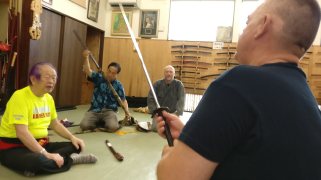
Our Waza were created during the Sengoku Jidai, (4) -what historians call the “Age of Warring States.” This period began with the Ōnin wars (1467-1477) and lasted for about a century. (5)

Oda Nobunaga emerged from this time of chaos and began the unification of the country. It will end with Hideyoshi, and bring Japan to peace with Tokugawa. This extended period of five centuries is the Bujinkan Jidai!

IMG_20180729_120028The history of the Samurai is what makes Japan so different from our own history. Initiated by Minamoto no Yoritomo with the Genpei War (fall of the Taira in 1185), a new Japan is born. (6)
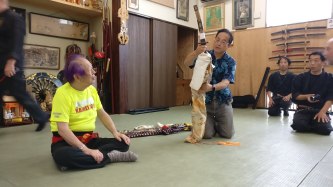
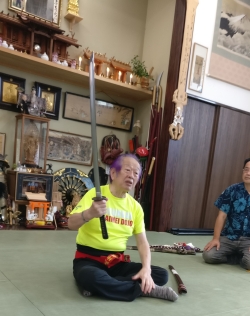
The victory of Tokugawa at Sekigahara in 1600 completes the transformation. (7)

Our fighting arts are the means with which these changes were carried out on the battlefield.

IMG_20180729_115706

Ignoring Rekishi is limiting the Bujinkan to another sport martial arts.

Thus the reason why Sensei wants us to study it.

The dōjō logic replaces the military needs with a form of business at the beginning of the 17th century. It is very far from the Yoroi logic developed on the battlefield.

img_20180729_115924.jpg

This is during this period that the Katana (Edo) replaces the Tachi (Sengoku). As a consequence, Tameshi Giri will develop only after the Samurai stopped fighting. (8)

This is the knowledge Sensei wants us to get.

One thing Sensei said on Sunday, was that “you should know what weapon is good for you.” Study them and use the ones that fit your abilities.

The Bujinkan Rekishikan (9) covers the 12th to the 17th century.

It should be studied like any other Waza.
Rekishikan can lead to Reishikikan, and give us “the intuition to have the correct manners of a knight.” (10)

_________________
1. Jidai 時代; period; epoch; era; age
2. Jidai 次代; the next era
3. Rekishi 歴史; history
8. In times of peace, there is no need to wear the Yoroi. It was then possible to cut with the sword instead of only stabbing (Tachi).
9. Rekishikan 歴史館; historical viewpoint
10. Reikishikan 礼騎士勘; Rei: manners, etiquette 礼; Kishi: knight 騎士; Kan: intuition 勘
“Netflix is not good for your training! Join www.koimartialart.com and get access to 92 Go of Bujinkan videos.”
…

Muishiki: Unconsciousness

From Shiro Kuma by kumablog

IMG_20171126_125042_01

These days Hatsumi Sensei arrives late and leaves late. It is not rare these days to finish three hours after the beginning. And Sensei explains a lot in class and during the breaks.

Sunday was no different. And Sensei is full of projects. He is getting a hundred Ninjatō swords to make an exposition. He wants to show the public how wrong scholars are about Ninpō. He is also preparing a new book with Kodansha on swords.

During class, a group of more than seventy were present. Sōke said that Dai Shihan should now train with a metal sword to understand the type of control of Mutō Dori. In the movements, he then detailed more of his understanding of “control.” Control is an essential part of Mutō Dori, but I guess that by now, you have figured it out.

Like in the previous sessions we did each technique with taijutsu, knife, hanbō, biken, and bō.

One concept he developed is “Muishiki,” unconsciousness. (1) This is the mental state where Mutō Dori can express itself. There are no more waza, no techniques.

What he does is beyond that. This also makes it very hard to explain with words. This is why in this post, I will use the words he said during training. Every quote will help you understand what “control is. It is not simple, except when he does it.

“Come close and stick to him.”
As always distance is a crucial element to master control. As there is no technique, what Sensei does is pure taijutsu. When you are afraid of the attacker, he feels it and continues even more to attack. By using “Yokeru Janai” (don’t avoid) and “Tatakai wa Janai” (don’t fight) (2), you stay close to the attacker and stick to him. This closeness forces him to react and stops his actions. Each Uke Sensei used stopped their attack after one movement. As we said earlier, they looked like suspended in mid-air. (3)

“Uke must not know what is happening, it is essential.”
Uke stops because what he faces is not logical. As Sōke is Muishiki, there is no intention he can detect. At the same time, there is no waza. Uke stops because there is no fight. He stays there because he doesn’t know what is happening. All senses are out.

“You’re not attacking or hurting him, you’re controlling.”
The quality of the control makes this lack of feeling possible. You don’t fight Uke, you position your body out of his reach but keeping contact with him. There is no fight, only control.

“Amo Isshun no Tamamushi.” (4) (5)
Ae you don’t use or show any force, Uke is not willing to attack. Sensei used the image of Amo Isshun no Tamamushi. The bee trapped between your hands will not sting because it is blind. It is unaware of what is happening.

“Remember to control within the space. Use the space within.”
Because Uke doesn’t feel, he is not threatened. You keep him controlled within the space. (6)

Muishiki is part of all that. It is like some Buddhist techniques of active meditation. You are free to move and to do whatever is possible. In Mutō Dori you are in control of yourself, of your opponent, and of your environment.

Muishiki. You are one with the universe.
_____________________

1. Mu Ishiki 無意識; unconsciousness
2. On Yokeru Janai and Tatakai wa Janai see HERE
3. See more about Ubaku in Hi no Ken HERE
4. Amo Isshun no Tamamushi: 中一瞬 の 吉丁虫. 中 amo: centre, inside, during. 一瞬 isshun: one moment. 吉丁虫 tamamushi: jewel beetle
5. On Amo Isshun no Tamamushi HERE
6. Control within the space HERE
Stream 92 Go of Bujinkan techniques with www.koimartialart.com
…

I Quit The Bujinkan!

From Shiro Kuma by kumablog

20180728seno1

After trying my best for many years, I have come to the conclusion that I have to quit training. At least, this is the feeling that everyone must have had today during Senō sensei’s class.

Today only fourteen came to the Honbu to train. I found it strange. Friday night, more than seventy participants attended Sensei’s class. I guess the light morning rain is to blame.

Only black belts were training, and a majority of us were fifteenth dan. Everyone was lost. And I guess that many were wondering what they were doing there. No one in the room could reproduce the two techniques of Senō sensei today!

Many like me must have thought: “Ok, this is too much, I quit the Bujinkan!”

And the techniques were simple: Omote Gyaku (taijutsu); and Tsuke Iri (hanbō). Finding something more fundamental is hard. But in Senō sensei’s personal blender, they become impossible.

We could have done them as we usually do them, but then why bothering to attend a masterclass? The others might have thought that. Who needs to get out of the comfort zone? And it was raining, you know?

Even though I couldn’t do them the way he demonstrated them, I will give you here a few glimpses of what he did.

Omote Gyaku:
On a right Tsuki. You absorb the fist with the right hand, your legs are in Shizen once you have the perfect distance. Then with a step to the left, your body gives the attacking hand to your left hand. The right elbow is close to the body to provide the power through the legs. But keep a certain distance between Uke and you. If you get too close, he will attack with the other fist. Your body is now on the right side of Uke, feet in Shizen. Your right thumb hooks Uke’s thumb. At the same time, your forefinger creates a Shiten on the wrist/forearm. There is no force.

Then using the other fingers as if playing the piano you turn the soft grip from the right hand to the left. You do the “piano” movement at the same time you move your left leg forward so that his hand is now at this side. You lower his arm, and the Omote Gyaku takes his balance. It is very subtle.

If you did that, the way I describe it, then you are better than me. Let me know in the comments.

Tsuke Iri with Hanbō:
On a Tsuki, you step backwards while being in contact with Uke’s arm. Your Hanbō is in line with the fist. The Waki Uchi is replaced by the Hanbō placed on top of the shoulder. Pulling the weapon and the arm to get his balance, you do a twist to the arm while stepping to the side. When you do that, it keeps the tip of the Hanbō in place on top of the shoulder. If you did the correct footwork, you are now more on the right side of Uke. From there, you exchange hands (arm/Hanbō) and continue to move towards Uke. Your Hanbō goes down vertical on the outside of Uke’s body. It locks Uke, and you take his balance with your footwork.

As I never figured out how to do the change of the hands, I never reached the right end of the movement. Once again, if you succeed, let me know in the comments.

Two hours, two basic movements. And a strong feeling of despair for everyone that attended the class today.

How come after so many years, we are unable to get this subtlety in our taijutsu. Is it time to accept the Bujinkan is not made for us? Or should we come more often, and learn with a “student mind,” the many things we still have to grasp? I guess the second option.

The difficulty of these basic moves is the reason why after many waza it says “there is a Kūden.”

As you all know, with his swollen legs Senō sensei cannot walk. Each step is painful. But, each Saturday, he comes and teaches at the Honbu, no matter what. No one forces him to do it. He does it because of his commitment to the Bujinkan and to Sensei. The Bujinkan is about resilience and perseverance.

And still, only fourteen attended his class!

_______________________________________
Online streaming www.koimartialart.com…

One Finger Is Enough!

From Shiro Kuma by kumablog

FB_IMG_1520066757336
Hatsumi Sensei showing the “one finger control” last December


Hatsumi sensei controls distance with only one finger. When you attack him, he moves away enough to place one finger on your attacking arm. He adjusts it on the hand, wrist, or forearm, and applies no pressure. Instead, there is only soft physical contact.

Sensei said that Josei Goshin Jutsu (1), to fight like a woman the last thing he learned from his teacher. He said it is the most challenging thing that he ever trained. Controlling the opponent’s violence without force is the highest level of fighting. This is Mutō Dori.

During wartime, we can use more violence. But in the 21st century, we have to limit our reactions to what is legally accepted. During peacetime, this type of control is vital as everyone must obey the Law. Be aware that legal environments differ significantly from one country to another.

“Self-defense is a countermeasure that involves defending oneself, one’s property or the well-being of another from harm. The use of the right of self-defense as a legal justification for the use of force in times of danger is available in many jurisdictions, but the interpretation varies widely.”

France has adjusted the laws about self-defense since January 2015. The violent terrorist attacks have created a near war state in the country. So, the law has evolved. (2)

Josei goshin jutsu is more powerful because it doesn’t need any strength. It is hard for practitioners to understand they can solve a fight without being violent. This is the famous “Chikara Janai” repeated by Hatsumi sensei in class. (3)

Sōke said that we keep using speed and strength even though he asks us not to do so because of wrong timing. He said that “everybody is rushing because we are late.” Using an analogy, he added, “it is like catchball, expect the point of arrival in space and time and bring in.” Anticipation is all you need.

When studying “Kannin Dokuson,” we learned to control everything: the opponent, us, and the environment. (4)

Last Sunday Sensei said that “if you are controlling yourself, then it is all the same.” By controlling yourself, you do not react too early but at the correct moment. Your timing will match the attacker’s speed and moment, and you will be able to control him with only one finger. When you can control yourself, you do not show anything. If your intentions motivate your actions, you make mistakes.

What you do when you are at the right distance and at the right moment depends on the attacker. It is not your fight, it is not your decision. Your actions are natural it is not a technique. He said that “whatever you have, use it.”

There is no technique because, at this level of Mutō Dori, we are way beyond the technical realm. (6)

Do you want to be invincible? Fight like a woman with “Josei goshin jutsu,” and you will always get the finger distance right.

And don’t forget: “One finger is enough!” (7)
_____________________________

1. Josei Goshin Jutsu: 女性護身術; woman art of self-defense
2. Terrorist attacks of Charlie Hebdo, the Bataclan, The Stade de France, Nice, etc
3. Chikara Janai 力じゃない; there is no force
4. Kannin Dokuson 貫忍 独貴; respect Uke, yourself, and the environment.
KAN 一貫/ikkan/consistency; coherence; integration; 貫/kan;
NIN 忍/nin/endurance; forbearance; patience; self-restraint;
DOKU 独り/hitori/one person|alone; solitary;
SON 尊/son/tattobu/to value; to prize; to esteem; to respect; revered; noble
5. Read https://kumablog.org/2017/01/20/kannin-dokuson-first-approach/ and after

6. Mutō Dori: check our streaming platform www.koimartialart.com
7. One finger is enough: Yubi Ippon Jūbun, 指一本十分
…

Sōzōryoku: Creativity And Imagination

From Shiro Kuma by kumablog

received_10212355079744395.jpeg
Noguchi sensei’s creative power is impressive! It is called “Sōzōryoku” in Japanese. Now, depending on how you write it, is (the power of) creativity (1); or (the power of) imagination. (2)

After training with him for more than 28 years, I am often surprised by his way of destructuring the Waza. This is still beyond my abilities. All the techniques we train in the dōjō are coming from the Densho.

Each class, Noguchi sensei read the technique as if it is the first time, and comes up with a new interpretation. Over the years, he has developed his own destructuring pattern. But I find the variations of these popular movements always surprising.

I guess this is due to the way the Japanese language plays with concepts and images instead of words, the way we do. By playing with the many meaning of one given set of kanji, you can come up with an infinity of interpretations.

For example, Sōzōryoku as “the power of creativity” is a mix of “genesis+create+power.” (3) (4) (5)
But when Sōzōryoku has the meaning of “power of imagination,” it is “idea+form.”
And with a Buddhist spiritual connotation, it becomes “perception+appearance.” (6) (7)
The many interpretations of the Kanji make Japanese more alive than western languages. In that respect, this is what makes Noguchi sensei’s taijutsu so playful.

Here are the definitions of the dictionary for creativity and imagination.
“Creativity refers to the phenomenon whereby a person creates something new that has some kind of value. What counts as “new” may be about the individual creator, or to the society or domain within which the novelty occurs.”
“Imagination also called the faculty of imagining, is the ability to form images and sensations when they are not perceived through sight, hearing, or other senses. Imagination helps provide meaning to experience and understanding to knowledge. It is a fundamental faculty through which people make sense of the world, and it also plays a key role in the learning process.”

Creativity adds value and imagination makes sense. Both are the sources of Mutō Dori. You can see them as two legs, to walk you need both of them. And proper walking is the secret of Mutō Dori. Through creativity and imagination, we will be able to move like Sensei does.

The way Hatsumi Sensei and the Japanese Dai Shihan move, is the result of their fantastic ability to rethink the already known. Keep in mind that they have been repeating the same Waza for more than fifty years! And still, they surprise us every class.

So, remember that, next time your students (or yourself) complain about repeating the Sanshin no kata and the Kihon Happō.

Sōzōryoku is the real training, and the correct path to develop your own taijutsu.
_____________________

1. Sōzōryoku 創造力; creative power.
2. Sōzōryoku 想像力; (the power of) imagination
3. 創 = genesis
4. 造 = create
5. 力 = power
6. 想 = conception; idea; thought . It is also “perception” for the Buddhists (Samjna)
7. 像 = image; picture; portrait , form; shape; appearance…

Sakizuke: The Ranks You Don’t Deserve!

From Shiro Kuma by kumablog

sakizukeThis morning, I was exchanging with my friend Leandro Barros from Brazil. We were discussing ranking in the Bujinkan.
He had read an article on Sakizuke by Duncan and was wondering when he should grade his students. (1)

This article is a reminder about the benefits aspects of the Sakizuke system. (2)

In modern Japanese, it means “appetizer.” (2)
When breaking it in two, you get “earlier” (3) + “add” (4).
Both mean that the “real stuff ” is coming later.

Sakizuke is a typical Japanese concept. It is the way Sensei gives ranks in the Bujinkan.
The black belt ranking in the Bujinkan is not a system based on rewards like in sports. You know why? Because the Bujinkan is not a sport! The Bujinkan teaches Budō, not entertainment.

The Sakizuke is for the black belts. But beginners need a comprehensive grading system. For many years I did like everyone not having exams for my students. Then I noticed they were quitting fast. So in 2005, I created a grading system for the Kyū belts covering the whole Tenchijin, and they began to stay. For a beginner, I guess it is essential to know what they know. Also, do not forget that in Japan, you get a black belt when the teacher thinks you have understood your basics. Shōdan, first Dan, means that you move wrong but that you are accepted as a student by your teacher. Coloured belts for Kyū is a Westerners’ invention. (5)

You can find the various modules for beginners on Koimartialart, my streaming platform . (6)

The real question is how do you rank your black belts? This is where the Sakizuke system comes into play. To understand the Sakizuke, imagine you get a gold medal and then you are asked to win the race. This is how it works.

Duncan says it better:
“The ranks in the Bujinkan are for the heart. Those with the right heart will accept rank from their teacher without question. Students having a feeling of discomfort or inadequacy for their new rank, should then go away and train hard until they become worthy of the grade. This is understanding Sakizuke and the correct feeling to have when dealing with the Bujinkan grades.”

Many criticize the system without understanding it. These teachers still have a sports mentality. The Sakizuke is typically Japanese, it is part of Budō.

I have a pleasant memory that might help you understand it. When I was 13th Dan, I had a coffee with Sensei in his house. At one point he said that he wanted to promote me to 14th dan.
I told him that I was not worth my 13th dan yet. He looked at me and said, “yes, but you are getting close to deserving it. This is why I want to give you a 14th dan.” I objected that I would be back to Japan four months later and that he could give it to me at this moment. “No,” he said while filling the diploma, “If I die tomorrow, you have the rest of your life to be worth it.” This is Sakizuke.

Your rank is a potential level. It is up to you to deserve it or not. Many high grades in the Bujinkan don’t understand it, which is why some have a deplorable level. Don’t be that kind of black belt. Be aware of your level and study hard to be worth it. At the end of the day, your rank will not protect you in the streets, train hard if you want to survive.

Bujinkan ranks are traps for your ego, they are a challenge to your intelligence. Accept them but train harder and fill them with sweat. See your rank as a container. From the outside, it looks like the Schrödinger’s cat who is dead or alive; your tank is either full or empty. What is inside only depends on you. (7)

The Bujinkan is Ura, so leave the Omote, and enter the Ura side, because there is much more to gain for your Budō and your life.

Be happy!

________________________

1. “Thoughts on Ranks” by Duncan Stewart (June 2012), https://tazziedevil.wordpress.com/page/2/
2. Sakizuke 先附 or 先付け; appetizer, postdating
3. Saki 先; earlier
4. Suke 附; to add, to join, to attach
5. Coloured belts: When Jūdō came to Europe, Kawaishi Sensei was forced to accept the coloured system by the French federation of Jūdō in exchange for a working permit! This system was then adopted worldwide, in and out of Jūdō. More on that: http://www.todayifoundout.com/index.php/2015/07/history-color-belt-scheme-martial-arts/
6. https://www.koimartialart.com
7. https://en.wikipedia.org/wiki/Schr%C3%B6dinger%27s_cat…