From Bujinkan Santa Monica by Michael
What are the current Bujinkan Themes?
For my second week of Japan training, I begin with a visit to 上野東照宮 Ueno Tōshōgū. This shrine was built in 1627, and enshrines Tokugawa Ieyasu. I have visited many times, but they did an extensive remodel a few years ago. This was my first time going beyond the 唐門 Karamon and into the grounds. The entire 本殿 Honden is covered in gold leaf and looks spectacular with the gingko leaves fluttering down around me.
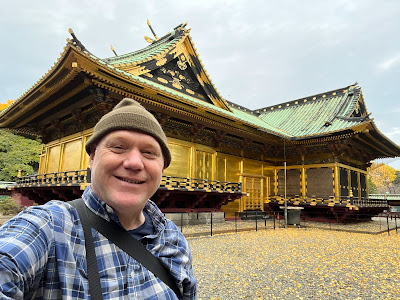 |
| Michael Glenn at 上野東照宮 Ueno Tōshōgū |
Later that night, I arrived a bit early for Nagase Sensei’s class. He had moved the class time back 45 minutes so I took the opportunity to review my notes from the prior class. He has been working with 十方折衝 juppō sesshō and the directions for 天地人 Tenchijin and the sanshin within it.
He described many aspects of Tenchijin. He would control his opponent at three points, high, middle, and low. He told us the Ten direction is 天照大御神 Amaterasu ōmikami. The Chi direction is 国常立尊 Kunitokotachi no mikoto (that’s how people pronounce these kanji). And the Jin direction is the spirit across from you, or your opponent.
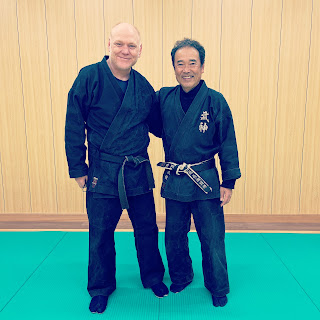 |
Nagase Sensei and Michael Glenn December 2022
|
He also emphasized these three points on the jutte: the tip; the pommel; and the hook. He told us that we have sanshin in our training development. Learn taijutsu up to godan, bōjutsu from godan until judan, and kenjutsu until 15th dan. Then after that is what Soke teaches with mutō dori.
The next morning I dressed up to go to the Daikomyosai party AKA Hatsumi Sensei’s birthday party. I wasn’t sure what to expect. Soke has had some health issues and everyone in Japan is taking precautions for the virus. There was a joke going around that we would all line up in the parking lot and Hatsumi Sensei would drive by and wave like the Queen.
Since the Bujinkan Honbu Dojo is still closed (as of December 2022), People ask me about class schedules and where is there training in Japan right now? They see my photos of my training at various dojos in Japan and they want me to give them the location and the schedule. That is not how it works. These are private classes and you have to be invited or ask permission.
Technically you even need permission and must be a “member” of the Bujinkan to train at the Honbu dojo. But in actual practice, anyone can drop by a class if it is on the schedule. But we all know each other, and strangers stick out…
For private dojos, every teacher is different and has different expectations, but it is customary to ask first. This is why it is so important to form good relationships with the teachers. Or if you are new to Japan, your own teacher should have these relationships so they can give you an introduction.
Back to training updates from Japan. The next morning, I went to Furuta Sensei’s dojo in 茨城県 Ibaraki-ken. He came to pick us up from the train station for a 25 minute drive to his house. It is a nice old Japanese house with a garden and an out building for a dojo. We trained for a morning session, then had lunch in his kitchen. Then we did an afternoon session.
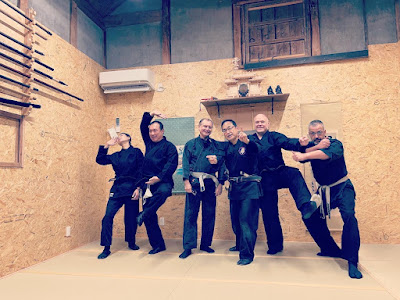 |
Furuta Sensei's Dojo December 2022
|
It seemed like Furuta Sensei had three years (pandemic years) worth of teaching waiting to get out. He had so much to share. He told us that many martial arts in Japan are like 化石 kaseki, or fossils. They are being preserved but there is no life in them.
Furuta spoke about kata and densho. He said these are like samples of a dish. You can take a bite of something to taste it, but that is not a meal. He said that people who only do kata or densho are missing the meal. This is something I often say to my own students. The Bujinkan is not just kata or the densho, it is also the kuden and direct transmissions from teacher to student that are not on any menu.
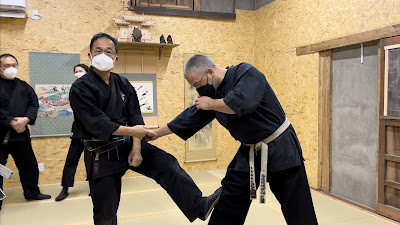 |
| Furuta Sensei said ここ当たり koko atari |
During training, he had some peculiar angles for evasion. He also showed various places to strike kyusho as he said ここ当たり koko atari, meaning “hit here.” I found out later why things looked strange to me.
After training, he took us out to dinner to a local Soba shop. If you didn’t know, Furuta will be the next Soke of 雲隠流 Kumogakure Ryū. So over dinner he shared that his recent training used the strategies from this school. He would hide himself in the space with subtle angling of his body, just like mountain hiding it’s slopes in the clouds.
Now I realized why all of my classes with him felt different. He had been expressing ideas from Kumogakure Ryū and I didn’t know it. Based on this new insight, I had to go back and revise my notes from each training session with him!
On the flight home from Narita to Los Angeles, I spent some time reflecting on Hatsumi Sensei’s birthday. The party was great fun for me. It had been 3 years since I had seen most of my friends here in Japan. Everyone was happy to let loose a little.
My friend from Senou Sensei’s dojo, Sasa, was entertaining our whole table. Sayaka, Ueki, and Hirotoshi kept things youthful and I enjoyed their wonderful smiles and energy. Nakagawa-san dressed up like some kind of scary geisha with unkempt nose hair and bad jokes.
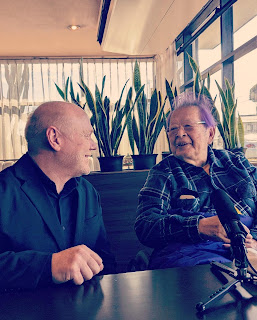 |
Hatsumi Sensei and Michael Glenn Dec 2022
|
 |
| Hatsumi Sensei and Michael Glenn Dec 2022 |
The restaurant has two levels. Hatsumi Sensei sat downstairs and we took turns visiting with our birthday gifts to him. I made this trip to Japan in his honor and I felt lucky I was able to see him.
I made a video about all of this while I was in Japan that you can watch here: Japan Report December 2022 Part 3
…