Skip to content

Bujinkan on Television

From Bujinkan Santa Monica by Mats "Toryu" Hjelm
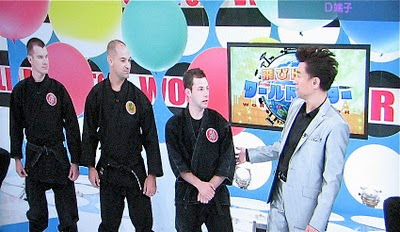
Dimitri, Duncan, Daniel on TV
Since I live and train in Los Angeles area, I receive many invitations to appear on TV shows.  Some of these are big popular shows on major network television.  The producers usually call or e-mail me and say that they are doing a show on the topic of Ninjas, and they want to find a gang of black clad people to do some crazy ninja flips while spewing throwing stars around the studio.  I always decline their exploitation.

There is something very important to understand about Bujinkan in the media.  The media almost always present something fake.  They do this because their goal is to sell advertising, not to inform anyone about anything real.  What sells more ads, the cartoon, movie flash of Ninja that people want and expect to see, or real training?  We have to admit, VERY few people are interested in real training.  But a lot of people love NINJA!

I have worked in film, television and the entertainment business for much of my life and I know this fact first hand.  Every show I have ever worked on that uses "real" people for part of its content, chews them up and spits them out.  They are rarely allowed to present their truth.  Where I live, with Hollywood Boulevard 10 minutes from where I train,  that showbiz mentality is just part of the fabric of life.  Most people here have come to expect the falsity of it.

So when any Bujinkan member somehow gets invited (or coerced) onto television, they should expect this repackaging of themselves to sell ads.  If you expect it and you go there to do your best to represent your art, you may sneak some reality in, but don't be disappointed if it makes you look silly.  Because it inevitably will.

Hatsumi Sensei has become very media Savvy in all his years of dealing with them.  He seems to know and accept the reality the media offer.  And by knowing this, he can choose to participate or not.  When he does, he takes full advantage of the opportunity.

My friend Duncan Stewart was on Japanese Asahi TV recently and he says this about the experience:
I knew that whatever I did, it would be difficult to give a good example.  This was because we were at the mercy of the Director and the editorial department, not to mention my own nerves. Also, the television show we were to be on was a very light hearted “variety show” aimed a comedic entertainment.  Regardless, I took the opportunity to learn first hand what Soke often talks about in regards to public demonstrations for the mass media...

Soke advised me on this type of thing before I went to the studio. However, like most things in life, you never understand the words of wisdom you receive from your teachers/parents until you experience them directly.
So I applaud Duncan for his transparency and willingness to jump into the fire of TV.  He looked great, and obviously is learning much more than combat skills from Hatsumi Sensei.

The "Ninjas" in the first part of the segment are not Bujinkan nor affiliated with Duncan.


…

Ki is Natural not Magic!

From Shiro Kuma's Weblog by kumablog

contemplation
  • (version française)
  • In the Abidharma sutra the Buddha (5th century BCE) says that “nothing is created, all is energy”.
  • At about the same period Anaxagoras, a Greek philosopher said that: “Nothing is born nor perishes, but things already existing combine and then separate again”.
  • Much later in 1789 Antoine Lavoisier, the “ father” of modern chemistry, said that “nothing is lost, nothing is created, everything is transformed”. He was beheaded (transformed?) during the Révolution Française in 1794.
  • This will lead in the 20th century to Einstein and his Theory of relativity.

But to us, martial art practitioners this is the best definition of what energy really is. It is the “thusness” of Buddhism.

Buddhists, pre socratic philosophers and scientists all agree about the endlessly recombination of everything . There is no magic here nor mysticism, only facts brought by pure observation. This “ever existent thing” is what the universe is made of. This is the “matter-energy” or “vital energy” of the universe of science and of Taoism.

気 is what we call “ki” or “Ch’i”; and it is “simply” the primordial emptiness or primordial existence of all things that flows infinitely and pulsates in everything. Ki is not esoteric at all and through long training we develop the eyes to see how it transforms itself and flows in order to adapt to it. I am sure that this is what sensei means when he spokes that we have to understand (or to get?) the “shinshin shingan”, the “mind and the eyes of the gods”. When the opponent attacks, our reaction must be attuned with the flow of the moment and this is why no preconceived idea must exist. The natural movement is there when the practitioner has the intuition of what to do next. Intuition or intuitus in latin means “to watch thoroughly, contemplation” it is the subtle observation of the situation that brings your body to move correctly.

There is no thinking because there is not time to think.

There is no time to think because time is relative.

During your next class try to react without thinking, you might discover a new world of possiblities.

Be happy!


…

Weapon Malfunctions Can Turn Into Tactical Failure

From Bujinkan Santa Monica by Mats "Toryu" Hjelm

Don't malfunction yourself.
What if your gun jams, or you sword breaks, or even worse, you have a complete tactical failure?  The first two are are easy problems, the third is more difficult, but can be dealt with naturally.  Let's consider all three in turn.

If you have any firearms training at all, you already know that you should train for malfunctions.  A malfunction in this case is confined to the weapon or the ammunition itself.  It is a malfunction of the tool you are using.  A stove-pipe, a misfeed, or the worst, a broken firing pin - are all situations that must be trained for.  One common malfunction that we don't even consider as a malfunction is running out of ammo.  Why is this not a malfunction?  The weapon is essentially useless.  We don't see it as a malfunction because this is something that we very naturally expect to happen.  We train to reload.  You should train for those other malfunctions just as you train to reload smoothly and with as little interruption to your defense as possible.

And of course this training must include making a hasty tactical withdrawal (retreat)!

On several occasions I have been training with Hatsumi Sensei and he has used two swords that have red saya.  These swords never draw properly.  He at first blamed it on them being new.  But I saw this occur again years later.  Maybe the saya have a poor fit or something.  The cool thing was, that he didn't let the malfunction slow him down at all.  He made use of the half drawn sword.  In one case he said, 
"It's OK if the sword doesn't draw.  What's important is this aspect of the sword not drawing.  You can't have the idea that the sword is always going to draw.  You must have the expectation that the sword won't always draw."

So lets consider tactical failure.  Whether with a gun, a sword, or with your tactics, use yourself in a way that you don't become an obstacle.  Don't malfunction yourself.

Don't get caught up in the malfunction so that you yourself malfunction.  The failure will spread like a virus.  Soke went on to say something simple yet profound about using weapons,
"All these things are connected and you have to have this connection within the weapon."

So if you want to overcome tactical failure, there is a natural solution to the problem.  If you understand Sensei's kuden up to this point, you will know that having a natural posture and natural heart is the secret. Soke refers to his teacher Takamatsu Sensei who said that nature lies in a sincere spirit.  And that nature will bring about the destruction of your opponent.

If this doesn't help you, remember this is kuden.  It is something I've learned and experienced directly from Soke and my teachers.  You need to find a teacher to experience it from.  You can't learn it by reading about it.


…

Gyokko Ryû No Kamae

From Shiro Kuma's Weblog by kumablog

After my previous article I have been asked to show the various kamae for the three levels of the Gyokko ryû kosshi jutsu.

All kamae start from hira no kamae (the wider shizen no kamae of the Gyokko ryû) which is using a “mudra like” hand posture. No magic here only waza. Sorry.

From these 3 hira no kamae, you move into tenchi inyo no kamae and take one of the 3 end kamae: ichimonji, hichô, jûmonji.

Goykko Ryû 1st Level

.

.

The first level uses ten ryaku uchu gassho no kamae.

This is the ten ryaku no maki or jo ryaku no maki.

.

..

.


Gyoko ryû 2nd level

.

The second level uses fûten goshin gassho no kamae.

This is the chi ryaku no maki or chû ryaku no maki.

.

.

.

..


Gyokko Ryû 3rd level

.

The third level uses hanno banitsu no kamae.

This is the jin ryaku no maki or ge ryaku no maki.

.

.

.

.


Receiving posture

.

Tenchi inyo no kamae can be seen as an evolution of the previous ones and give easy access to the 3 “normal” kamae.

Remember that the Gyokko ryû kosshi jutsu is the source of Japanese budô and that these kamae are visible with minor modifications into the other ryûha.

Be happy!


…

New Dvds Are Coming Soon

From Shiro Kuma's Weblog by kumablog

Tentô Uchi

We finished the Yari Jutsu of the Kukishin Ryû and the taijutsu of the Gyokko ryû. The videos are being edited right now and will soon be availalbe on koimartialart and budomart.

In the last year we have been quite productive:

  • Ten Ryaku no Maki: short and extended version (4 dvds),
  • Chi Ryaku no Maki: short and extended version (3 dvds),
  • Jin Ryaku no Maki: short version (an extended version is being prepared),
  • Buki Waza basics for small weapons: tantô, Kunai, Shotô, (2 dvds)
  • Buki Waza basics for medium weapons: hanbô, jo, biken, (3 dvds)
  • Buki Waza basics for long weapons: bô, yari, naginata, (3 dvds)
  • Nawa Jutsu basics: nawame (knots) and rin (loops)
  • Gyokko Ryû Kosshi Jutsu: the first level is being duplicated now and should be available in a few days on budomart, (2 dvds)
  • Bô jutsu of the Kukishin Ryû: the complete set (ready for Christmas), (btw 6 and 10 dvds!)
  • Yari Jutsu of the Kukishin Ryû: the complete set (ready beginning og 2011), (btw 4 and 6 dvds)
  • Gyokko Ryu Kosshi Jutsu: the second and third levels are recording and will be available as soon as possible,  (4 dvds)
  • Manriki Gusari Basics: A general overview on the chain and the basics of the Masaki Ryû that Sensei learnt with Nawa sensei.

And I am not speaking of the “Foundation” series covering all the techniques Kyû per Kyû from 9th Kyû to 1st Kyû. (18 dvds)

We are planning to record soon a ne version of the Sanshin no Kata and of the Kihon Happô (Gyokko Ryû style) and a set of dvds on hanbô Jutsu. After that we will move to the other schools. The next schools are either Koto Ryû and then Shinden Fudô Ryû. Which one do you prefer to have next?

Be happy!

Arnaud Cousergue


…