From Bujinkan Santa Monica by Mats "Toryu" Hjelm
Daikomyosai has started with a crunch. Hatsumi Sensei started the morning
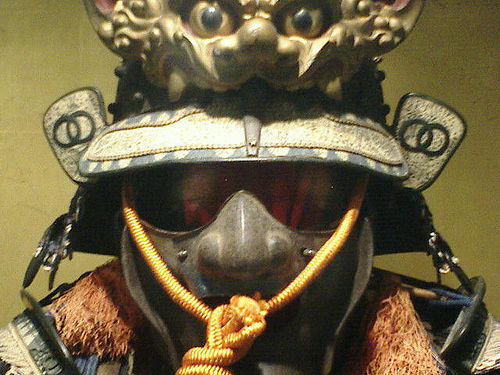
wearing armor that he said was like that worn by Tokugawa. This armor was meant to have no weak points or openings. It was impenetrable and an impressive gold color for when the shogun would lead the way into battle.
Duncan and Holger were also in armor. Sensei used Duncan as his uke and
proceeded to demolish him and his armor stitch by stitch. As Duncan put it, "my armor is now rubbish." And he later told me, Sensei used his armor against him as a weapon. It appeared very disconcerting for Duncan. Duncan is good with ukemi and there was really no useful ukemi for what he was enduring.
Sensei really has been focusing on the 15th dans while I've been here. He
wanted them all to show something that they have been exploring in their
training this year. It was a great chance for us to see how the Bujinkan is being taught around the world. Sensei called on teachers from Spain, England, Russia, Venezuela, Israel, Argentina, the United States, Australia, Canada, and more from around the globe, to share with us.
He also has been instructing the jugodans directly about the godan test.
Sometimes he even speaks during the test itself. I won't say here what he has been saying, but it's obvious he is trying to improve the way the test is taken and given.
Day 2 was more crash and smash in yoroi. Sensei had all of the Shihan battle Duncan and Holger with tachi and yari. Their movement looked great and Sensei pointed out to us that it was all unrehearsed.
Then Sensei pushed and coached Duncan and Holger into sort of randori with yoroi on. It was smashing and crashing. When they were taking turns winning sensei encouraged them not to give up. There was no submitting. The energy rose and those two really got into the spirit of bushinwa. Everyone in the room felt the specialness of this moment and erupted with a very enthusiastic applause.
After the first break some of the new godans were asked to demonstrate something with the tachi and they did well for being put on the spot.
The afternoon session was mostly tachi. The use of the tachi is very
different than that of the katana. So many people have not trained well with katana, and the tachi is even more foreign for them. Even to the point of not knowing how to wear or hold the weapon. Since that has been part of the theme for 2010, people still have time to study.
My training partners and I were called on to demonstrate a technique, so we went to the middle, it was a two swordsmen vs one tachi scenario. We began our attack, the defender clocked the first attacker with the kashira of his weapon right on the bridge of the nose. Blood spurted.
I hesitated with my attack. The audience urged us to continue. I attacked and was thrown.
By now he blood was really gushing from a cut on the guys nose and dripping all over the tatami mats of the budokan. I decided we should not continue and held off on attacking further. The other poor attacker had to get bandaged up for the rest of the day.
Control of distance and of the kukan is paramount with tachi or yoroi kumiuchi. I saw many lessons being learned the hard way today.
Then Sensei asked the Shihan to explain how to give the godan test for the
jugodans. I won't repeat these lessons here, but there was a lot to consider. I think this is very important for the future of the Bujinkan.
Day 3 was great with a real family feeling throughout.
Sensei said the jugodans were always taking the sakki test. He referenced a throw that someone did as sakki nage.
Steve showed us some wonerful tai sabaki using his wheelchair. And later Brian who is missing his lower legs and half one arm was simply amazing. Sensei had us all work on the samurai walk along with suwari waza to get the feeling he conveyed. He and Steve were extremely well spoken and moved me greatly in sharing their experience of this Daikomyosai.
And I think their sentiments were shared by most people. This was the warmest and most heart filled Daikomyosai I have ever attended.
Soke had the Jugodans share some more of their experiences with training and there seems to be more camaraderie than I have seen before. Really special.
Then Sensei gave us maybe a bit of a preview for the new year with an exploration of kihon happo.
Sensei said that in the Bujinkan, there is always tomorrow and a chance for a new beginning. I definitely am looking forward with a renewed heart and spirit to many tomorrows in this art that has opened up my international family.


…




 …
…