Skip to content

Bujinkan Shodan 初段: Searching for the Bull

From Bujinkan Santa Monica by Michael

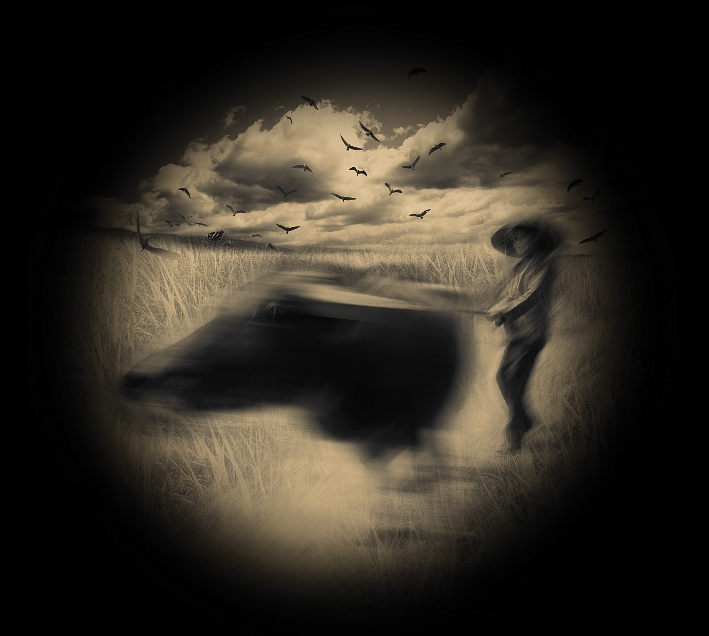
The Search for the Ox, digital c-print photograph by Andrew Binkley
When I first studied the 十牛圖頌 ten ox herding pictures and poems, I recognized some of my own journey reflected in Bujinkan training. Maybe you will see yourself there as well.

The Ten Ox Herding pictures illustrate the stages of a Zen life in the quest toward enlightenment. In Zen the ox represents the mind which is at first wild and untamed, running from one thing to another. It is said that these stories are trying to express the inexpressible.

Hatsumi Sensei has a favorite teacup with these ten illustrations on it. As he sips his tea, he says he likes to reminisce about the "old days," and he tells us how we have the same ten stages in our journey through Budo: First dan through Tenth Dan.

This will be the first in a series of 10 posts.
Just as a man would tie to a post
A calf that should be tamed,
Even so here should one tie one's own mind
Tight to the object of mindfulness.
What does it mean to be a Shodan 初段 in the Bujinkan? Let's look at this first stage from the Oxherding perspective:
Woodblock print by 德力富吉郎 Tokuriki Tomikichirō
寻牛 The Search for the Bull

In the pasture of the world,
I endlessly push aside the tall
grasses in search of the bull.
Following unnamed rivers,
lost upon the interpenetrating
paths of distant mountains,
My strength failing and my vitality
exhausted, I cannot find the bull.
I only hear the locusts chirping
through the forest at night.
Somehow you find inspiration to start training in the Bujinkan. This may come from a feeling that you are missing something or a need to better yourself. Or maybe that your current training is lacking in some way.

This is known as 初発心 sho-hosshin or the first stirring of the heart.

This goes from first hearing about the Bujinkan all the way through learning your basics so that you start to glimpse that there is an essence to this art that lies beyond technique. These are the footprints you look for while training on the basics. You may not know where they lead, and they remain elusive.

You will be distracted by other styles and many things that are not even related to training. There is so much to absorb that your senses will be confused.

Traps at this stage are thinking you know what is good or bad training, striving to gain rank or prove something, fear that you cannot do things, and giving up the search before you know what you are searching for.

This stage is critical for finding an authentic teacher. You will find the teacher you deserve. If your mind is clouded by what you think is right, you will get a teacher who will only confirm and magnify your ill chosen path.

All of your training will be energetic and have a feeling of really going for it. You get bloody, bruised and sweaty but love the process.

You start to notice that no matter how much you train, there is always more. The Bujinkan seems to expand the more you learn. You never reach the place where you can say, "I've got this."  This can lead to a time of doubt where other paths become tempting. You want to find training that you can master and the Bujinkan rarely supplies this feeling.

After your strength and spirit are drained, you wonder, what now? Where can I go from here? How can I keep training and persevere? Can I even do this?

Every visit to the dojo feels like another wasted effort to learn anything. Frustration will rule your mind.

This is a very important passage in training. Reaching this place means you are ready to begin learning. That is why Shodan is beginner's level. You may recognize you are caught in your own conditioning and seek a way out through taijutsu.

You will feel you are nearing the end of this level when you sense that the ego's efforts to capture the essence of training are not enough.

Next we look at Bujinkan Nidan 弐段: Discovering the Footprints

Budo 武道: Bloodlust, or a Path to Peace?

From Bujinkan Santa Monica by Michael

Memorial Cathedral for World Peace, Hiroshima. photo by scarletgreen
What is the point of Budo? Training in a martial art is a strange endeavor. You learn how to bruise, break, maim, and kill all in the name of peace and love for humanity. At least that's what most teachers would tell you. None ever admit to having a love for violence.

But most martial arts have their roots in violence that was either forced on them by lovers of war, or developed by those who loved war. True peace lovers would never train to do what we do, right? I don't know. I don't think it's that black and white.

武道 Budo means martial way. The character of Bu 武 is composed of three different kanji radicals two 二, shoot or spear 弋, and stop 止. So the essence of Bu is the way of stopping two people from shooting at each other or from fighting! Budo prevents or stops fighting among people. Martial arts are to promote harmony and act to stabilize society.

During the 1860's in Japan, a time marked by bloody infighting among various samurai factions, this meaning seemed lost.

For training to cut human flesh, men were forced to perform executions or to act as seconds for those condemned to commit seppuku. I guess this is how they learned to decapitate. It is said that if the trainee even grimaced or turned a little pale at the sight of the gore, he would fail the test.

They would then skewer the bloodied heads onto bamboo stakes and leave them near bridges with a note attesting to 天誅 Tenchuu or heaven's revenge.

The author Kan Shimozawa wrote about how they bragged of their bloody feats:
"Every day the men would go out and cross swords with the enemy. One corpsman claimed the blood of the man he had killed today splattered on the ridge of the adjacent house. Another said that the blood [of his victim] hadn't splattered beyond the white paneled wall. Still another boasted that the blood of the man he had cut down had reached the roof of the house."
One of the men's mistresses described their bloodlust:
"People would talk about whom they had killed today, and whom they were going to kill tomorrow. It was all so frightful."
One group of hit men even adopted the nickname 人斬 hito kiri which is like calling yourself "the beheaders".

Not all were so enamored of blood. Katsu Kaishū, founder of the Japanese navy said,
"I despise killing and have never killed a man. Take my sword for example. I used to keep it tied so tightly to the tsuba, that I couldn't draw the blade even if I had wanted to. I've always been resolved not to cut a person even if that person should cut me. I look at such a person as no more than a flea. If one lands on your shoulder, all it can do is bite a little. This causes nothing more than an itch, and has nothing to do with life."
I think that whether you have an affinity for violence and martial arts bring you some measure of peace, or you are a peace lover who wants to understand the other side, training taps into some very primal aspects of our dual natures. To be a whole complete human requires knowing the dark and light and gray.

So go ahead and learn how to bruise, break, maim, and kill… all the while embracing the understanding that our training leads us to a place of never needing to use these violent skills. If you have a good teacher they will show you the path from one to the other. Do not neglect the depths of real combat and violence with the power contained therein, nor the heights of love and peace and the great powers that arise from this stillness.

Hankyou 2008 – Kaigozan Christmas Seminar

From Budoshop by BUDOSHOP.SE

Reflections of this years Bujinkan theme, Togakure-ryu ninpo taijutsu. Many people went to Japan this year and they all came together to share on this seminar.

The instructors was Paul Waserbrot, Mats Hjelm, Steven Helling, Daniel Bodin, Fredrik Markgren, Arvid Karlsson, Jens Lindstrand, Richard Maier, William Ustav.

Most of the instructions is in Swedish!

Recorded in Stockholm, Sweden December 2008

Note: Some of the instructors spoke Swedish, and others English.

This movie is available on DVD (click here!) or available as download, click button below.


100 minutes, 707 Mb for $11.99

Instructions are in SWEDISH!

Joukenhansha 条件反射: Reflex Conditioning or a Trap?

From Bujinkan Santa Monica by Michael

正拳 photo by  *嘟嘟嘟*
I love it when I get to spar with a martial artist who has great conditioning. Not only is it a great test for me and what I think I know about martial arts, but I have a secret weapon in our Bujinkan taijutsu that allows me to defeat them even if they have superior conditioning. This weapon is the conditioning itself. I can use it to trap them.

In martial arts, sports, or combat training people strive to develop fast reflexes. Reflexes don't require conscious thought. In fact the action of a true reflex follows the reflex arc to create a near instantaneous response to stimuli.

This is an advantage in dangerous situations where there isn't time to think about your choices. You just pull your hand out of the fire. In our training we are not usually studying true hard-wired reflexes. Instead we are conditioning our muscles and bodies to develop responses that have proved effective in our training and in combat.

Some people call this muscle memory. Or another term is procedural memory. This is where you commit a specific action to memory by training it over and over. This repetition strengthens neural pathways allowing the brain to access these patterns more efficiently. A medical definition for this might be more like the word reflexive as opposed to reflex.

For the most part, this conditioning is useful and good. Unless you are facing a devious and thinking opponent who can turn it against you. Soke calls this 条件反射 joukenhansha which is a conditioned response. He spoke of this while talking about how you should not take ukemi. Which I wrote about here: Why Do You Take Ukemi? So How can this conditioning be turned against you?

Well a reflexive action is a habitual and unthinking behavior; or relating to or consisting of a reflex. It's the habitual and unthinking part that gets you. When I recognize these reflexive actions in your movements, whether they are offensive or defensive, I will seek to trigger them to set a trap.

It's easy to see this in action no matter the style. Test it out on any person (choose someone who will not seek revenge). Stand facing each other, but don't tell them what you are testing. No reach as fast as you can for their ear.

How do they react? People with no training at all act with pure reflex in a startle-flinch response. People who train in a specific style will reveal their training, which is reflexive. In the 1980s the US Army conducted experiments to discover that people can be startled into their favored, trained fighting stances, no matter what those stances were.

Then set a trap so that when they react with their reflexive conditioning again, you will defeat them. All you have to do is trigger that reaction by reaching for their ear. Or you can make some other feint, kyojitsu, or threatening motion.

Hatsumi Sensei says this is like Pavlov's dogs. And he says we all know how easily dogs are controlled by people. So we should not train ourselves to be conditioned like dogs. Don't design reflexive traps into your training program.

Hankyou 2007 – Kaigozan Christmas Seminar

From Budoshop by BUDOSHOP.SE

Reflections of this years Bujinkan theme, Kukishin-ryu daken-taijutsu. Many people went to Japan this year and they all came together to share on this seminar.

The instructors was Mats Hjelm, Christian Spicker, Petter Swedin, Daniel Åberg, Daniel Neiberg.

Most of the instructions is in Swedish!

Recorded in Stockholm, Sweden December 2007

Note: Some of the instructors spoke Swedish, and others English.

This movie is available on DVD (click here!) or available as download, click button below.


92 minutes, 648 Mb for $11.99

Instructions are in SWEDISH!

Japan Trip April 2012 – Diary

From Shiro Kuma's Weblog by kumablog

I came back yesterday from a fantastic trip and I hope you have been able to share with me the things I trained in Noda.

I have been asked in Japan why I was writing so much*. It is to share with the community some of the knowledge we get in Japan with Sôke and the shihan. I hope it will help you to wait for your next trip.

These texts* and these pictures are my attempt to give a fair image of what is happening in Japan. This is why I have added many pictures to these texts.


I took many pictures and not all are good but please see them as a training documentary. Pictures being forbidden during training, you will mainly have pictures taken before and after the class. As today someone asked me to put a link here to access the pictures uploaded on facebook during my trip you will find them below:

The first album contains the first 10 days (over 500 pict):

https://www.facebook.com/media/set/?set=a.3395318174028.144619.1601937800&type=3

and the second one only the last day (around 100 pict):

https://www.facebook.com/media/set/?set=a.3464131334314.145724.1601937800&type=3

Enjoy and comment them if you feel like it.

*All the texts in this blog were uploaded in April. If you want to read them again, click on “April 2012″ in the home page and they will appear.


Kunai shinken

From Paart Budo Buki by buki stolar

My dear Buyu's I have some time to finally finish my "live" kunaiso here is some pictures for start,
later I will write something more about him, mainly blade is made ​​of steel and the handle of an ordinary iron welded to the blade, thereby prevent cracking handle when I throw kunai or when is use as leverage for breaking.


Hankyou 2006 – Kaigozan Christmas Seminar

From Budoshop by BUDOSHOP.SE

Reflections of this years Bujinkan theme, Shindenfudo-ryu kosshijutsu. Many people went to Japan this year and they all came together to share on this seminar.

The instructors was Fredrik Markgren, Arvid Karlsson, Maria Eneroth, Patrik Johansson, Mats Hjelm, Roger Mattsson, Kent T, Daniel Bodin.

Most of the instructions is in Swedish!

Recorded in Stockholm, Sweden December 2006

Note: Some of the instructors spoke Swedish, and others English.

This movie is available on DVD (click here!) or available as download, click button below.


125 minutes, 889 Mb for $11.99

Instructions are in SWEDISH!

Ultimate Teaching

From Shiro Kuma's Weblog by kumablog

Today was my last class with sensei during this japan trip and it was a very nice class where we could train also with long weapons. As sensei was coming a little late I was asked to begin the class and when sensei arrived, we started by a three tsuki attack demonstrated by an American friend. 

From there I got lost as sensei used no strength at all and was playing with uke as if uke was unable to see that he was going to die. Shawn Gray, after being sensei’s uke, commented that each one of the uke nagashi was piling up on top of the previous one, and that he became aware of his loss of balance only when it was too late. 

Sensei’s movements reminded me of some form of “kotonoma”, 空と海は (verb, sound) and “kokyû”, 呼吸 (breathing) demonstrated by Ueshiba sensei in his Aikido videos. Friday night he insisted to pay attention to the breathing of the opponent and to our own breathing too. If you hit uke while he is breathing in you increase the power of your hits. This is why you must take your time and wait for uke to breath in. If you rush to do the technique you will be less efficient. Timing is essential (kaname?).

When Hatsumi sensei is moving his body turns into the “chûshin”, 中心 (pivot, center) of everything. Even though he didn’t speak about “shinrabanshô”, 森羅万象 (all things in Nature) today, he was expressing it in each one of his movements. He was the “shinrabanshô no kaname”, 森羅万象 の要, the center of the whole creation.

Whatever his uke was doing he was speeding up the destruction process. Like in the theme of 2007 ”kuki taisho”, 九鬼大笑 (the laughter of the ninth demon), tori has no fear. If uke attacks, he dies; if he doesn’t, he lives. That is his call. What was really amazing was to see how easily sensei, with very little movements of the whole body can deal with the opponent. It took me quite a long time (gracias Hector) to figure it out, and even when I got close to get it, I was miles away from sensei’s movements. Sometimes I find it frustrating to attend his classes. You see the technique, you understand it, and you are incapable. This can be quite depressing.

His movements are so subtle that if you don’t pay atttention to everything at the same time, you don’t see them. As Shawn said later, the motion of sensei’s hands is catching his attention and the body movements were getting his balance totally unnoticed. When facing sôke, you are drawn into a sort of “uzumaki”, 渦巻 (whirlpool) feeling, from which there is no escape. It is interesting to watch but it is scary to feel it. There is no strength at all and uke falls because he cannot be standing up anymore. From the observer’s perspective it is as if nothing is applied to him. It is magic!

Each point of contact between tori and uke (today mainly the elbows) turns into a kaname as sensei keeps pivoting softly using his legs to do that. He spoke again about kaname, explaining it to be the highest expression of taijutsu. Once you can find the kaname everywhere there is nothing impossible. But what is impossible is to understand it solely at the intellectual level. 

He said that this cannot be understood or acquired by “researchers”, it is coming from real experience, this is not mental. Over the years how many times did we hear him saying out loud: “don’t think!”. He also said: “there are too many researchers in the bujinkan and the kaname concept is out of their grasp as long as they keep their knowledge at the intellectual level. It was like what he told us about kuden on Friday night: “kuden cannot be written, this is why it is an oral transmission”.

Sensei repeated again that understanding his words or the movements were not important: “if you get out of the class with the feeling you remember nothing it is ok because I teach the jûgodan”. I hope I was not the only one totally lost. 

Feeling this kaname action through the body is teaching the mind. I went to ask him to demonstrate it on me and when he did, it was like fighting a “puff of smoke”. There was no information sent to me, nothing. I felt like falling into the kûkan.

As not so many people attended the class today, we applied these techniques with sword, bô and naginata and it was nice to learn how to use the space available. With a weapon or not, when facing sensei you are not afraid, you are simply frozen. You stop moving because it is comfortable and safe. We don’t use the weapons, we use our taijutsu with the help (hojo?) of the weapons. 

The sakki test ended the class and I went to his house where I joined Sayaka Oguri, Lubos and some of his students. Sensei showed us many new swords he got recently including one that belonged to a Togakure general (yoshitaka?) with the togakure crest on the scabbard. Another tachi was wearing the shingon crest, and the blade was engraved with the Fudô myô sword on one side and three bija letters representing Fudô myô, Marishi ten, and Dainichi nyorai. He also showed us a very nice tantô in an orange scabbard that looked like a big caterpilar. He also showed us a beautiful kyoketsu shôge, 距跋渉毛 with the sword and dragon of fudô myô on one side, and the double edged sword with a vajra tsuka on the other side (you can see the pictures of those weapons on facebook). 

We were departing when sensei asked us to the new storage room next to his house. It was like entering an antique shop! Various types of weapons and pieces of art are there, waiting for an hypothetic museum. What caught my eyes were the few long yari that he showed. Each blade was around 80 cm! No wonder why the yari was considered to be the most dangerous weapon of all. I read somewhere from an archeological study that between Muromachi (1333) and Meiji (1868), death by swords only accounted for about 20% of the casualties, and the majority happened after the beginning of the Tokugawa shogunate (1603). The yari was the weapon of choice of the samurai, and the Japanese yoroi was initially designed to fight it.

Before leaving sensei, and after thanking him for the time he spent with us, he gave Lubos and me two omamori from the Kashima Katori shrine from the Miyagi prefecture that he signed with his martial name.

It was indeed a very nice day today, thank you sensei. I am sure we will speak about it with Lubos tomorrow as we are sharing the same flight back to Europe.

Sayonara

Hankyou 2005 – Kaigozan Christmas Seminar

From Budoshop by BUDOSHOP.SE

Reflections of this years Bujinkan theme, Gyokko-ryu kosshijutsu. Many people went to Japan this year and they all came together to share on this seminar.

The instructors was Christian Spicker, Ola Grönlund, Martin Berg, Fredrik Markgren, Roger Mattsson, Petter Swedin, Kristoffer Metsälä, Christer Westberg, Mats Hjelm, Jonas Stenlund, Arvid Karlsson, Arne Elmlund.

Most of the instructions is in Swedish, some instructors spoke in English!

Recorded in Stockholm, Sweden December 2005

Note: Some of the instructors spoke Swedish, and others English.

This movie is available on DVD (click here!) or available as download, click button below.


125 minutes, 884 Mb for $11.99

Instructions are in SWEDISH!