Stars & Galaxies
From Shiro Kuma's Weblog by kumablog
A…From Shiro Kuma's Weblog by kumablog
A…From Shiro Kuma's Weblog by kumablog
A…From Shiro Kuma's Weblog by kumablog
The YSTT begins in 2 months and places are limited.
Register at www.budomart.com to be sure to participate.
YSTT Team 2010


 …
…From Shiro Kuma's Weblog by kumablog

Seigan no Kamae by Chris Bernsdorf (Ger)
“Kamae is attitude” was written a few years ago, this is an updated version of it.
Budo Taijutsu begins with the study of “kamae” or body posture. This first introduction to budô gives us a strong physical foundation, which allow us to grasp the true essence of natural body movement. Unfortunately with time passing, we seem to forget the value of training the basics in general and particularly the body postures. In each Bujinkan Ryûha there is a set of given kamae that is called kurai-dori. If we translate “kurai” and then “dori” the meaning is “about grabbing” and it looks that it is dealing only with the physical aspect of fight. But a good dictionary tells you that “kuraidori” in one word means “positional notation”, like the digits after the comma. This induces precision and it translates by “precise notes for postures”. It is a lot different from kurai + dori !
Even though the Ten Chi Jin ryaku no maki has a basic set of 9 kamae, each particular ryû has differences which depend upon the time where the kamae were created, and the evolution of warfare they had to adapt to. How do you “Ukemi” (receive, dodge, absorb) a bullet? So kamae is not only physical, the mind gives also value to the posture. ”kamae” means posture or attitude, so apart from the “physical attitude” we now have to consider the “mental attitude”. This is why when teaching the basics we speak of “tai gamae” and “kokoro gamae“. The tai gamae is the body posture where the kokoro gamae is the mental attitude.
If we broaden this understanding it can be also understood as our “attitude in life”. Having good kamae in the dôjô is nice nut it is even better to have a good kamae in life. This is our human attitude that makes us different. Having a good technical ability is not enough and from my perspective too many do not have a good attitude in life as human beings. If you thoroughly study your kamae on the mats they will change your attitude in life. When sensei says that our goal “in the Bujinkan is to create better human beings” he means that the study of the tai gamae will change your kokoro gamae, not only in the dôjô but also in life. Even though there is no spiritual teaching in the Bujinkan, no link to any religion or mystical system, Hatsumi sensei has created and transmitted a powerful tool to help us become true human beings (bujin).
As always there is always more in the ura of things than the omote let you think there were.


 …
…From Shiro Kuma's Weblog by kumablog

Sven & Arnaud in Paris
Thank you for all those who registered already!
It seems this 8th YSTT is going to be succesfull and the first registration forms have arrived from:
Are we going to have more than 16 countries attending this year?
Important note: If you register for more than one person, please fill in ONE form per person it will facilitate our work.
Thank you.
the YSTT team


 …
…From Shiro Kuma's Weblog by kumablog

Yûro Shi Tennô Arnaud
Organizing a Taikai such as this one is always a lot of work for the Taikai Team. Last year many of you didn’t register early enough and we had to cope with some problems concerning the food and the t-shirt.
If you know you are attending then please register as fast as possible and do not forget to tick the boxes for:
This will help us a lot and save you a lot of money. The sooner you register the cheaper you pay!
So please register online so that we can order the food and t-shirt accordingly.
Thank you for your help.
YSST team 2010


 …
…From Shiro Kuma's Weblog by kumablog
Here is the picture of the 4 calligraphies by sôke when he decided to change the name into Yûro Shi Tennô Taikai.
Each one bears the new name and the name of the beholder. Here from left to right: Arnaud, Pedro, Sven, Peter. Painted by Hatsumi sensei in August 2009.
I was surprised when he called me and did the four calligraphies in front of me. Good memory!


 …
…From Shiro Kuma's Weblog by kumablog
 Black belts should wear the yoroi to understand the value of balance. When you are dressed with the yoroi, the weight is spread all around the body and not only on the back as we experienced it with a backpack.
Naturally the extra weight transforms the body repartition and we move with about 50% of our weight on each leg. This is why the kukishin ryû and the takagi yôshin ryû kamae do not have the same appearance compared to the togakure or other low kamae systems.
Peter on the picture is showing here the kosei no kamae as if he was receiving some kind of attack from his opponent. As though “kosei” means “attack” he is absorbing the blow with his protected forearm (aite to kumu kokoro gamae) and uses his legs to cushion it. Next he will spring forward and take uke‘s balance to counter-attack. Once the blow has been received, there is no power left in the weapon, the momentum is gone.
As sensei said back in 2003, concerning the yoroi kumiuchi: “when there are two attacks (body or weapon) they are not of the same quality”. The first attack is fuelled by the footwork and his strong and fast, the second starts where the first one was stopped and uses a different distance.
Note that the back hand stays at the hip level as if Peter was holding a tachi.
Every waza in Japan originated from yoroi kumiuchi.


 …
…From Shiro Kuma's Weblog by kumablog
 Why is the Ten Chi Jin Ryaku no Maki so important?


 …
…From Shiro Kuma's Weblog by kumablog
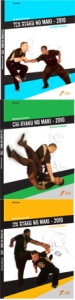 What does the Ten Chi Jin imply?


 …
…