Shinrabanshô
From Shiro Kuma's Weblog by kumablog

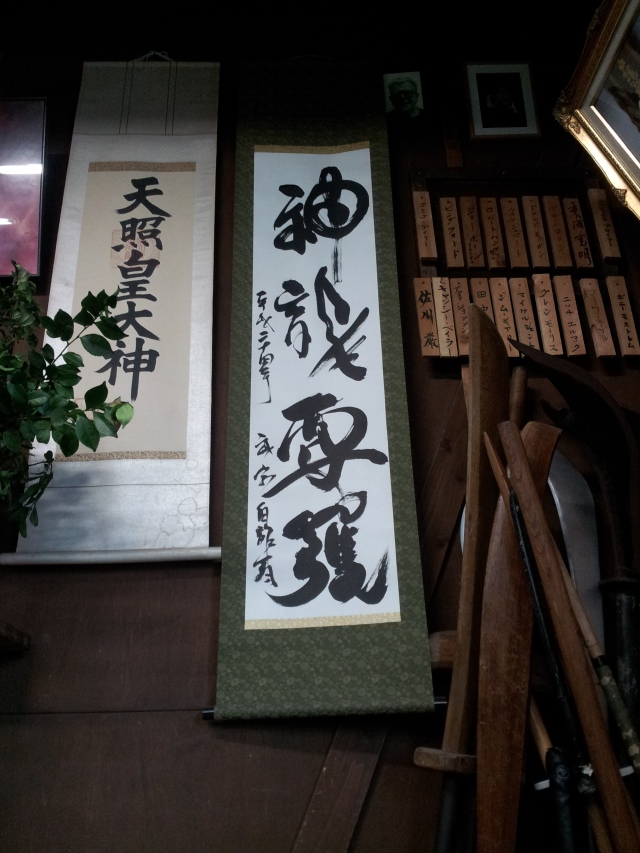
In each class with sensei I wait for “the word” that will give a new turn to my taijutsu. Last friday night at the honbu the word was “shinrabanshô”, 森羅万象 (all thing in nature, the whole creation).
I had the privilege to open the class. On a fist attack, you slide to uke’s left and take his hand, rotate the body leftward while pushing up on his elbow, therefore extending his arm. The left hand controls uke’s left shoulder. This turns naturally into a kind of Ô gyaku and uke falls at your feet still in control.
After a few tries by everyone, sensei did it “his way” on me and I got the feeling that he vanished in front of me. In fact when I was asked to explain what I felt, the only word that came to mind was “nuku” (see http://kumafr.wordpress.com/2012/04/17/1012/).
Sensei is moving slightly before you have the time to get him. His moves are not fast they are just in tune with everything, this is when he began to speak about “shinrabanshô”. The “whole creation” is one with him and his actions are so natural that the time you see them it is already too late. I insist here on the fact that a movement being natural is not “human”, it is a manifested yûgen (幽玄) action of “elegant simplicity”. As everyone was lost, he reminded us that “I’m teaching at fifteenth dan level”.
Then he went on explaining this idea of “”shinrabanshô”. I must say that most of it went passed my level of understanding and I began to feel bad. But then he said that understanding was not important (good for us, gaijin and Japanese altogether), the kaname is to “hear it”.
He added that the vibration of the words (like in a sutra or a prayer) is the thing that only matters, the meaning is secondary. Prior to the class I was speaking with Maria Somera (Mexico) and Craig Olson (Canadian resident) about the translation of his book “Chihayaburu kami no oshie wa tokoshie ni tadashiki kokoro mio mamoruran”* to Spanish. At one point Craig said that the last sound of the last word “mamoruran”, the “an” was similar to the buddhist “a un”, the end and the beginning of things. And this is exactly what sensei was told us that night: “sound is life and this is why the sound is more important than the meaning”.
Sensei added that we should not try to remember the things he says or do during his classes as long as we attend the class. “if you put it in writing, it loses its power of creation”. I understand what he said but I wanted to share it with you in writing anyway.
To me this was the first time I truly understood what a kuden is. As you know the meaning of kuden (口伝) is oral transmission. For years I have been wondering why a kuden would be written. It must be, so that the sôke would be able not to forget it. Yesterday I understood that the kuden is a natural expression of life and that, if you have the level, your connection to the divine will find a way to express it through your words.
In the kûkan created by nuki waza, the sakki is revealed, this is the kaname of Hatsumi sensei’s teachings these days.**
* The “Chihayaburu” is said by the bujinkan teacher prior to the “shikin haramitsu daikomyô” at the beginning and at the end of the class. Here is the text in Japanese:
千早振る神の教えはとこしえに正しき心身を守るらん - chihayaburu kami no oshie wa tokoshie nitadashiki kokoro mio mamoruran. There are a few websites giving some explanations on the meaning of it but I advise you to get the book by Craig which covers this prayer/Mantra in more than 100 pages as he spoke a lot with sensei when writing the first edition of the book. A short and maybe inappropriate translation would be: “With a pure heart the kami will guide you through a happy life”, but there is much more in the book.
**note: we did also many techniques during this class, but I will explain that in a future post.

 …
…

 …
…

 …
…

 …
…

 …
…

 …
…


 …
…


 …
…


 …
…


 …
…