Skip to content

Gensô illusion

From Shiro Kuma's Weblog by kumablog
Gensô illusion

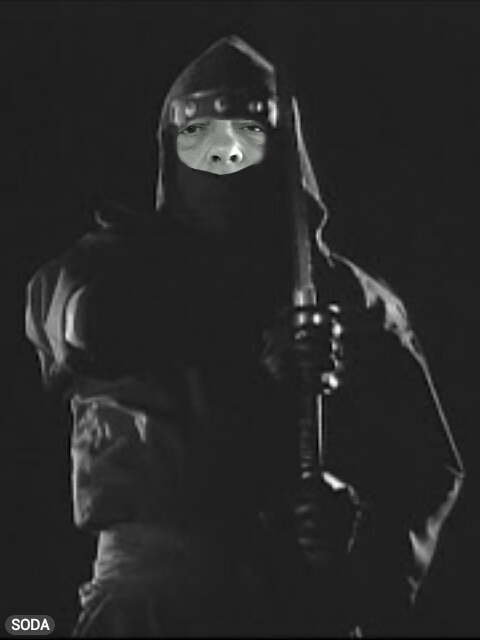
Wearing the ninja outfit doesn’t give you the abilities. The Omote side is nothing compared to the Ura side of reality. Too many of us forget that 幻想 Gensô Is illusion. This is the same as in Genjutsu, and the essence of Gen jutsu, for me, lies in 虚辞 kyojitsu. And remember that kyojitsu is the backbone of the bujinkan. 虚実皮膜, “the difference between truth and fiction in art being very subtle, Art abides in a realm that is neither truth nor fiction”.


Zero no Chikara – no power

From Shiro Kuma's Weblog by kumablog

Zero no Chikara - no power

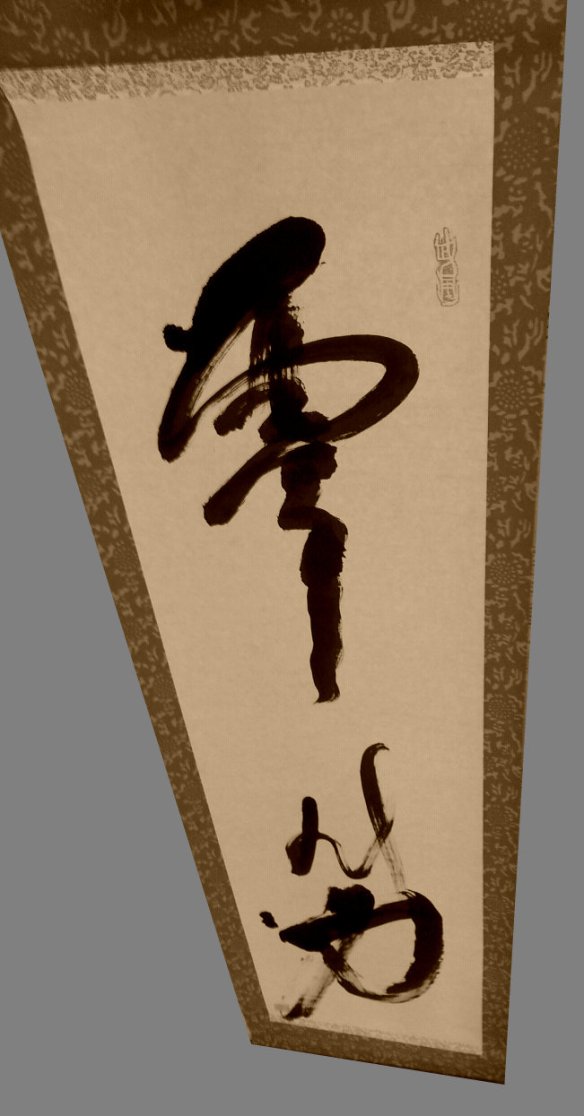
The theme for 2013 was mainly ken and mutô dori. Sensei ended the year by speaking a lot about “zero no Chikara” or “no strength” (picture).
But did you know that 力 chikara and 刀 sword are nearly written the same? -the vertical line protruding on top of the”ken”. Therefore strength and sword are linked; and if you are not using any strength then you achieve 無刀取り mutô dori.
By using no power you have unlimited power as 無刀取り mutô dori is having the courage to do what you have to do, whatever the outcome might be.


A Fantastic Day (part 3)

From Shiro Kuma's Weblog by kumablog

hsajc2013dkmsThis post was originally posted directly on my Facebook page on December 2nd in Japan.
It follows http://kumafr.wordpress.com/2013/12/12/a-fantastic-day-part-1/
and
Right after the class some of us “Jurassic Ninja ” were invited by Sensei. Noguchi, Pedro, Jack, Sheila, Moti, Gillian, Doug, Christian and a few others.
Having lunch with sensei is always fun and the mix of beer, Sake and whisky made it even more memorable.

Sensei spoke a lot of the future of the bujinkan. The year 2014 is a new beginning, the beginning of a new 42-year cycle. This is why sensei announced that he will be with us until he reaches 120 years of age.

I am sure that Sensei will explain in the next months what he has in mind, so I let him explain it when the time comes. It will mainly concern the new honbu, a new office dealing with the bujinkan paperwork, the time for the jugodan to take responsibility for our organization.

But the main subject he unveiled is the necessity to befriend our fellow buyu from all over the world.

The bujinkan  has been spreading in many countries over the past 42 years and there are no border. Bujinkan is a human art and humans are the same all over the world. Nationalism is not part of the bujinkan, we are all members of the same world.

As Sensei said last year: “Bujinkan Budô is made in human”, please don’t forget it.
At the end of the lunch we were all very “happy” including our host.

On the way back to Kashiwa we stopped at Starbucks for a few coffees and cakes with Pedro, Sheila, Gillian, Christian and many others. And here again there was a lot of happiness.

Thank you sensei for this fantastic day and for the depth of your teachings making us more adult and human.

Happy Birthday!

Read the previous parts of this entry: http://kumafr.wordpress.com/2013/12/12/a-fantastic-day-part-1/
http://kumafr.wordpress.com/2014/01/04/a-fantastic-day-part-2/

A Fantastic Day (part 2)

From Shiro Kuma's Weblog by kumablog

2013-12-01 12.18.11This post was originally posted directly on my Facebook page on December 2nd in Japan.
It follows http://kumafr.wordpress.com/2013/12/12/a-fantastic-day-part-1/
A Fantastic Day (part 2)
But reducing sensei’s movements to those of a puppet master, does not show the “simple intricacy” of his teachings.
Sensei at 84 moves like he is half this age. In fact he once again spoke about the 42-year cycle (see my blog on 42). Later during lunch he mentioned it again and repeated that this year is the end of a 42-year cycle. This end is the beginning of another one beginning next year. As a joke he added that this should let him reach 120 years of age!
The main thing during the class was what he said about Mu no Kûkan. Mu no Kûkan is the zero power of the previous class that expresses the Seishin no jutsu (see previous entries).

When able to manifest this Mu no Kûkan the practitioner doesn’t apply any given waza. He is only surfing on the waves of intentions of the adversary. This is the third edge of the sanshin triangle detailed in the first part of this article. In fact the Sakki experienced during the Sakki test is the perfect illustration of this. The receiver and the emitter are somehow connected and the flow of energy is going both ways. You don’t give the sakki you connect yourself to the Sakki existing in any sentient being.

This is about relation. Without it the only thing happening is a bump on the head followed by a big headache.

Sensei spoke a lot about this connection. He said that once reactivated the Sakki should pulse permanently. The test is only there to reveal it to yourself. There’s no magic only natural understanding of what a human is. When you are in a middle of a fight you don’t fight. You control and secure every angle, but you keep a Mushin state of mind. You do not try to do anything. You don’t want to do anything specific.

Sensei going deeper in his explanations commented that it is important to hide your understanding and not to reveal yourself too much. Be aware that most of your daily fights will not be physical. They will happen at the if office, in your daily lives. If you do not develop this Sakki you’ll end up having an unhappy life.

For many years Hatsumi sensei has tried to make us accept and find happiness in our lives. In fact this is for me the most important part of his teaching. I will always remember this one class where he came to me during training and told me that he had decided to live a happy life. And he added: ” and you should try it too!”.  Since then I’ve tried to be happier. It is not always simple but when you understand that happiness is often only a moment, then it is possible to get it.

A moment of happiness is similar to a cloudy sky. At some point the clouds split and you can enjoy the light of the sun for a few minutes. Learn to recognize these moments and to enjoy them.

A moment of happiness is exactly what he offered to a group of us yesterday after the class when we went to eat together in Noda. This was what made this day such a fantastic one.

Read here the last part A Fantastic Day (part 3)
http://kumafr.wordpress.com/2014/01/04/a-fantastic-day-part-3/


Thank You for the Magic, Sensei!

From Shiro Kuma's Weblog by kumablog

hsmagic14On the 28th of January 2014 we will be entering the year of horse of wood. This will be my third year of the horse in the Bujinkan like it has been the case on 27th of January 1990 and on the 12th of February 2002.  I see this third occurrence as some kind of Sanshin.
Every year of the horse that happened always brought for me some major outbreak.

Horse 1990. This is the year when I came to Japan for the first time and I experienced this as an epiphany. Everything I saw during my first stay in Japan inside and outside of the dojo was like magic: to train with Sensei in Japan; to meet with the Japanese Shihan; and to discover Japan and getting a taste of true Japanese culture.

Horse 2002. With “Menkyo Kaiden” or 面 虛 怪 伝 as the yearly theme. Somehow the primitive magic of 1990 was gone but a new magic was arriving, a magic leaving the sole mechanical movements to enter something more mental, more spiritual.  Techniques are easy but this evolution (revolution), this new paradigm was much more difficult and impossible to grasp. Menkyô Kaiden introduced us to a reality that existed behind reality; it introduced us to a 世界 sekai (world, society, universe) that existed only beyond the physical world. Please remember that 2002 was the last year of  Budô Taijutsu and that Sensei was preparing us to grasp the pure magic of the realm of Juppô Sesshô opening in 2003. The year 2002 can be actually considered as Juppô Sesshô 101.
Horse 2014. I don’t know exactly why but I have the feeling that this new horse, will bring us another one of Sensei’s conundrums. And this transmission will undoubtedly bring us deeper into his magic. Trying to understand Hatsumi sensei’s Sekai through our occidental preformatted minds is useless and will never lead you to get the 極意, gokui (essential point, essence) of what he is showing and explaining.
The year of the horse in the Bujinkan  reminds me of the story of the Kachi mushi, “the dragonfly holding the tail of the horse will travel further and faster”. This story has been repeated over and over by Sensei. This is a metaphorical story. The dragonfly never flies backwards and therefore was assimilated to victory by the Samurai. But in Sensei’s perspective, it is not only that but also that by training with him, we become this dragonfly and go further and faster at his running speed. We are the insects and Sensei/Bujinkan is the horse we are holding on to.
We have been holding the Bujinkan tail for many years now and with the help of  Sensei’s unstructured system we have come to understand several sekai (worlds) of magic. But if Sensei is the horse and we are the insects, the “tail” is our excuse to evolve.
The tail is only a tool, don’t worship it. The Bujinkan is the tail, it is not the horse!

His magic is revealed and demonstrated in each class. But how many bujinkan members are really able to see that what he is teaching us goes far beyond a mere collection of waza and fighting skills? Not so many I guess and this is a pity.

But for those able to see, this is how we learned to see through the illusions of “reality”. The “real” world is not WYSIWYG, it is more like WYSIDNWYG (what you see is definitely not what you get)!
In fact what Sensei teaches is true genjutsu 幻術 (magic). Sensei used to repeat during class that we were all “doctors”, now I understand that we are all becoming “magicians” if we train properly under him and see the world through kanjin kaname 観 神 要 “to see the truth through kyojitsu”, the magical reality is ours.
Thank you Sensei for these magical gifts that you have displayed for us to take! I cannot wait for this new year of magical discoveries.
Thank you for the magic!

Nagare Is Important to Nagare

From Shiro Kuma's Weblog by kumablog

sven141The year 2014 began a few days ago and after wishing everyone a happy new year it is time to get back to the dôjô.
As Sensei didn’t give us yet, the theme for the year of the horse of wood, I have decided to begin the year by digging a little more into the concept of  流れ, nagare (stream, current, flow).
Everything we do on the mats is related to this concept.
When I announced that I would focus on 流れ, I was surprised to receive immediately a message from my dear friend Sven saying: “This is interesting Arnaud, my intent exact. Nagare (flow) is my “new beginning” for the day seminar the 4th January”.
Even though I’ve been training in the Bujinkan for 30 years, I can’t help being amazed when this type of coincidence happens. This is not the first time and surely not the last.
To begin the year with 流れ, nagare was somehow quite logical for me. It was like an obvious choice. Hatsumi sensei has been teaching footwork for many years emphasizing the importance of distance and “no strength”. When you look at how those different concepts mingle together, the word 流れ nagare comes to mind immediately. Because if you position yourself correctly by using the adequate footwork then there is no need for strength and the movements flow naturally from the situation. The Bujinkan is 流れ, nagare.
Nagare is THE answer. But when you look at  a class you notice that Bujinkan students are often stuck in a 1, 2, 3 way of moving. It seems more like a bad “kata” than a real flow of action. At beginner’s level, to study the 1,2,3 steps is necessary in order to learn the sequence and to absorb it correctly within the body. But with the development of expertise if you don’t go there you end up mimicking movements that have nothing to do with actual reaction in a real fight.
We, teachers, have a strong responsibility here. We have to teach the forms but also to teach in a formless manner. Now, this second phase of the learning process can only be achieved when the forms are known. Forms cannot be avoided. Formlessness comes from well known forms.
The nagare is transmitted through, what the Japanese call Kûden. A Kûden is not a secret, it is only the expanation allowing the practitioner to get rid of the form so that he/she can enter the world of natural movement. In a way, Kûden can be seen as the didascaly*, the notes of the author of a play adds to the text to help the actors undersand the situation, the feelings and the ambiance when acting on stage. The play doesn’t need it, but the actors will play better with the help of the didascaly included in between the dailogues.
So 流れ nagare will be my study apporach in the first seminars of  2014. And as we are going to have a new Honbu Dôjô in Japan in April, we can see that the year 2014 will be a new start for the Bujinkan getting finally recognized for what it is, a sytem created to render us responsible and mature. And the maturing process is also nagare 名枯れ (reputation growing up, maturing).
Enjoy the year of the horse of wood, and don’t get confused with the wooden horse which either has been used by kids to play, or by the Greeks to get rid of the Trojan!
Tomorrow go and train nagare with Sveneric Bogsater in Deventer (holland) if you are in the area.
*http://en.wikipedia.org/wiki/Didascaly

Happy New Year of the Horse

From Shiro Kuma's Weblog by kumablog

Image

Dear friends,

In this first day of the new year, I wanted to thank you for your support to this blog.

Read here the blog annual report, it is amazing! Thank you.

2013 has been an active year for us at Solkan Europe, www.budomart.eu, and www.koimartialart.com

We have released 18 new dvds with the help of our Indian Connection in Bangalore,

We have revamped totally our website making it more user friendly and more complete,

We have opened our download section, and the first titles are now available, many others will follow soon,

On the streaming side at koi we have uploaded many new dvds to cope with the development of our DVD market,

And we are working on our ebooks section with over twenty books being adapted and written right now!

2014 is the year of the horse and we are already galloping: seminars begin de pile up, trips to Japan, India, Europe, South America, Mexico are being setlled; new products dvds and ebooks are in the making, and a complete reorganization of ALL our platforms into one single one is under construction. We plan to realease it in about 6 to 8 months.

Take a tour of the new website and enjoy!


A fantastic day part 1

From Shiro Kuma's Weblog by kumablog

2013-11-01 18.46.50Sunday will stay in my memory as one of these days that makes life enjoyable.
The sky was blue and the weather good, the air crispy. I attended the first class of the day with Noguchi who did his magic again, using the 3rd level of Shinden Fudô Ryû. As he has been doing it how for nearly a year he revisit these well known Techniques but twists them in a new manner so much that I’m totally lost. I love it!
We did some donkey kicking (uma geri?) in all directions to Uke’s legs (front or back leg) with both hands on the ground and also hiting the body at tenchijin levels depending on the distance.
We did some “shoehorn” technique where we hit butsumetsu with the forefinger turning it into a fist after impact. Some kind of Niken waza.
We used the whole karada (body) turning inside or outside uke in a Uzumaki sort of move and delivering multiple hits: fist, elbow, fist…

Then it was sensei’s class.

Unlike his usual behavior, sensei began the class without asking anyone to demonstrate. He was in a very good mood as it is often the case with him around his birthday.

Receiving the punch he merely stepped forward and outside shielding the attack with the whole body. He said again that the theme of the year was Muto dori and that was not about defending yourself unarmed when facing a weapon. It is about moving fearless into the attack in a Mushin state of mind. The key to Muto Dori is to go toward the attacker with your guts.
Sensei said that every move is like a triangle where uke and Tori represent the first two angles. Now the third angle is kukan or zero and this is not simply the interaction between the first two, no it is something more complex that is not definable. This world of the 3rd dimension, Sanjigen no Sekai is what the bujinkan has been working on since the discovery of juppo sesshô in 2003.
Your intention or the lack of it moves the opponent by triggering or destroying any of his abilities making him move like a puppet, Tori being the puppet master.

Muto dori is definitely the expression of natural power.

Please read part 2 and 3 
http://kumafr.wordpress.com/2013/12/12/a-fantastic-day-part-1/


Seishin no Jutsu

From Shiro Kuma's Weblog by kumablog

2013-12-01 12.14.47Last night we had a very good class with Sôke where he spoke a lot about concepts. Seishin no jutsu 精神 の 術 was the general idea he tried to convey.

Seishin means: mind, soul, heart, spirit, intention, and I have to admit that the variety of these meanings are all true.
When sensei moved it look like he was doing nothing, playing only with uke’s mind. I was lucky to be uke a few times and each time I had the feeling I was totally lost. There was no danger, sensei was not violent, on the contrary, he was very relaxed as if not concerned by my useless attempts to get him.

He explained later that this Seishin no jutsu was based on the concept of kyojitsu no Kûkan 虚実 の 空間, or to put it in other words, to understand the 虚実混交, kyojitsu konkô, “a mishmash of truth and untruth, a mixture of fiction and fact”. By “making believe” that reality is not and conversely, Sensei makes his uke react in a way that is always detrimental to his survival. Interacting with Inyo, and time and space at the same time, Sôke destroys our willingness to fight.

We have to develop this ability to act without intention (seishin) and not give any strength to the opponent. When sensei was demonstrating he said that it is done without grabbing but applied with the whole body. The difficulty is to “move” the attacker without really using force.

This is when sensei added one extra level to his Seishin no jutsu by speaking of Zero no chikara  ゼロ の 力 or 無 の 力, the power of Zero. The power of zero is what is experience when we take the Sakki 殺 気 test.

In fact after this class I begin to understand the simple complexity of Hatsumi sensei’s vision. The bujinkan is about releasing the “natural movement ” and this is achieved when we are always one i.e. zero at the Sakki level.

Good luck!